Facts
The deceased, Nikitaben, married Shashikant (Respondent No. 1) on 14.02.2010
Source reference: para 2The prosecution alleged that after Nikita conceived, her mother-in-law (Respondent No. 2) questioned the child's paternity and subjected her to physical and mental harassment, supported by the husband
Source reference: para 2Nikita delivered a premature baby in her seventh month of pregnancy.
Source reference: para 2On 14.04.2011, Nikita committed suicide by hanging
Source reference: para 2A complaint was filed under Sections 498(A), 306, and 114 of the IPC.
Source reference: para 2The Trial Court (Sessions Case No. 128 of 2012) acquitted the accused on 31.07.2012, citing a failure to prove the case beyond reasonable doubt
Source reference: para 1, 5The State of Gujarat preferred this appeal against the acquittal
Source reference: para 1Issues
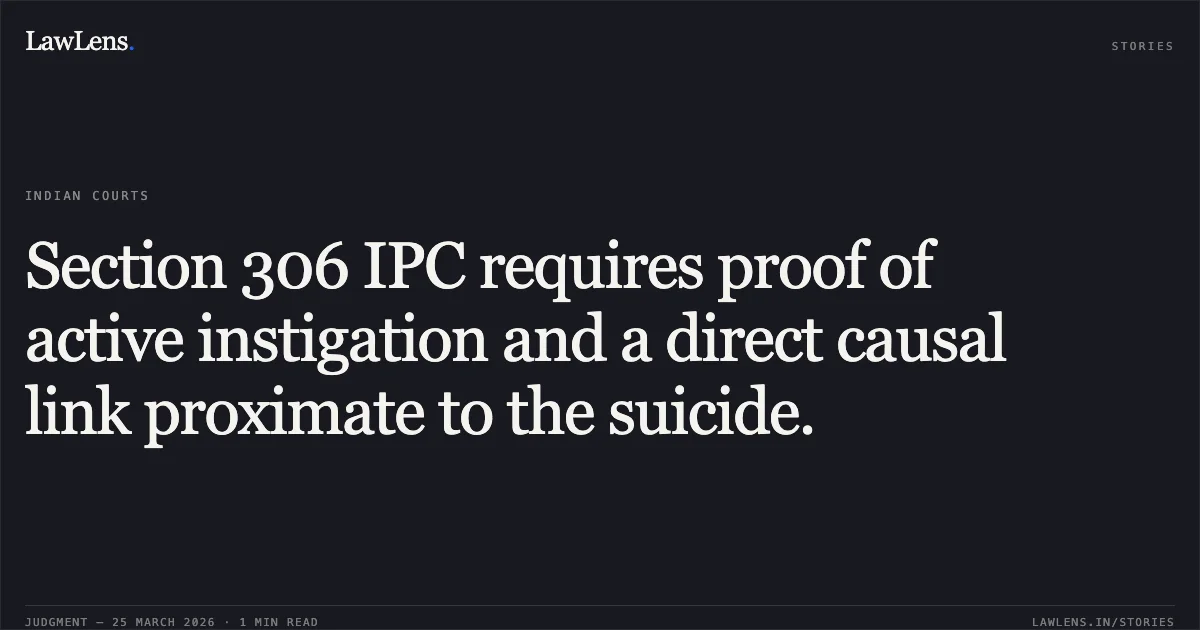
1. Whether the prosecution established that the acts of the accused amounted to "instigation" or "abetment" of suicide under Section 306 read with Section 107 of the IPC
Source reference: para 9.1, 9.42. Whether there was a proximate link between the alleged harassment and the act of suicide
Source reference: para 9.6, 10.43. Whether the Trial Court’s judgment of acquittal was perverse or suffered from manifest illegality warranting interference under Section 378 of the CrPC
Source reference: para 18, 20Law Applied
The Court primarily applied Sections 306 (Abetment of suicide), 498A (Husband or relative of husband of a woman subjecting her to cruelty), and 107 (Definition of abetment) of the IPC.
Source reference: no citationIt relied on the principle from Mahendra K.C. v. State of Karnataka, which defines 'instigation' as provoking, inciting, or encouraging an act with reasonable certainty of the consequence
Source reference: para 10It further applied the "proximity" rule from Amalendu Pal v. State of West Bengal, stating that harassment without a positive act proximate to the time of occurrence cannot sustain a conviction under Section 306
Source reference: para 10.2Regarding the scope of acquittal appeals, the court followed Chandrappa v. State of Karnataka, which established that an appellate court should not disturb an acquittal if two reasonable conclusions are possible
Source reference: para 17Reasoning
The Court observed significant inconsistencies in the prosecution's evidence.
Source reference: no citationPW-5 (mother) admitted that Respondent No. 1 had accepted paternity of the child, contradicting the alleged motive for harassment regarding the deceased's character
Source reference: para 8.2the deceased was shown to have existing health complications and was frequently taken for treatment by the accused, suggesting a lack of neglect
Source reference: para 8.10Crucially, the families had visited a temple together just four days before the incident, indicating no immediate matrimonial discord
Source reference: para 8.11The Court found that the prosecution failed to prove any "positive act" of incitement proximate to the suicide
Source reference: para 9.7Applying Section 107 IPC, the Court reasoned that domestic disagreements or a wife's distress do not ipso facto constitute abetment without evidence of mens rea and a direct causal link
Source reference: para 9.5, 9.6The brother’s testimony (PW-6) was discounted as it contained facts not mentioned in his police statement
Source reference: para 8.7Holding
The Court held that the prosecution failed to demonstrate the foundational elements of abetment, specifically the failure to prove that the accused intended to drive the deceased to suicide
The Court concluded that the Trial Court’s view was a "possible view" and lacked patent perversity, thus precluding interference under Section 378 CrPC
Source reference: para 18, 20The High Court dismissed the appeal and upheld the Trial Court's judgment of acquittal. The respondents were cleared of all charges under Sections 498(A), 306, and 114 IPC
Source reference: para 21Acts & Sections Cited
7 provisions across 2 statutes referred to in this judgment. Each provision opens on LawLens.
Indian Penal Code, 18604
Code of Criminal Procedure, 19733
Original Court PDF
STATE OF GUJARATvsSHASHIKANT DEVIDAS GAJBHIE
Click to open original judgment
Original judgment, available to read, download and summarize on LawLens.in