Facts
The deceased, Dr. Rajesh Kumar Verma, was married to petitioner No. 3; petitioners Nos. 1 and 2 were his parents-in-law. The informant alleged that the petitioners had pressured the deceased to partition family property and that matrimonial discord had followed.
Source reference: p. 2–4, 7–8After the deceased went missing and was believed to have drowned in the Ganga, the informant lodged an FIR alleging kidnapping for ransom and murder. Following investigation, the police submitted a final form exonerating the petitioners for want of evidence, which the court accepted.
Source reference: p. 2–4, 7–8The informant’s protest-cum-complaint was registered as a complaint case; after examining the complainant and inquiry witnesses, the Magistrate took cognizance against the petitioners under Sections 306/34 IPC. The petitioners sought quashing of that order.
Source reference: p. 2–4, 7–8Issues
1. Whether the complaint, the complainant’s solemn affirmation, and the inquiry witnesses’ statements disclosed a prima facie case of abetment of suicide under Section 306 IPC against the petitioners.
Source reference: p. 7–82. Whether, in light of the materials before the Magistrate and the police final form, continuation of the complaint proceedings would amount to an abuse of the process of the court.
Source reference: p. 8Law Applied
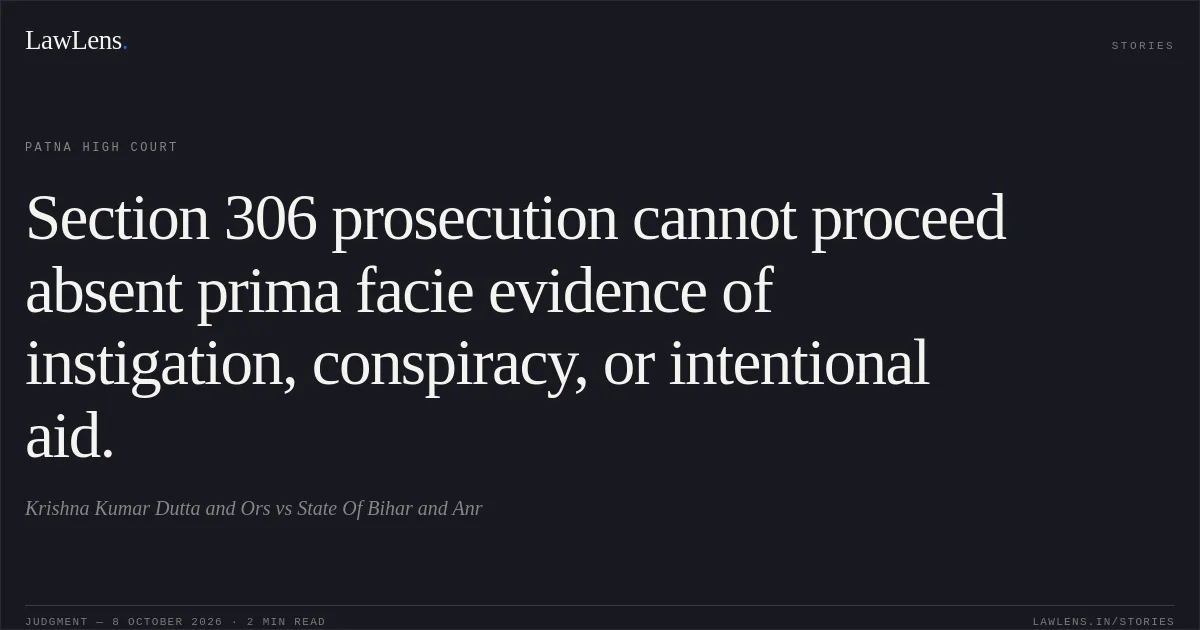
Section 306 IPC requires material indicating abetment of suicide; the court identified instigation, conspiracy, or intentional aiding as relevant forms of abetment.
Source reference: p. 6–7The Magistrate must apply judicial mind to the complaint and supporting material before summoning an accused; the petitioners cited State of Haryana v. Bhajan Lal, 1992 Supp (1) SCC 335, and Pepsi Foods Ltd. v. Special Judicial Magistrate, (1998) 5 SCC 749, in support of quashing and the need for judicial application of mind.
Source reference: p. 6Reasoning
The court found that neither the complaint, the complainant’s solemn affirmation, nor the inquiry witnesses’ statements disclosed instigation, conspiracy, or intentional aid by the petitioners. The alleged independent witnesses to the quarrel had not been examined, and the complainant’s account indicated that the deceased slipped from the riverbank and fell into the river.
Source reference: p. 8The court further noted that the police investigation had resulted in a final form exonerating the petitioners for lack of evidence. On these materials, the court concluded that the allegations did not make out the essential ingredients of Section 306 IPC and that continuing the proceedings would constitute an abuse of process.
Source reference: p. 8Holding
The High Court held that the materials did not disclose the ingredients of abetment required for an offence under Section 306 IPC and that the complaint proceedings should not continue.
It quashed the Magistrate’s order dated 2 March 2017 taking cognizance against the petitioners in C.A. Case No. 519 of 2013 and allowed the application.
Source reference: p. 8Acts & Sections Cited
7 provisions across 3 statutes referred to in this judgment. Each provision opens on LawLens.
Indian Penal Code, 18605
Code of Criminal Procedure, 19731
Arms Act, 19591
Original Court PDF
Krishna Kumar Dutta and OrsvsState Of Bihar and Anr
Click to open original judgment
Original judgment, available to read, download and summarize on LawLens.in