Facts
On 22 October 1998, appellant Ashok Dan went to the informant’s house to demand repayment of money. A quarrel followed when the other accused joined him. The appellants allegedly surrounded and assaulted the informant with lathis and a bhala; appellant Pradip Dan allegedly struck him on the head with an iron rod. The informant suffered a head injury and his house roof was allegedly damaged by stones and bricks. He was initially treated at Tundi Government Hospital and subsequently at Central Hospital, Dhanbad, where he remained admitted for nearly one month.
Source reference: pp. 2–3, para. 3; p. 6, para. 14An FIR was registered as Tundi P.S. Case No. 109 of 1998 under Sections 323, 341, 337 and 427/34 IPC. After investigation, charges were also framed under Section 307/34 IPC. The Trial Court convicted the appellants under Sections 323, 341, 337, 427 and 307/34 IPC, sentencing them principally to seven years’ rigorous imprisonment under Section 307/34 IPC, with concurrent sentences for the other offences.
Source reference: pp. 3–4, paras. 4–7Before the High Court, the appellants primarily challenged the sentence and sought the benefit of Section 4 of the Probation of Offenders Act, 1958, relying on the fact that the occurrence was more than 27 years old and that they had no previous criminal antecedents.
Source reference: p. 4, para. 8Issues
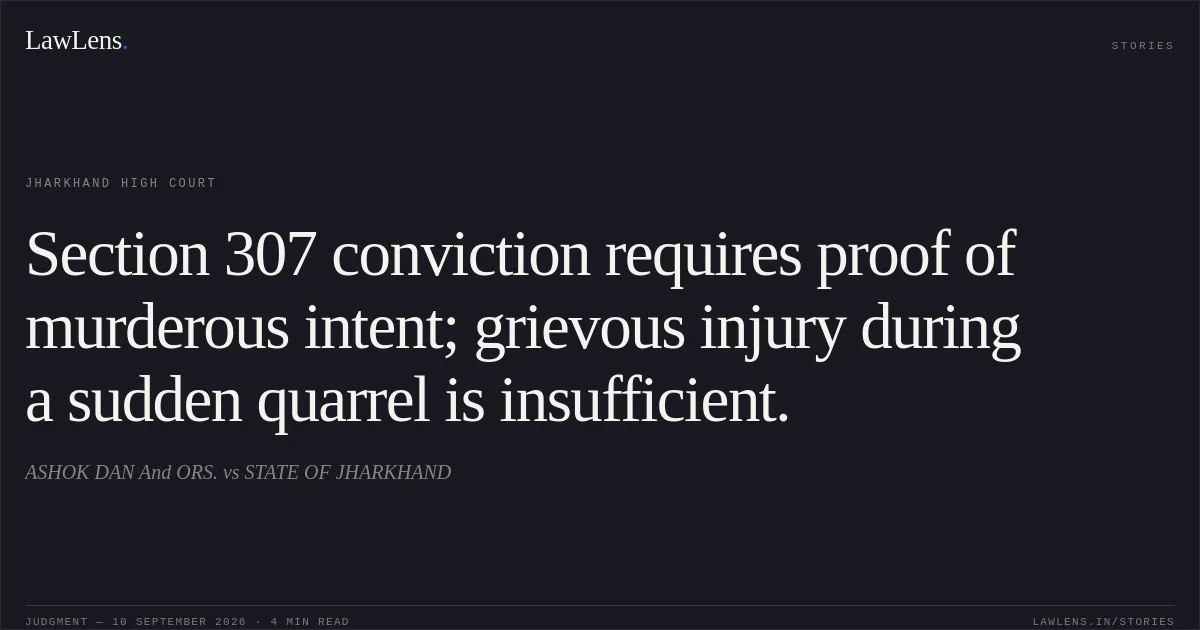
Whether the conviction of the appellants under Section 307/34 IPC was sustainable when the head injury occurred during a sudden quarrel arising from a money dispute, without premeditation or the requisite intention to commit murder?
Source reference: pp. 6–8, paras. 15–18Whether, having regard to the appellants’ first-offender status, antecedents, character, and the lapse of time since the occurrence, they were entitled to the benefit of Section 4 of the Probation of Offenders Act, 1958?
Source reference: p. 8, para. 19Whether the convictions under Sections 323, 341, 337 and 427 IPC were supported by the evidence and injury report?
Source reference: p. 6, para. 14Law Applied
The Court applied Sections 323, 341, 337 and 427 IPC concerning voluntarily causing hurt, wrongful restraint, causing hurt by a rash or negligent act, and mischief, respectively, along with Section 307 IPC, which requires proof of the intention or knowledge necessary to constitute murder, and Section 34 IPC concerning acts done in furtherance of common intention.
Source reference: no citationRelying on Hari Singh v. Sukhbir Singh, (1988) 4 SCC 551, the Court held that intention under Section 307 IPC must be inferred from the weapon used, manner of use, motive, severity and location of the injury, and the surrounding circumstances.
Source reference: p. 7, para. 16It further relied on Jage Ram v. State of Haryana, (2015) 11 SCC 366, which requires proof of both the accused’s intention to commit murder and an overt act, while clarifying that a fatal injury is not essential if the requisite intention is otherwise established.
Source reference: p. 7, para. 17Section 4 of the Probation of Offenders Act, 1958 permits release on probation where, considering the circumstances of the case, the nature of the offence, and the offender’s character, the Court considers it appropriate to release the offender instead of sentencing him to imprisonment.
Source reference: p. 8, para. 19Reasoning
The High Court found the informant’s testimony to be corroborated by the medical evidence, particularly the evidence of PW-4, Dr. N. R. Mahapatra, who proved the grievous head injury and fracture of the parietal bone. Accordingly, the convictions under Sections 323, 341, 337 and 427 IPC were upheld.
Source reference: p. 6, para. 14However, the Court distinguished the existence of a serious injury from proof of the specific intention required under Section 307 IPC. The occurrence arose suddenly from a dispute concerning repayment of money, occurred in the heat of passion, and was not shown to have been premeditated. On these circumstances, the prosecution failed to establish the intention or knowledge necessary to constitute an attempt to murder.
Source reference: pp. 6–8, paras. 15–18Considering that the appellants were first offenders, had no adverse antecedents, and that approximately 27 years had elapsed since the occurrence, the Court held that release on probation was appropriate under Section 4 of the Probation of Offenders Act.
Source reference: p. 8, para. 19Holding
The conviction under Section 307/34 IPC was set aside, while the convictions under Sections 323, 341, 337 and 427 IPC were affirmed.
Instead of undergoing the substantive imprisonment imposed by the Trial Court, each appellant was directed to furnish a bond of ₹5,000 with one surety of like amount under Section 4 of the Probation of Offenders Act, for maintaining peace and good behaviour for one year.
Source reference: p. 8, para. 20The appellants were further directed to pay ₹10,000 collectively as compensation to the injured informant, Prabhat Dan, or his dependants, at the time of furnishing the bond.
Source reference: p. 9, para. 22In the event of breach of the bond conditions or non-compliance with the compensation direction, the appellants could be required to undergo the sentence originally awarded.
Source reference: p. 9, para. 23Acts & Sections Cited
7 provisions across 2 statutes referred to in this judgment. Each provision opens on LawLens.
Indian Penal Code, 18606
Probation of Offenders Act, 19581
Original Court PDF
ASHOK DAN And ORS.vsSTATE OF JHARKHAND
Click to open original judgment
Original judgment, available to read, download and summarize on LawLens.in