Facts
The appellant was married to the complainant, Leela Bai (PW-1), in 2006. Following allegations of harassment, the complainant resided at her maternal home with their infant son.
Source reference: para. 2On April 30, 2008, the appellant visited the complainant’s maternal home to stay the night. At approximately 3:30 a.m., the complainant alleged that while she went to fetch water for the appellant, she returned to find him attempting to strangulate their son with a nylon rope.
Source reference: para. 2, 9The complainant’s parents (PW-2 and PW-3) rushed to the room upon hearing her alarm and claimed to have rescued the child.
Source reference: para. 10, 11The appellant was subsequently charged and convicted by the Sessions Judge, Durg, under Section 307 of the IPC and sentenced to five years of rigorous imprisonment.
Source reference: para. 1The appellant challenged this conviction, contending that the complainant suffered from mental illness and had attempted to harm the child herself, leading to his false implication.
Source reference: para. 5, 15Issues
1. Whether the prosecution established the ingredients of Section 307 of the IPC beyond a reasonable doubt, specifically regarding the appellant's intention and the credibility of the eyewitness account.
Source reference: para. 8, 202. Whether the lack of established motive and the admitted mental health condition of the complainant rendered the prosecution's narrative unreliable.
Source reference: para. 19, 20Law Applied
The court primarily applied Section 307 of the Indian Penal Code (IPC) regarding the attempt to commit murder, which requires proof of intent or knowledge and an act toward the commission of death.
Source reference: para. 1It relied on the evidentiary standards of the Code of Criminal Procedure, 1973 (Section 374) for criminal appeals.
Source reference: para. 1The Court further applied the principle from Raju and another v. State of Uttarakhand, which emphasizes that in the absence of a clear motive and where the prosecution narrative is unconvincing, a conviction under Section 307 cannot be sustained.
Source reference: para. 19The Court noted the procedural requirement for bail/surety under Section 481 of the Bharatiya Nagarik Suraksha Sanhita (BNSS), 2023, following an acquittal.
Source reference: para. 22Reasoning
The Court found the prosecution's case riddled with inconsistencies.
Source reference: para. 17While PW-1, PW-2, and PW-3 alleged the appellant attempted strangulation, the Court noted that PW-2 and PW-3 were not eyewitnesses to the act but arrived only after the alarm was raised.
Source reference: para. 17Crucially, the complainant (PW-1) and her parents admitted that she had been undergoing treatment for mental stress and illness.
Source reference: para. 9, 10, 11, 16The Court observed that the prosecution failed to attribute any motive for the appellant to kill his own son, especially since he had visited the house with the intent to take his wife back.
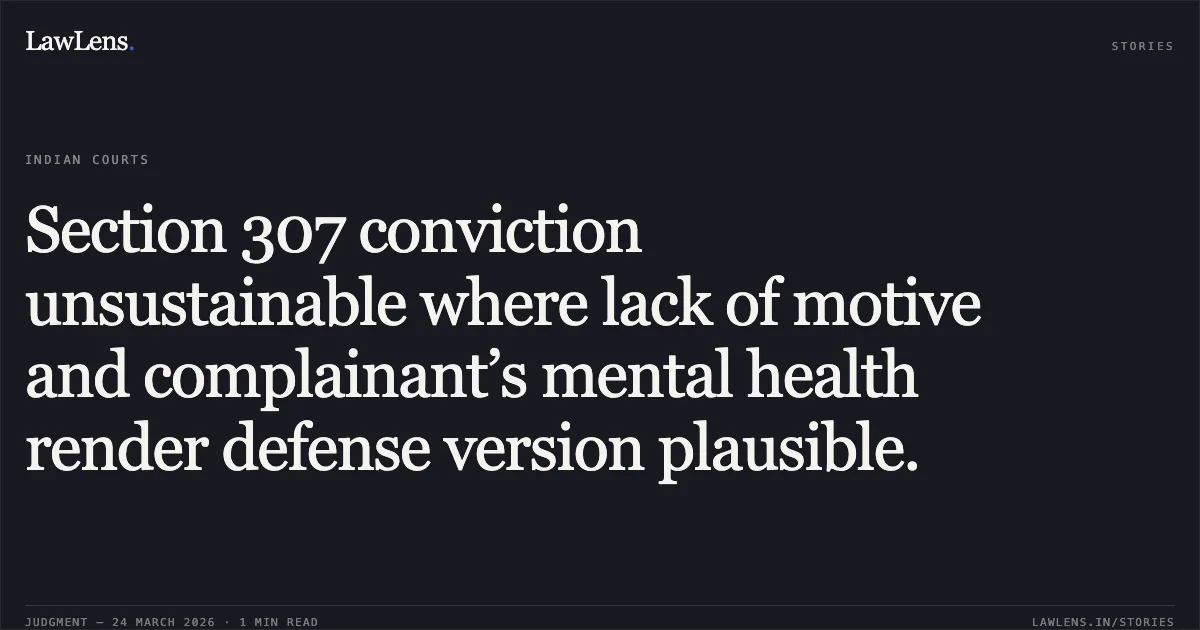
Source reference: para. 20Applying the Raju precedent, the Court held that the appellant’s defense—that the mentally distressed complainant attempted the act herself—was a plausible explanation that the prosecution failed to disprove.
Source reference: para. 20Furthermore, admissions by PW-2 and PW-1 that they directed the police to ensure the appellant was jailed "by any means" severely undermined the credibility and objectivity of their testimonies.
Source reference: para. 10, 13, 20Holding
The Court held that the prosecution failed to meet the threshold of proof beyond reasonable doubt, describing the evidence as unreliable and the findings of the trial court as perverse.
The High Court allowed the appeal, set aside the judgment dated November 19, 2008, and acquitted the appellant of the charge under Section 307 of the IPC.
Source reference: para. 21The appellant was directed to furnish a personal bond of Rs. 25,000/- pursuant to Section 481 of the BNSS to remain effective for six months.
Source reference: para. 22Acts & Sections Cited
4 provisions across 3 statutes referred to in this judgment. Each provision opens on LawLens.
Indian Penal Code, 18601
Code of Criminal Procedure, 19732
Bharatiya Nagarik Suraksha Sanhita, 20231
Original Court PDF
SHESHNARAYANvsSTATE OF CHHATTISGARH
Click to open original judgment
Original judgment, available to read, download and summarize on LawLens.in