Facts
On August 19, 1994, a police patrolling party in Janakpuri observed a TSR with a defective registration plate moving suspiciously.
Source reference: p. 1After the SHO laid a trap, the TSR attempted to flee, prompting a chase.
Source reference: p. 2During the pursuit, the Appellant, Aditya Kumar, fired a gunshot from the TSR’s rear window at the police vehicle.
Source reference: p. 2Upon stopping the TSR, police recovered a country-made pistol with a spent shell in the barrel and a live cartridge from the Appellant’s person.
Source reference: p. 2The Trial Court convicted the Appellant under Sections 307 and 186 of the IPC, sentencing him to four years of rigorous imprisonment for the former and two months for the latter.
Source reference: p. 3The Appellant challenged the conviction, citing lack of injury to the police, absence of independent witnesses, and alleged investigative lapses.
Source reference: p. 4, 12Issues
1. Whether the act of firing at the police party without causing physical injury fulfills the requisite ingredients of "intention or knowledge" under Section 307 of the IPC.
Source reference: p. 4 / para. 72. Whether the prosecution’s case is vitiated by minor contradictions in testimony, the absence of independent public witnesses, or alleged defects in the site plan and seizure records.
Source reference: p. 8 / para. 20, p. 13 / para. 27Law Applied
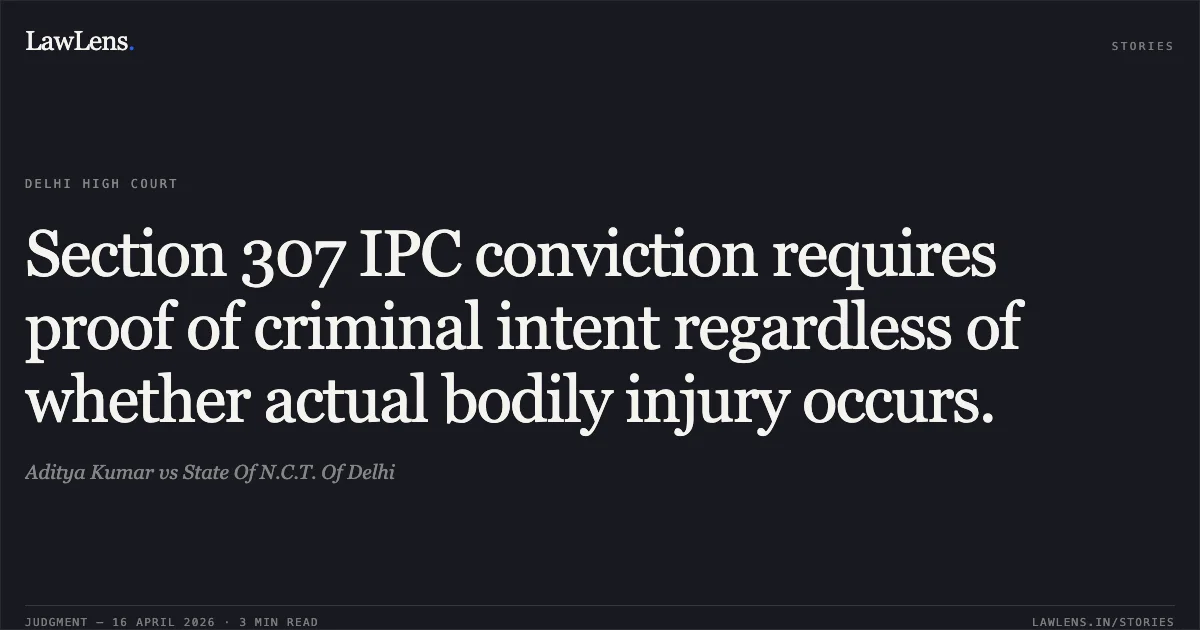
The court primarily applied Section 307 of the IPC, which stipulates that the absence of bodily injury does not preclude a conviction for attempt to murder if the act was done with the requisite intention or knowledge.
Source reference: p. 4Relying on Hari Kishan v. State of Haryana, the court noted that intention must be gathered from the nature of the weapon, the manner of its use, and the severity of the circumstances.
Source reference: p. 5It further applied Kesar Singh v. State of Haryana and Jai Prakash v. State (Delhi Admn.) to distinguish between "intention" as a conscious pursuit of an end and "knowledge" as awareness of consequences.
Source reference: p. 6Regarding ocular evidence, the court followed Balu Sudam Khalde v. State of Maharashtra, which establishes that minor contradictions or the absence of public witnesses do not invalidate truthful official testimony if the "core" of the narrative remains intact.
Source reference: p. 8-11Reasoning
The Court rejected the Appellant's contention that the shot was fired merely to scare the police, observing that firing a lethal weapon from a rear window at a chasing party demonstrates a clear intention or knowledge of potential fatality.
Source reference: p. 8The CFSL report confirmed that the weapon had been fired, and the recovery of the firearm from the Appellant’s possession linked him directly to the act.
Source reference: p. 7-8The Court found the absence of bullet marks on the police vehicle immaterial, as the shot was fired between two moving vehicles.
Source reference: p. 12Regarding procedural challenges, the Court held that "Milk Booth" and "Mother Dairy" were used interchangeably as landmarks and did not constitute a material defect.
Source reference: p. 12It further ruled that independent public witnesses are not mandatory for a conviction, especially given the common public reluctance to join police proceedings.
Source reference: p. 13Finally, the Court verified from the Malkhana register that the TSR had indeed been seized, debunking the Appellant’s claim of its non-seizure.
Source reference: p. 12-13Holding
The Court dismissed the appeal and upheld the conviction and sentence passed by the Trial Court.
It held that the prosecution successfully proved the Appellant’s guilt under Sections 307 and 186 of the IPC beyond reasonable doubt, as the use of a lethal weapon aimed at the police party sufficiently established the criminal intent required under Section 307.
Source reference: p. 7, 14The Appellant was ordered to surrender to undergo the remaining sentence.
Source reference: p. 15Acts & Sections Cited
8 provisions across 3 statutes referred to in this judgment. Each provision opens on LawLens.
Indian Penal Code, 18604
Arms Act, 19593
Code of Criminal Procedure, 19731
Original Court PDF
Aditya KumarvsState Of N.C.T. Of Delhi
Click to open original judgment
Original judgment, available to read, download and summarize on LawLens.in