Facts
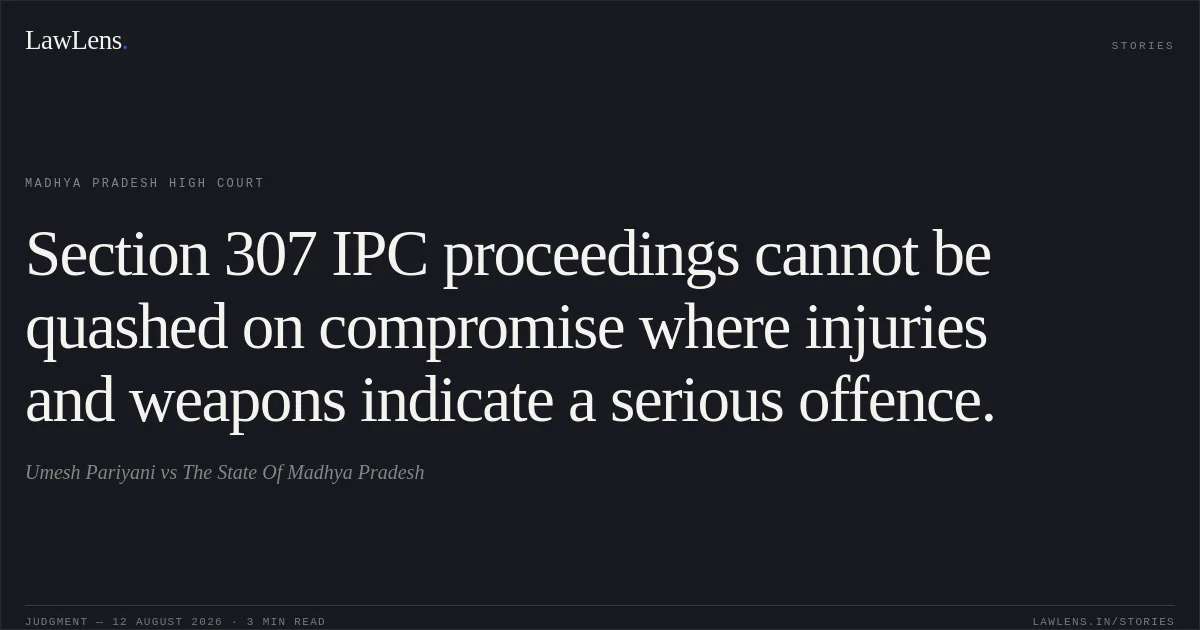
The petitioners invoked Section 528 of the BNSS, corresponding to Section 482 of the CrPC, seeking quashing of FIR dated 03.05.2019, registered as Crime No. 117/2019 at Police Station Shyamla Hills, Bhopal, for offences under Sections 147, 148, 294, 323, 324, 506, 325, 307 and 459 of the IPC.
Source reference: para. 1–2The FIR was initially registered under Sections 147, 148, 294, 323, 324 and 506 IPC, and Section 307 IPC was subsequently added in the chargesheet.
Source reference: para. 1–2A cross-case arising from the same incident was registered as Crime No. 116/2019.
Source reference: para. 2–3During the trial, the parties entered into a compromise and moved applications before the trial court, which declined to record the compromise since Section 307 IPC was non-compoundable.
Source reference: para. 2–3Issues
1. Whether the High Court should exercise its inherent jurisdiction under Section 528 of the BNSS/Section 482 of the CrPC to quash the criminal proceedings for non-compoundable offences, including Section 307 IPC, on the basis of a compromise between the parties.
Source reference: para. 6–82. Whether, on a prima facie assessment of the medical evidence, nature of weapons, manner of assault and other circumstances, the inclusion of Section 307 IPC was merely ornamental or disclosed a serious offence warranting continuation of the prosecution.
Source reference: para. 8–10Law Applied
The Court applied Section 528 of the BNSS, corresponding to Section 482 of the CrPC, which preserves the High Court’s inherent power to prevent abuse of process and secure the ends of justice, distinct from the statutory power of compounding under Section 320 CrPC.
Source reference: para. 6; para. 8Under Gian Singh v. State of Punjab, non-compoundable proceedings may be quashed after settlement where the dispute is predominantly private or civil in nature and continuation would be futile, but serious offences affecting society generally should not be quashed merely on compromise.
Source reference: para. 7Narinder Singh v. State of Punjab held that offences under Section 307 IPC are ordinarily heinous and societal offences, though the High Court may examine whether Section 307 was added merely formally by considering the nature and location of injuries, weapons used, medical evidence and the likelihood of conviction.
Source reference: para. 8State of Madhya Pradesh v. Laxmi Narayan further required scrutiny of the complete factual conspectus, including medical evidence, weapons, nature of the dispute and conduct of the accused, rather than reliance solely on compromise.
Source reference: para. 8Reasoning
The Court acknowledged that compromise may be considered while exercising inherent jurisdiction even in respect of non-compoundable offences, but held that the power is discretionary and must be exercised cautiously.
Source reference: para. 6–8On the facts, the Medico-Legal Certificate recorded grievous injuries to the complainant, allegedly caused by an iron rod and stick.
Source reference: para. 9The chargesheet also recorded recovery of the weapons of offence at the instance of a co-accused, providing prima facie corroboration to the prosecution case.
Source reference: para. 9The complainant and an eyewitness had deposed against the petitioners, and the medical evidence supported the prosecution version.
Source reference: para. 4Accordingly, the Court held that the nature of the weapons, the manner of their use and the gravity of the injuries prima facie indicated a serious offence; Section 307 IPC could not be treated as a mere ornamental addition.
Source reference: para. 9–10The existence of a settlement therefore did not justify terminating the criminal proceedings.
Source reference: para. 9–10Holding
The Court answered the issues against the petitioners.
It held that this was not a fit case for exercising inherent powers under Section 528 of the BNSS/Section 482 of the CrPC to quash the FIR and consequential proceedings on the basis of compromise, since the prima facie material disclosed a serious offence under Section 307 IPC.
Source reference: para. 10The petition seeking quashing of the FIR and criminal proceedings was accordingly dismissed.
Source reference: para. 11Acts & Sections Cited
13 provisions across 3 statutes referred to in this judgment. Each provision opens on LawLens.
Bharatiya Nagarik Suraksha Sanhita, 20231
Code of Criminal Procedure, 19732
Original Court PDF
Umesh PariyanivsThe State Of Madhya Pradesh
Click to open original judgment
Original judgment, available to read, download and summarize on LawLens.in