Facts
A search and seizure operation was conducted at the Petitioner’s residence and offices on June 22, 2016, under the Income Tax Act
Source reference: para. 2Following investigations, the Respondent filed a complaint on May 31, 2018, under Sections 51(1) and 54 of the Black Money Act, 2015
Source reference: para. 3While the complaint’s index mentioned "Annexure F," only a single page was actually filed
Source reference: para. 3The learned ACMM took cognizance on September 5, 2018
Source reference: para. 4Eight months later, during the pre-charge evidence stage, the Respondent filed an application under Section 311 of the Cr.P.C. to bring on record additional documents mentioned in Annexure F that were inadvertently omitted
Source reference: para. 4The ACMM allowed the application on October 1, 2019
Source reference: para. 6This order was upheld by the learned ASJ in revision on February 19, 2021
Source reference: para. 7The Petitioner challenged these orders before the High Court, arguing that criminal complaints cannot be amended or augmented with additional documents post-cognizance
Source reference: para. 8Issues
1. Whether a criminal complaint under Section 200 Cr.P.C. can be amended or augmented with additional documents after cognizance has been taken and the accused summoned.
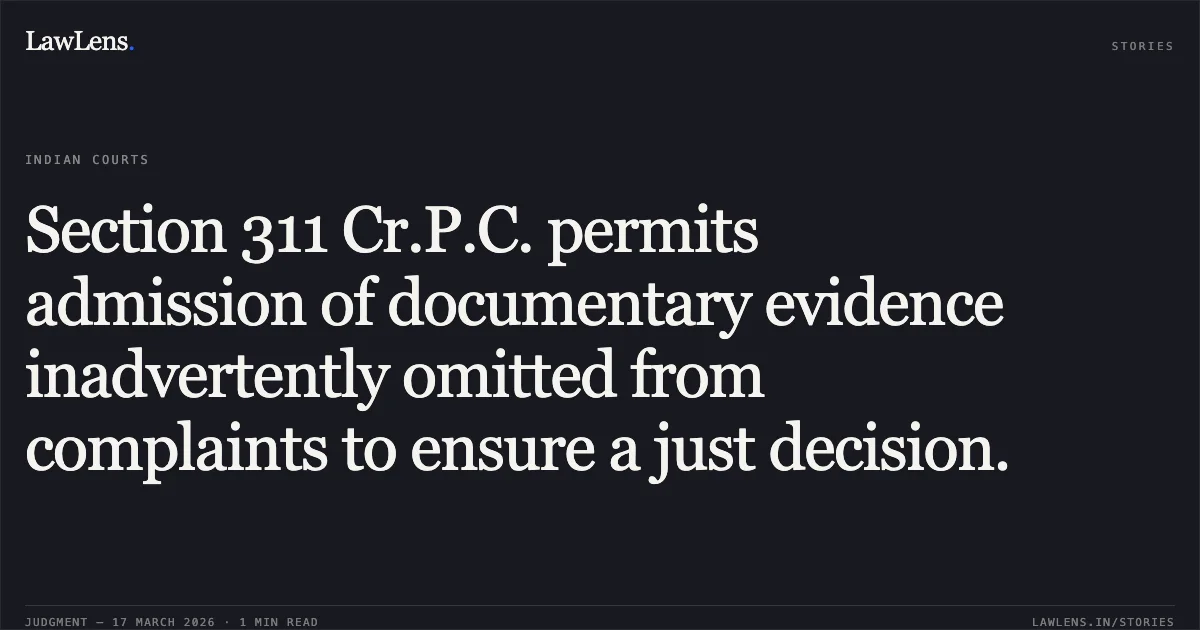
Source reference: para. 292. Whether Section 311 of the Cr.P.C. permits the court to allow the production of documentary evidence that was omitted due to inadvertence or oversight.
Source reference: para. 43Law Applied
The court primarily applied Section 311 of the Cr.P.C., which grants the court wide discretionary power to summon or examine evidence at any stage of inquiry or trial if essential to a just decision
Source reference: para. 43-44It relied on U.P. Pollution Control Board v. Modi Distillery and S.R. Sukumar v. S. Sunaad Raghuram, which established that formal or curable legal infirmities in a complaint can be amended if no prejudice is caused to the accused
Source reference: para. 31, 33The court further cited Bansal Milk Chilling Centre v. Rana Milk Food Private Limited, confirming that amendments to a complaint are not strictly prohibited even after cognizance
Source reference: para. 40Regarding the scope of Section 311, the court relied on V.N. Patil v. K. Nirajanan Kumar and P. Chhaganlal Daga v. M. Sanjay Shaw, which hold that Section 311 encompasses both oral and documentary evidence to unearth the truth
Source reference: para. 51-53Reasoning
The court observed that although the Cr.P.C. lacks a provision equivalent to Order VI Rule 17 of the CPC, judicial precedents allow for the correction of clerical or typographical errors and curable legal infirmities
Source reference: para. 30-33The court distinguished between "substantive amendments" (such as adding a new accused), which are impermissible, and the "elaboration of material facts" or filing omitted documents
Source reference: para. 37-38It found that the Petitioner’s argument regarding "prejudice" was fallacious because the documents in question were already referenced in Paragraph 9 of the original complaint and Annexure F
Source reference: para. 42, 54, 57Since the documents were part of the material considered for the grant of Sanction and were not "new" evidence, their inclusion was a curable irregularity
Source reference: para. 58-59The court emphasized that the aim of Section 311 is to discover the truth and that an inadvertent omission by the prosecution should not be treated as an incurable lacuna if the evidence is essential for a just decision
Source reference: para. 45, 49Holding
The High Court answered both issues in favor of the Respondent. It held that an amendment to a complaint is permissible after cognizance if it corrects a curable irregularity without causing prejudice
It further held that Section 311 Cr.P.C. is wide enough to permit the placement of documentary evidence on record at any stage if found necessary for the quest for justice
Source reference: para. 53, 59The court found no infirmity in the orders of the ACMM and ASJ and dismissed the Petitions
Source reference: para. 60Acts & Sections Cited
10 provisions across 3 statutes referred to in this judgment. Each provision opens on LawLens.
Black Money (Undisclosed Foreign Income and Assets) and Imposition of Tax Act, 20152
Negotiable Instruments Act, 18811
Code of Criminal Procedure, 19737
Original Court PDF
Deepak TalwarvsIncome Tax Office
Click to open original judgment
Original judgment, available to read, download and summarize on LawLens.in