Facts
The petitioner, an Accountancy teacher, was charged under Sections 354/354A/354B of the IPC and Section 10 of the POCSO Act following complaints by five female students alleging inappropriate sexual conduct, touching, and threats
Source reference: p. 2Charges were framed in 2016, and the victims (PW-1, PW-2, and PW-4) were examined and cross-examined between 2017 and 2018
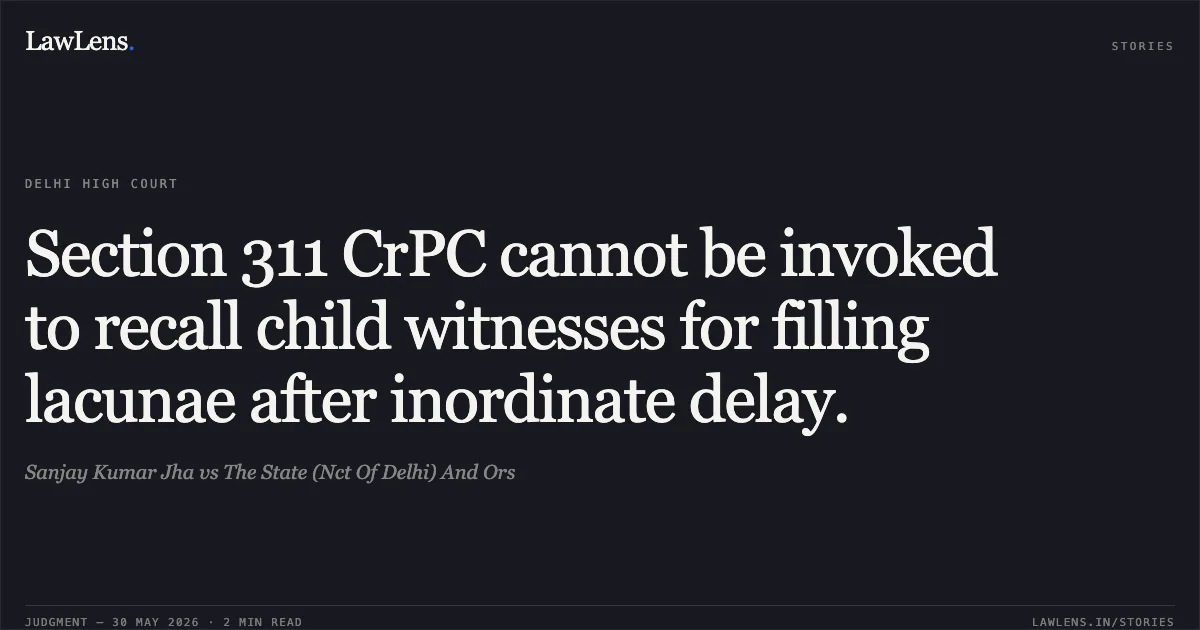
Source reference: p. 3In 2023, nearly six years later, the petitioner moved an application under Section 311 of the Cr.P.C. to recall PW-1, PW-2, and PW-4 for further cross-examination
Source reference: p. 3He contended that their initial statements to the School Principal were not exhibited or used to confront them during the trial
Source reference: p. 4The Trial Court dismissed the request to recall the victims, leading to this revision petition
Source reference: p. 4Issues
1. Whether the petitioner is entitled to recall child victims for further cross-examination under Section 311 Cr.P.C. after an inordinate delay
Source reference: p. 5 / para. 102. Whether the mandate of Section 33(5) of the POCSO Act restricts the court’s discretion to recall child witnesses to prevent repeated harassment
Source reference: p. 6 / para. 11Law Applied
The court applied Section 311 of the Cr.P.C., which grants discretionary power to recall witnesses if their evidence is essential to a just decision, provided it is exercised judiciously and not to fill lacunae
Source reference: p. 5-6Section 33(5) of the POCSO Act, which mandates that the Special Court ensure a child is not called repeatedly to testify
Source reference: p. 6-7The court relied on Madhab Chandra Pradhan v. State of Odisha, holding that Section 33(5) is not an absolute bar but requires context-specific application
Source reference: p. 7Rakesh v. State of NCT of Delhi, emphasizing that the right to a fair trial includes the victim's right not to be unnecessarily harassed
Source reference: p. 8-9Reasoning
The court reasoned that while Section 311 powers are broad, they must be exercised with caution in POCSO cases to prevent re-traumatization of victims
Source reference: para. 12, 14Regarding PW-4, the court found no statement was ever recorded by the Principal, rendering the petitioner's ground factual baseless
Source reference: para. 15For PW-1 and PW-2, the court noted that the statements in question were part of the chargesheet from the inception; therefore, the petitioner had full access and "adequate and fair opportunity" to use them during the original cross-examinations in 2017
Source reference: para. 16-17The court observed that the six-year delay in filing the application suggested an attempt to delay the trial rather than a bona fide pursuit of justice
Source reference: para. 17The court found the allegations in the FIR and the statements to the Principal were "broadly consistent," meaning the lack of confrontation did not result in a miscarriage of justice
Source reference: para. 19Holding
The court held that Section 311 Cr.P.C. cannot be used to fill lacunae in the defense when sufficient opportunity for cross-examination was already provided
The court concluded that the rights of the accused must be balanced with the statutory protection of child witnesses under Section 33(5) of the POCSO Act to avoid subjecting them to repeated trauma and dismissed the petition, upholding the Trial Court's order
Source reference: para. 20, 21Acts & Sections Cited
6 provisions across 3 statutes referred to in this judgment. Each provision opens on LawLens.
Indian Penal Code, 18601
Protection of Children from Sexual Offences Act, 20123
Code of Criminal Procedure, 19732
Original Court PDF
Sanjay Kumar JhavsThe State (Nct Of Delhi) And Ors
Click to open original judgment
Original judgment, available to read, download and summarize on LawLens.in