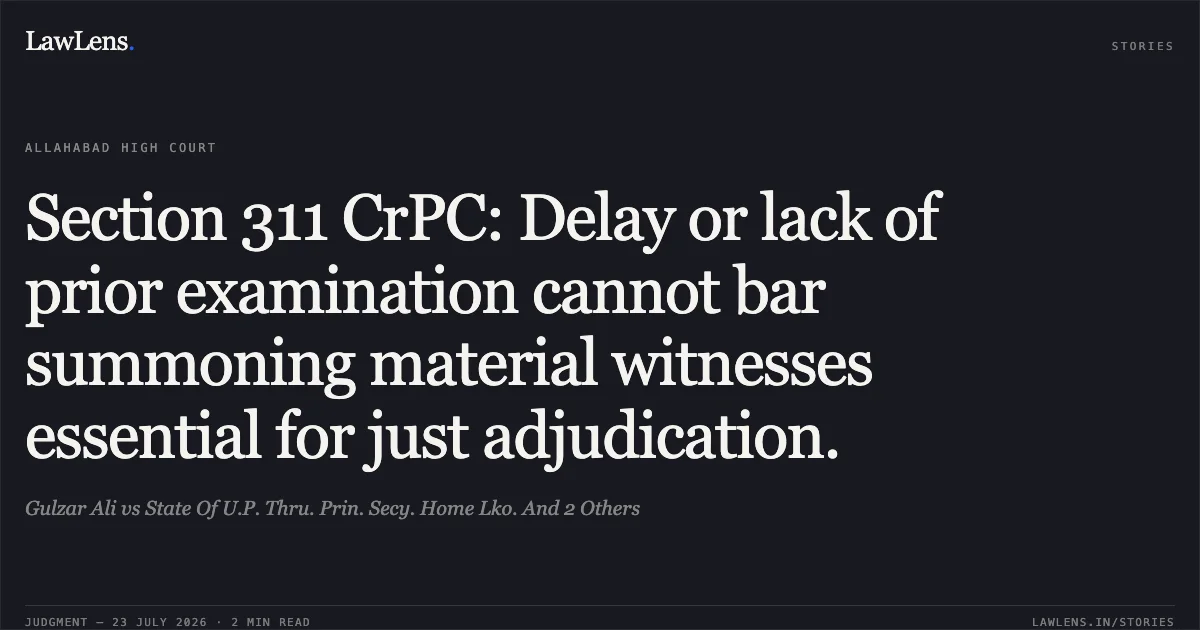
Facts
The applicant sought to set aside an order dated 15.05.2026 passed by the Additional and Session Judge, FTC, Unnao, which rejected an application under Section 311 Cr.P.C.
Source reference: para. 3, 4The applicant requested the summoning of P.W.1 (the victim's mother) and two experts (Kiran Shukla and Meenu Tiwari) from the BSA Office.
Source reference: para. 3, 4The victim, who is mentally challenged, had recorded statements under Sections 161 and 164 Cr.P.C. with the assistance of these experts.
Source reference: para. 4, 5While the FIR only alleged outraging of modesty, the victim's Section 164 statement—assisted by the experts—introduced a more serious allegation of rape.
Source reference: para. 5, 10The trial court rejected the application on the grounds of delay (the application was filed nearly three years after P.W.1’s testimony) and because the proposed witnesses had not undergone examination-in-chief, making cross-examination impermissible.
Source reference: para. 9, 19Issues
1. Whether the trial court can summon or re-examine a material witness under Section 311 Cr.P.C. even if there has been a significant delay in filing the application.
Source reference: para. 16, 182. Whether the lack of an examination-in-chief acts as a legal bar to summoning a material witness under Section 311 Cr.P.C.
Source reference: para. 19Law Applied
The court primarily applied Section 311 of the Cr.P.C., which empowers the court to summon any person as a witness at any stage of inquiry or trial if their evidence is essential to a just decision.
Source reference: para. 12, 13It relied on Manju Devi v. State of Rajasthan (2019), establishing that the age or duration of a case cannot displace the requirement of ensuring a just decision through material evidence.
Source reference: para. 16, 17Furthermore, it cited Natasha Singh v. CBI (2013), holding that Section 311 is expressed in the widest possible terms to discover the truth, provided it is not used to fill a lacuna or cause prejudice.
Source reference: para. 8, 20Reasoning
The High Court observed that the trial court erred by failing to assess the relevance of the two experts, whose assistance was pivotal in the mentally challenged victim leveling rape allegations for the first time.
Source reference: para. 10, 22The Court reasoned that Section 311 uses the widest possible terms—"any court," "at any stage," and "any person"—meaning there is no statutory limit on judicial discretion based on the stage of the trial.
Source reference: para. 13, 18The Court found the trial court's logic—that witnesses cannot be summoned because their examination-in-chief had not occurred—to be "erroneous and groundless," as the very purpose of Section 311 is to bring material witnesses into the trial process regardless of prior stages.
Source reference: para. 19Even if the case was at the stage of arguments, the interest of the accused must not be jeopardized by unfounded presumptions of delay when material facts remain unexplored.
Source reference: para. 14, 15Holding
The High Court allowed the application and set aside the order dated 15.05.2026.
It held that the statements of the experts were relevant evidence for a just decision, given the change in the nature of allegations.
Source reference: para. 22The matter was remitted to the trial court to decide the Section 311 Cr.P.C. application afresh in light of the observations made, within a period of eight weeks.
Source reference: para. 24Acts & Sections Cited
4 provisions across 1 statute referred to in this judgment. Each provision opens on LawLens.
Code of Criminal Procedure, 19734
Original Court PDF
Gulzar AlivsState Of U.P. Thru. Prin. Secy. Home Lko. And 2 Others
Click to open original judgment
Original judgment, available to read, download and summarize on LawLens.in


