Facts
The petitioner filed a complaint under the Negotiable Instruments Act after two cheques issued by respondent no. 2 towards part payment of an alleged business liability were dishonoured
Source reference: p. 2, paras. 2–3During defence evidence, respondent no. 2 produced a bank statement showing a payment of ₹1,45,457 to the petitioner
Source reference: p. 2, paras. 4–5The petitioner maintained that the payment related to an earlier invoice dated 1 June 2016, not the liability in the complaint, and sought under Section 311 Cr.P.C. to place that invoice and related payment and tax records on record
Source reference: pp. 2–3, para. 6The Trial Court dismissed the application, noting that the petitioner’s evidence had closed and that the invoice had not been filed earlier
Source reference: p. 3, para. 7The petitioner challenged that order under Section 482 Cr.P.C.
Source reference: p. 1, para. 1Issues
1. Whether the proposed invoice and related payment and tax records were relevant and necessary for a just and proper adjudication
Source reference: p. 4, para. 122. Whether the petitioner’s failure to produce the documents before its evidence closed barred their later production, or whether permitting them would merely fill a lacuna in its case
Source reference: pp. 4–5, paras. 12–16Law Applied
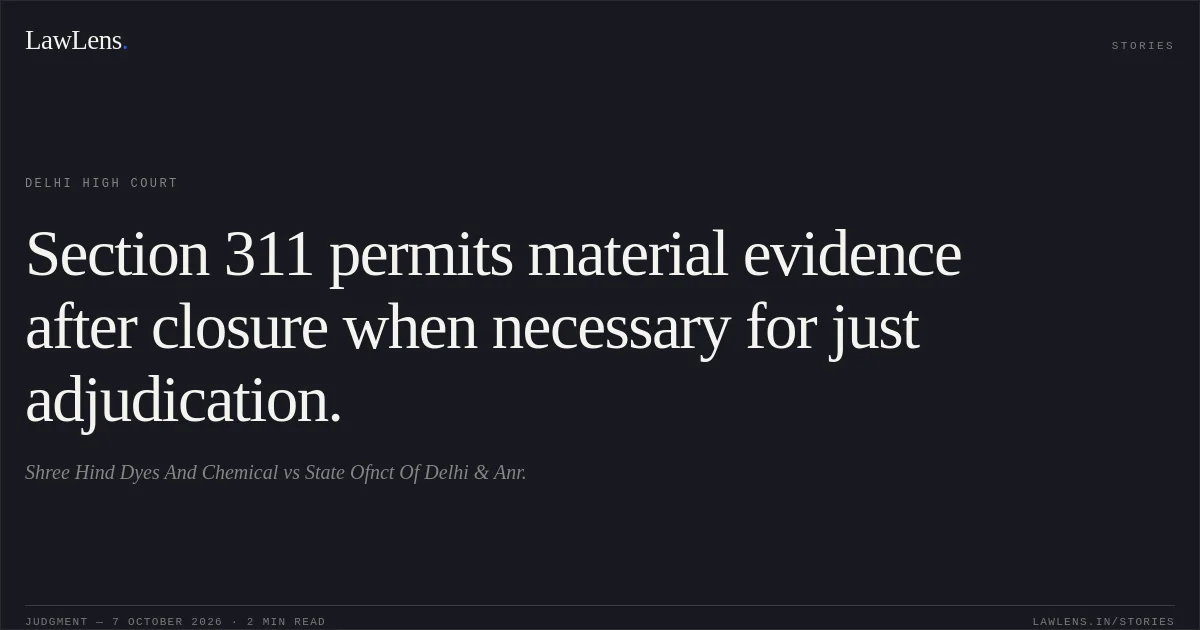
Section 311 Cr.P.C. gives the court broad power at any stage of an inquiry or trial to summon, examine, recall or re-examine a person where the evidence appears essential to the just decision of the case; the determinative consideration is the necessity of the evidence, not merely the stage at which the application is made
Source reference: p. 4, para. 13A prior omission to produce a document does not, by itself, justify excluding it where the document is material to an issue arising for adjudication
Source reference: p. 5, para. 16The petition was brought under Section 482 Cr.P.C., but the judgment identifies no separate Section 482 principle or precedent as the basis for its reasoning
Source reference: p. 1, para. 1Reasoning
The payment shown in respondent no. 2’s bank statement was directly relevant to his defence, while the petitioner asserted that it related to a different invoice and transaction
Source reference: pp. 4–5, paras. 14–15The proposed documents could therefore help the Trial Court determine the nature of that payment.
Source reference: p. 5, para. 15In the circumstances, the request was not shown to be merely an attempt to cure a deficiency in the petitioner’s original case; it sought to explain a fact placed in issue during the trial
Source reference: p. 5, para. 15Although the invoice could have been produced earlier, that omission was not an absolute bar to admitting material evidence, and respondent no. 2 could be given an opportunity to contest the documents
Source reference: pp. 5–6, paras. 16–19Holding
The High Court allowed the petition and permitted the petitioner to place on record the invoice dated 1 June 2016 and the corresponding bank receipt/payment statement and VAT/GST record
Respondent no. 2 was to have a full opportunity to contest the documents in accordance with law.
Source reference: p. 6, paras. 18–19The Court made clear that its observations concerned only the request to bring the additional material on record and expressed no opinion on the merits
Source reference: p. 6, paras. 20–21Acts & Sections Cited
3 provisions across 1 statute referred to in this judgment. Each provision opens on LawLens.
Code of Criminal Procedure, 19733
Original Court PDF
Shree Hind Dyes And ChemicalvsState Ofnct Of Delhi & Anr.
Click to open original judgment
Original judgment, available to read, download and summarize on LawLens.in