Facts
An FIR was registered as Paliganj P.S. Case No. 247 of 2009 under Sections 302, 328 and 34 of the Indian Penal Code, alleging that Phulendra was killed by administering poison. The FIR named Ranju Kumari, Sita Sundri Devi, Shankar Yadav and Anita Devi as accused.
Source reference: p.2, para. 2After investigation, the police submitted a charge-sheet only against Ranju Kumari and Sita Sundri Devi, while Shankar Yadav and Anita Devi were not sent up for trial for want of evidence; the final form concerning them was accepted by the learned Magistrate.
Source reference: p.2, para. 2Nathuni Yadav, who was neither named in the FIR nor sent up for trial, was also not implicated during investigation.
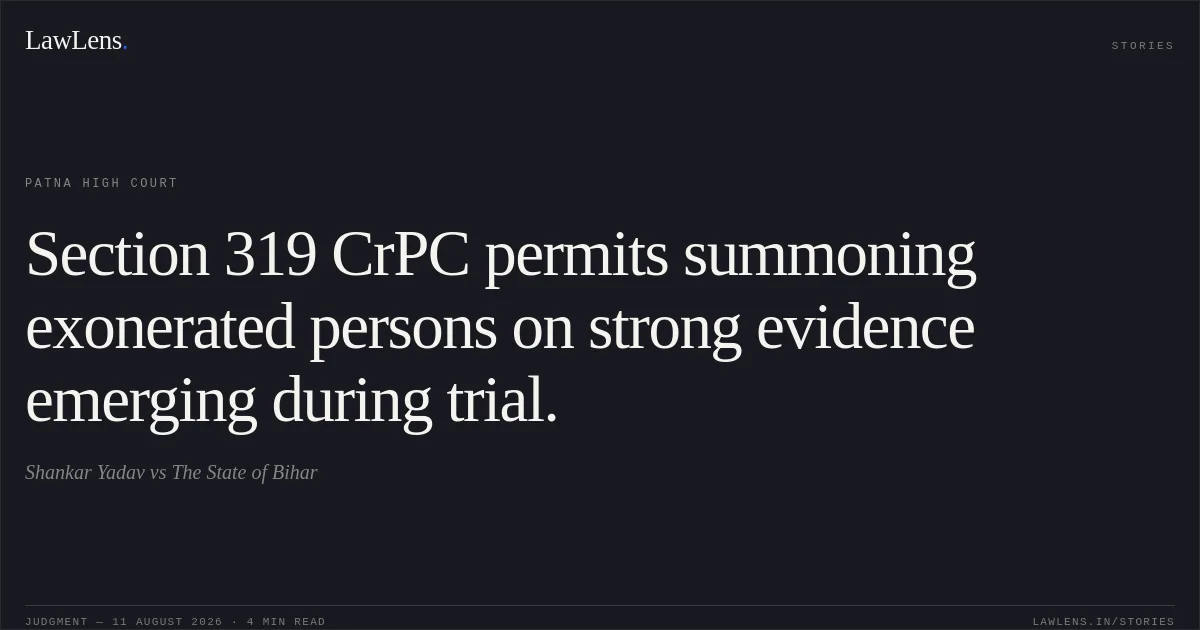
Source reference: pp.3–4, para. 5; p.12, para. 20During the trial, five prosecution witnesses were examined. On 25 July 2016, after considering their evidence and before pronouncement of judgment, the learned Additional District and Sessions Judge invoked Section 319 of the Code of Criminal Procedure, 1973 (“Cr.P.C.”), and summoned Shankar Yadav, Anita Devi and Nathuni Yadav to face trial along with the existing accused.
Source reference: p.3, para. 3The petitioners challenged the summoning order under Section 482 Cr.P.C.
Source reference: p.4, para. 4Issues
1. Whether the trial court could exercise power under Section 319 Cr.P.C. to summon persons who were named in the FIR but not charge-sheeted, or whose exoneration had been accepted by the Magistrate, on the basis of evidence recorded during trial?
Source reference: pp.7–10, paras. 11–182. Whether a person who was neither named in the FIR nor investigated by the police could be summoned under Section 319 Cr.P.C. on the basis of the depositions of prosecution witnesses recorded during trial?
Source reference: pp.10–12, paras. 18–203. Whether the order dated 25 July 2016 summoning the petitioners disclosed illegality or warranted interference under Section 482 Cr.P.C.?
Source reference: p.4, para. 4; pp.13–14, paras. 21–24Law Applied
Section 319 Cr.P.C. empowers a trial court, at any time before pronouncement of judgment, to proceed against a person who is not already an accused if evidence recorded during the inquiry or trial indicates that such person appears to have committed an offence for which he could be tried together with the existing accused.
Source reference: pp.7–8, para. 12The power extends to persons not named in the FIR, persons named but not charge-sheeted, and persons discharged, provided that strong and cogent evidence emerges during trial.
Source reference: pp.10–12, paras. 18–20In Hardeep Singh v. State of Punjab, (2014) 3 SCC 92, and Brijendra Singh v. State of Rajasthan, (2017) 7 SCC 706, the Supreme Court held that Section 319 is an extraordinary and discretionary power that must be exercised sparingly; the evidence must be stronger than the mere prima facie standard applicable at the stage of framing charge, although evidence in examination-in-chief may be considered even before cross-examination.
Source reference: pp.8–10, para. 16The Court also referred to Municipal Corporation of Delhi v. Ram Kishan Rohtagi, (1983) 1 SCC 1, for the proposition that the power may extend even to persons against whom proceedings had earlier been quashed.
Source reference: p.12, para. 19The inherent jurisdiction under Section 482 Cr.P.C. may be exercised to prevent abuse of process or secure the ends of justice, but does not justify interference with a lawful Section 319 order supported by substantial trial evidence.
Source reference: p.4, para. 4; pp.13–14, paras. 21–24Reasoning
The High Court held that the trial court had relied not merely on the FIR or the investigation materials, but on evidence recorded on oath from PW-1 to PW-5 during the trial.
Source reference: pp.3, para. 3; p.12, para. 20These witnesses specifically alleged that Ranju Devi, Sita Sundri Devi, Nathuni Yadav, Shankar Yadav and Anita Devi participated in killing the deceased by administering poison.
Source reference: p.12, para. 21The allegation was corroborated by the viscera report, Exhibit 7, which indicated poisoning as the cause of death.
Source reference: p.12, para. 21Applying the standard laid down in Hardeep Singh and Brijendra Singh, the Court found the evidence sufficiently strong and cogent to justify summoning the petitioners, notwithstanding that two of them had not been charge-sheeted and the third had not been named or investigated.
Source reference: pp.12–14, paras. 20–24The Court therefore found no abuse of process, perversity or illegality warranting exercise of Section 482 jurisdiction.
Source reference: pp.12–14, paras. 20–24Holding
The High Court dismissed the application under Section 482 Cr.P.C. and upheld the order dated 25 July 2016 summoning Shankar Yadav, Anita Devi and Nathuni Yadav under Section 319 Cr.P.C. to face trial along with the existing accused.
The trial court was directed to proceed without unnecessary adjournments and to conclude the trial within six months, preferably on a day-to-day basis.
Source reference: pp.13–14, paras. 22–23No order as to costs was made, and any pending interlocutory application was disposed of accordingly.
Source reference: p.14, paras. 25–26Acts & Sections Cited
7 provisions across 2 statutes referred to in this judgment. Each provision opens on LawLens.
Code of Criminal Procedure, 19734
Indian Penal Code, 18603
Original Court PDF
Shankar YadavvsThe State of Bihar
Click to open original judgment
Original judgment, available to read, download and summarize on LawLens.in