Facts
The informant, a retired teacher, alleged a fraudulent withdrawal of Rs. 11,00,000/- from his bank account via IRCTC transactions.
Source reference: para. 3Following an investigation, a charge-sheet was filed solely against co-accused Rahul Kumar Jha under Sections 420, 379 IPC, and Section 66(C) of the IT Act.
Source reference: para. 4During the trial (Tr. No. 1640/18), the petitioner, Sharvan Kumar Pandey, was examined as a prosecution witness (PW-7) because his company provided the internet connection used by the co-accused.
Source reference: paras. 5, 6None of the prosecution witnesses (PW-1 to PW-6) implicated the petitioner in the crime.
Source reference: para. 6However, on July 13, 2018, the Chief Judicial Magistrate (CJM), Gopalganj, acting on an application filed by the co-accused Rahul Kumar Jha, issued a summons against the petitioner to face trial as an additional accused under Section 319 of the Cr.P.C.
Source reference: paras. 2, 6, 7Issues
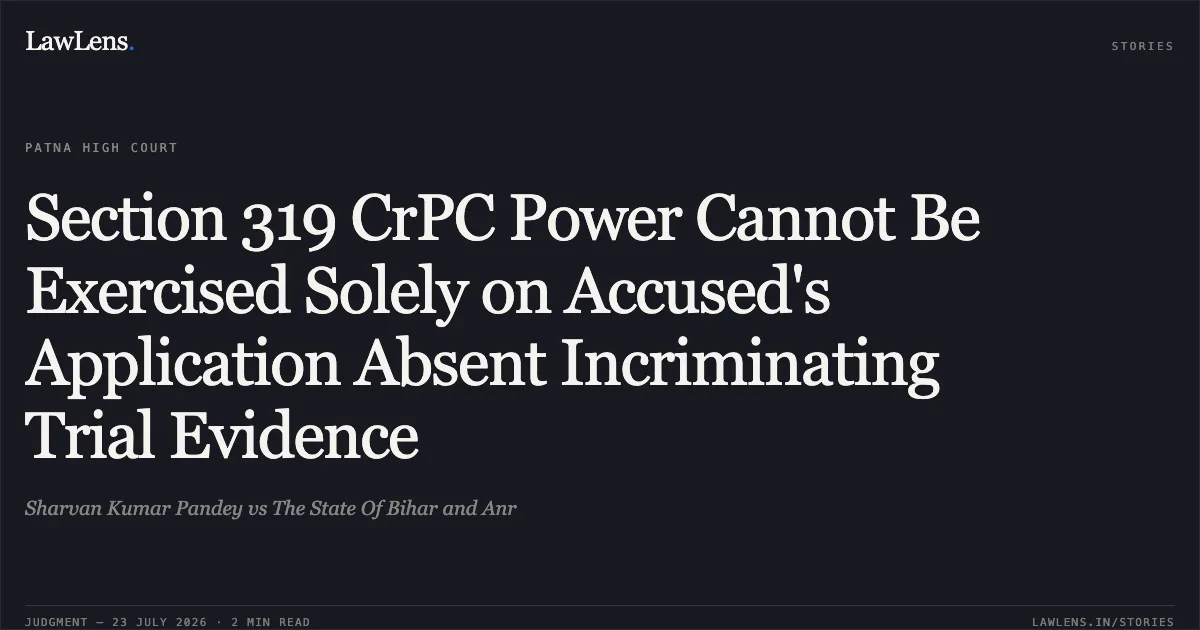
Whether a person can be summoned to face trial under Section 319 of the Cr.P.C. solely based on an application by a co-accused and materials in the police diary, without incriminating evidence surfacing during the trial.
Source reference: paras. 10-11Law Applied
Section 319 of the Code of Criminal Procedure (Cr.P.C.), which empowers the court to proceed against persons not currently accused if it appears from the "evidence" during inquiry or trial that they have committed an offence.
Source reference: para. 8The power under Section 319 is extraordinary and discretionary, requiring a higher degree of satisfaction than "prima facie" at the stage of framing charges, but lower than what is required for conviction.
Source reference: para. 9This satisfaction must be based on "evidence" brought on record during the trial.
Source reference: para. 9.1Reasoning
The Court observed that for a summons under Section 319 Cr.P.C. to be valid, incriminating evidence must surface "in the course of any inquiry into, or trial of, an offence".
Source reference: para. 10In the present case, the CJM issued the summons based on an application by the co-accused and references to the Case Diary (specifically paragraphs 51 and 70) rather than evidence recorded during the trial.
Source reference: para. 7, 11The High Court noted that none of the seven prosecution witnesses had said anything incriminating against the petitioner; in fact, the petitioner himself had appeared as PW-7.
Source reference: para. 11The Court reasoned that the CJM’s reliance on the co-accused's petition—who had the opportunity to testify under Section 315 Cr.P.C. but did not—instead of trial evidence was a perverse finding contrary to settled law.
Source reference: para. 11Holding
The Court held that the impugned order was legally unsustainable as the mandatory prerequisite of "evidence" appearing during the trial was not met.
The High Court allowed the petition and quashed the order dated July 13, 2018, passed by the CJM, Gopalganj, set-aside the summons against the petitioner, and directed a copy of the judgment be sent to the trial court.
Source reference: paras. 12-14Acts & Sections Cited
4 provisions across 2 statutes referred to in this judgment. Each provision opens on LawLens.
Code of Criminal Procedure, 19732
Indian Penal Code, 18602
Original Court PDF
Sharvan Kumar PandeyvsThe State Of Bihar and Anr
Click to open original judgment
Original judgment, available to read, download and summarize on LawLens.in