01Facts
The petitioners sought quashing of FIR No. 0580 of 2026 dated 03.11.2026, registered at P.S. Sitarganj, District Udham Singh Nagar, under Sections 115(2), 191(2), 351(3) and 352 of the Bharatiya Nyaya Sanhita, 2023 (BNS)
¶ 1Along with the writ petition, the parties filed a joint compounding application (IA/1/2026), supported by separate affidavits of the petitioners and respondent Nos. 3 to 5
¶ 2They stated that the dispute had been amicably settled through the intervention of elders from both sides, and that no grievance remained against the FIR
¶ 3The petitioners, the complainant (respondent No. 3) and the two injured persons (respondent Nos. 4 and 5) appeared in person and were identified by counsel. They confirmed that they are residents of the same village, live in the same vicinity, and do not wish to prosecute, and they fairly conceded that they had no objection to the compounding application being allowed
¶ 4The learned State Counsel submitted that some of the offences sought to be compounded are non-compoundable
¶ 502Issues
i.1. Whether an FIR disclosing offences that are not compoundable under Section 320 of the Code of Criminal Procedure, 1973 (Cr.P.C.) can be quashed on the basis of a compromise between the parties
¶ 6–7ii.2. Whether, in view of the settlement, the continuation of the criminal proceedings would be unfair, contrary to the interest of justice, or an abuse of process, so as to warrant quashing in exercise of the High Court's extraordinary jurisdiction
¶ 8–903Law Applied
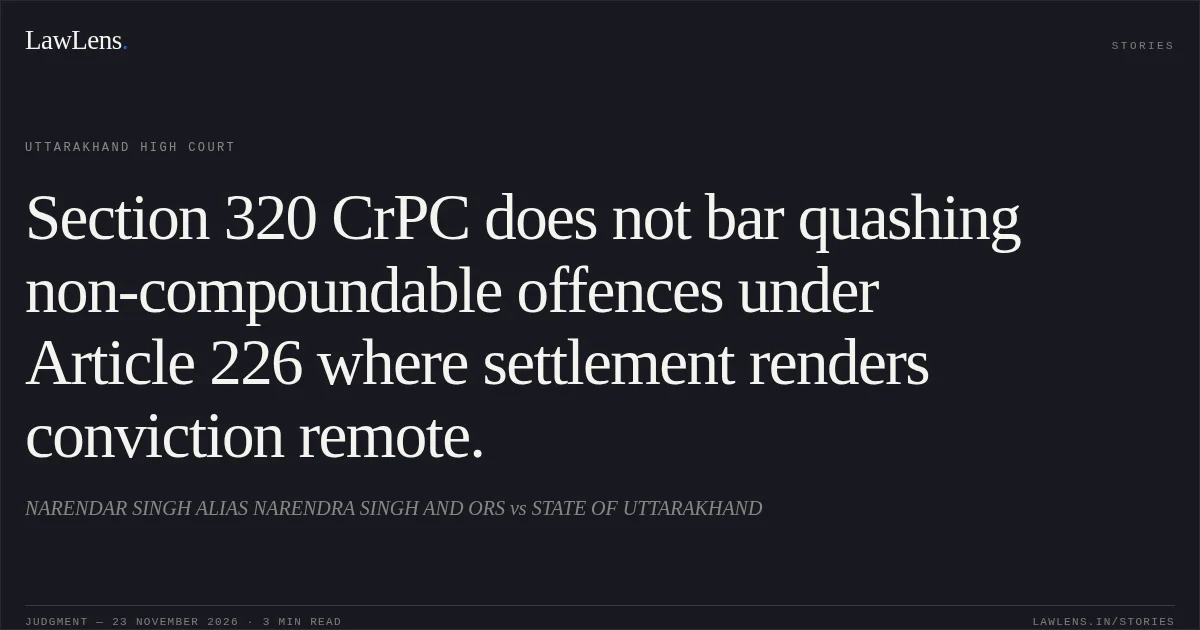
The Court relied on Section 320 Cr.P.C., which governs the compounding of offences, and recognised that it does not restrict the High Court's wider power to quash proceedings
¶ 6–7It applied B.S. Joshi v. State of Haryana, (2003) 4 SCC 675, which holds that Section 320 is no bar to quashing an FIR where necessary to secure the ends of justice, the exercise of that power depending on the facts of each case
¶ 6It further relied on Gian Singh v. State of Punjab, (2013) 1 SCC (Cri) 160, which holds that the High Court's inherent power, exercised to secure the ends of justice or prevent abuse of process, is distinct from compounding under Section 320
¶ 8Under Gian Singh, quashing is appropriate where, because of a settlement between offender and victim, the possibility of conviction is remote or bleak, and continuation of the case would cause oppression, prejudice or extreme injustice to the accused. No fixed category of cases is prescribed
¶ 8The Court also invoked Article 226 of the Constitution as the source of its extraordinary power to quash FIRs and proceedings
¶ 7Provisions in the judgment · 5 · Linked ones open on LawLens
Bharatiya Nyaya Sanhita, 2023 Section 115Section 191Section 351Section 352
Code of Criminal Procedure, 1973 Section 320
04Reasoning
The Court first held that Section 320 Cr.P.C. does not limit its power under Article 226 to quash criminal proceedings, which allowed it to consider the compromise even though the State contended that some offences were non-compoundable
¶ 5–7It then applied the Gian Singh test to the facts. The complainant and both injured persons, who are neighbours, personally confirmed the settlement, did not wish to prosecute, and had no objection to quashing
¶ 4On that basis, the Court held that conviction was remote or bleak and that continuing the proceedings would be unfair and contrary to the interest of justice
¶ 9The judgment does not separately examine the State's objection that some offences are non-compoundable, nor does it identify which offences were non-compoundable; it proceeds on the general power to quash
¶ 5, 905Holding
The Court answered both issues in the affirmative. Relying on B.S. Joshi and Gian Singh, it held that the FIR could be quashed on the basis of the compromise, as the possibility of conviction was remote and continuation would be unfair and an abuse of process
¶ 9The compounding application (IA/1/2026) was allowed, the compromise was accepted, and FIR No. 0580 of 2026 dated 03.11.2026 under Sections 115(2), 191(2), 351(3) and 352 BNS, P.S. Sitarganj, was quashed. All consequential proceedings arising from the FIR stand terminated
¶ 10The criminal writ petition was allowed and pending applications, if any, were disposed of
¶ 11–12Original Court PDF
NARENDAR SINGH ALIAS NARENDRA SINGH AND ORSvsSTATE OF UTTARAKHAND
Click to open original judgment
Original judgment, available to read, download and summarize on LawLens.in