Facts
The petitioner was facing trial for an offence under Section 326B of the Indian Penal Code, 1860.
Source reference: para. 2–4After the prosecution evidence had concluded, he applied under Section 329 CrPC for constitution of an Expert Medical Board, relying on his alleged psychiatric condition and its possible effect on his mental capacity when the offence was committed. The Sessions Court dismissed the application. The petitioner challenged that order under Section 528 BNSS.
Source reference: para. 2–4The documents relied on were dated after the alleged offence; the Sessions Court also recorded that its interaction with the petitioner disclosed no apparent unsoundness of mind.
Source reference: para. 13–14Issues
Whether an application under Section 329 CrPC is maintainable when made after the prosecution evidence has concluded and the defence stage has been reached.
Source reference: para. 11–12Whether the materials before the Trial Court provided a sufficient basis to require a medical-board inquiry into the petitioner’s unsoundness of mind and consequent incapacity to make his defence.
Source reference: para. 12–16Whether the petitioner’s claim about his mental capacity at the time of the alleged offence fell within Section 329 CrPC or instead concerned the defence under Section 84 IPC.
Source reference: para. 8–10Law Applied
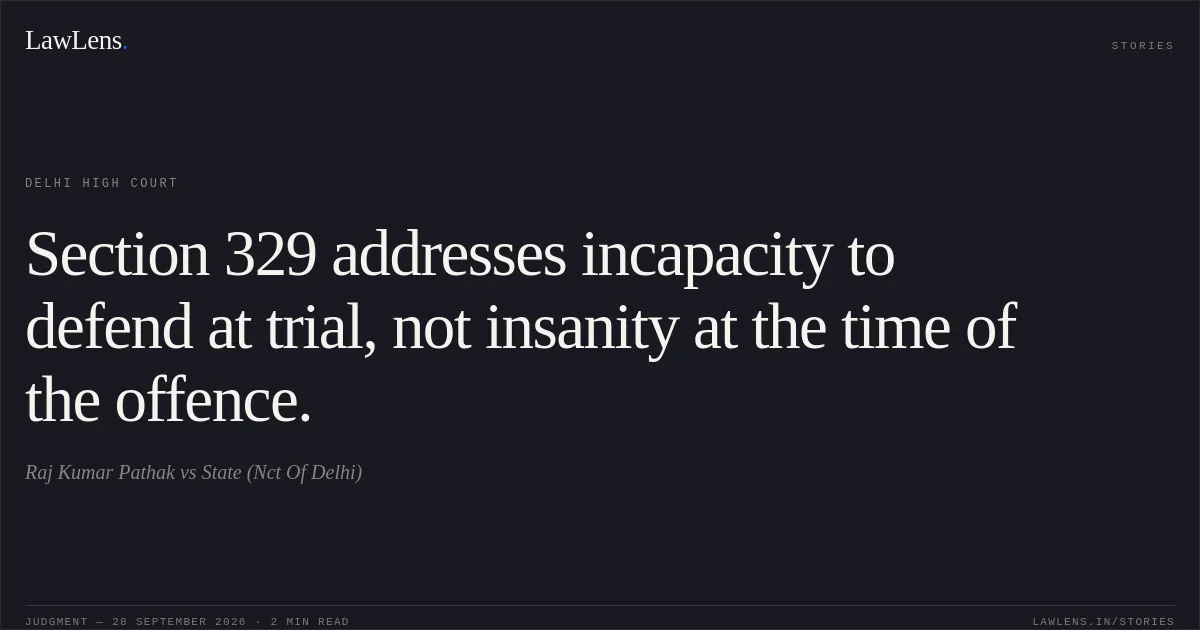
Section 84 IPC concerns whether, at the time of the act, unsoundness of mind rendered the accused incapable of knowing the nature of the act or that it was wrong or contrary to law. Section 329 CrPC concerns unsoundness of mind during trial that makes the accused incapable of making or entering a defence.
Source reference: para. 9–11As explained in Inderjit Singh v. Central Bureau of Investigation, 2024 SCC OnLine Del 2931, Sections 329(1) and 329(2) operate at different stages, and the latter applies after the prosecution evidence has closed and the defence stage has been reached.
Source reference: para. 9–11The stage at which an application is made does not, by itself, make it untenable; however, an assertion of unsoundness alone does not require a medical-board inquiry—the circumstances must provide a sufficient basis to inquire into unsoundness and consequent incapacity.
Source reference: para. 12Kamal Bhardwaj v. State, 2016 SCC OnLine Del 4315, supports referral for psychiatric opinion where prima facie material indicates mental impairment.
Source reference: para. 15Reasoning
The Court held that the petitioner’s application was not barred merely because it was filed after the prosecution evidence had concluded. However, its principal focus on the petitioner’s mental capacity at the time of the alleged offence concerned Section 84 IPC, rather than the trial-stage incapacity addressed by Section 329 CrPC.
Source reference: para. 8–12The documents were created after the offence and did not indicate that the petitioner suffered from unsoundness of mind; the Sessions Court’s interaction with him likewise disclosed no such condition.
Source reference: para. 13–14Accordingly, the prima facie material contemplated in Kamal Bhardwaj was absent.
Source reference: para. 15Holding
The Court declined to interfere with the Sessions Court’s order and dismissed the petition. It held that the application’s timing did not itself defeat maintainability, but the material presented did not warrant constitution of a Medical Board under Section 329 CrPC.
Acts & Sections Cited
7 provisions across 5 statutes referred to in this judgment. Each provision opens on LawLens.
Bharatiya Nagarik Suraksha Sanhita, 20231
Code of Criminal Procedure, 19733
Indian Penal Code, 18601
Bharatiya Sakshya Adhiniyam, 20231
Mental Healthcare Act, 20171
Original Court PDF
Raj Kumar PathakvsState (Nct Of Delhi)
Click to open original judgment
Original judgment, available to read, download and summarize on LawLens.in