Facts
The dispute concerns Block Nos. 539 and 570 in Village Thori-Mubarak, Ahmedabad.
Source reference: p. 3The land was originally cultivated by the joint family of Trikam Rupa, and following his death, his sons Ribha, Mala, and Lakha Trikam (and grandson Ganda Vala) were recorded in heirship entry No. 1129 in 1948.
Source reference: p. 4-5Although Ribha and Lakha were both listed as ordinary tenants in 1959 (Entry No. 1370), proceedings under Section 32G of the Bombay Tenancy and Agricultural Lands Act ("the Act") were conducted only in Lakha Trikam’s name, resulting in a Section 32M certificate of purchase being issued solely to him.
Source reference: p. 10, 16In 1990, the Mamlatdar initiated proceedings under Section 84C of the Act, initially withdrawing the notice by declaring Lakha’s heirs as sole tenants.
Source reference: p. 3Ultimately, on 04.08.1995, the Mamlatdar & ALT held that all brothers had equal shares and were joint occupiers/cultivators, ordering their names be inserted into the revenue record, which was upheld by the Deputy Collector (1996) and the Gujarat Revenue Tribunal (2011).
Source reference: p. 5-6Issues
1. Whether the Mamlatdar & ALT exceeded jurisdiction under Section 84C of the Act by determining the shares of family members instead of strictly inquiring into invalid land transfers.
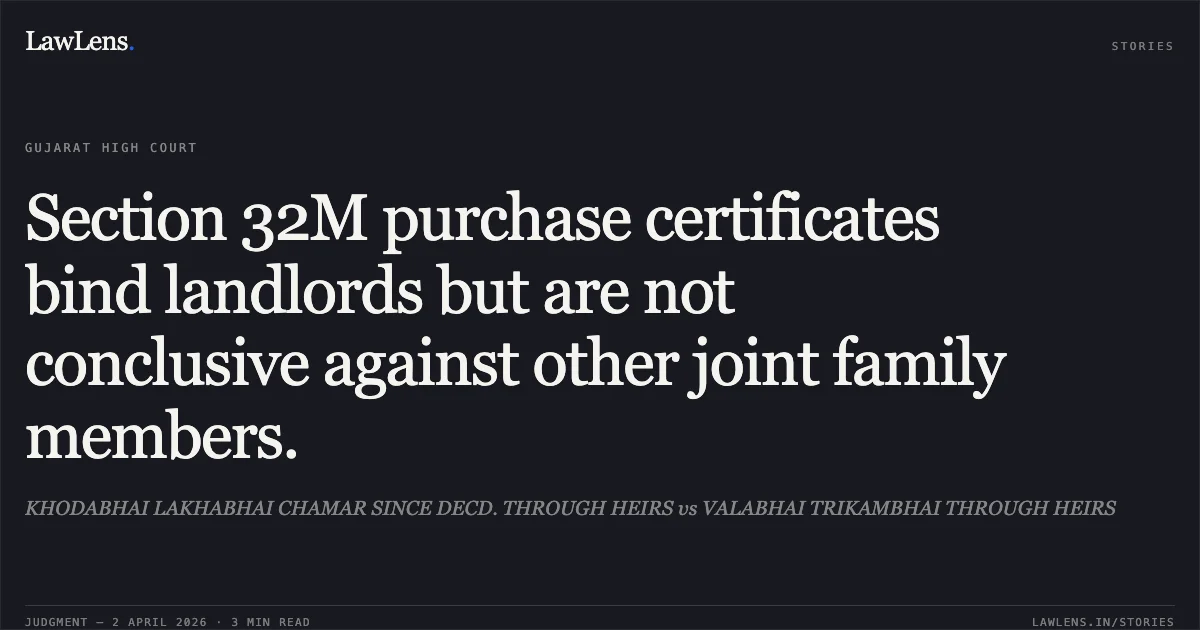
Source reference: p. 8 / para. 42. Whether a certificate of purchase issued under Section 32M in the name of the Karta or an elderly member of a joint family is conclusive evidence of sole tenancy against other family members.
Source reference: p. 10 / para. 7, p. 17 / para. 113. Whether the initiation of suo motu proceedings 33 years after the deemed purchase was barred by the principle of reasonable time.
Source reference: p. 9 / para. 5Law Applied
Bombay Tenancy and Agricultural Lands Act, specifically Section 32M (conclusiveness of purchase certificates), Section 70(b) (Mamlatdar’s power to determine tenancy), and Section 84C (inquiry into invalid transactions).
Source reference: p. 2, 22, 33-34The precedent Shankerbhai Kanjibhai v. Dagadubhai Govindbhai (1991), which established that a Section 32M certificate issued to a Karta is for the benefit of the joint family and is conclusive only against the landlord, not against co-sharers.
Source reference: p. 17, 32Government Resolution dated 15.03.1996, which mandates protecting the interest of all heirs when land is mutated only in the name of an elder brother.
Source reference: p. 18, 40The principles from State of Gujarat v. Patil Raghav Natha (1969) regarding the exercise of powers within a "reasonable time".
Source reference: p. 9Reasoning
The Court reasoned that under Section 70(b), the Mamlatdar has exclusive jurisdiction to decide whether a person is a tenant, including whether multiple persons are joint tenants.
Source reference: para. 18, 20Applying Shankerbhai Kanjibhai, the Court held that since the family was joint and the respondents were proved to be in possession and cultivating their shares, the Section 32M certificate in Lakha Trikam's name must be treated as being held for the benefit of the entire joint family.
Source reference: para. 11, 21The Court found the "reasonable time" argument inapplicable because the cause of action for the respondents arose only when the Mamlatdar initially attempted to exclude them by declaring Lakha the sole tenant in 1991, which they challenged promptly.
Source reference: para. 19Evidence such as Entry Nos. 1129 and 1370 supported the finding that the tenancy was joint.
Source reference: para. 9-10The Court emphasized that while revenue records reflect possession and collective tenancy, the final determination of civil rights remains with the competent Civil Court, a right explicitly reserved in the Mamlatdar's order.
Source reference: para. 17, 22Holding
The High Court dismissed the petition, upholding the concurrent findings of the lower revenue authorities.
It held that the respondents (heirs of the other brothers) are co-occupiers as the land was a joint family tenancy and the Section 32M certificate issued to Lakha Trikam did not extinguish the rights of the other joint tenants.
Source reference: para. 21The Court discharged the rule, leaving it open for parties to agitate specific civil rights and inheritance issues before a competent Civil Court.
Source reference: para. 22-23Acts & Sections Cited
6 provisions across 1 statute referred to in this judgment. Each provision opens on LawLens.
Bombay Tenancy and Agricultural Lands Act-19486
Original Court PDF
KHODABHAI LAKHABHAI CHAMAR SINCE DECD. THROUGH HEIRSvsVALABHAI TRIKAMBHAI THROUGH HEIRS
Click to open original judgment
Original judgment, available to read, download and summarize on LawLens.in