Facts
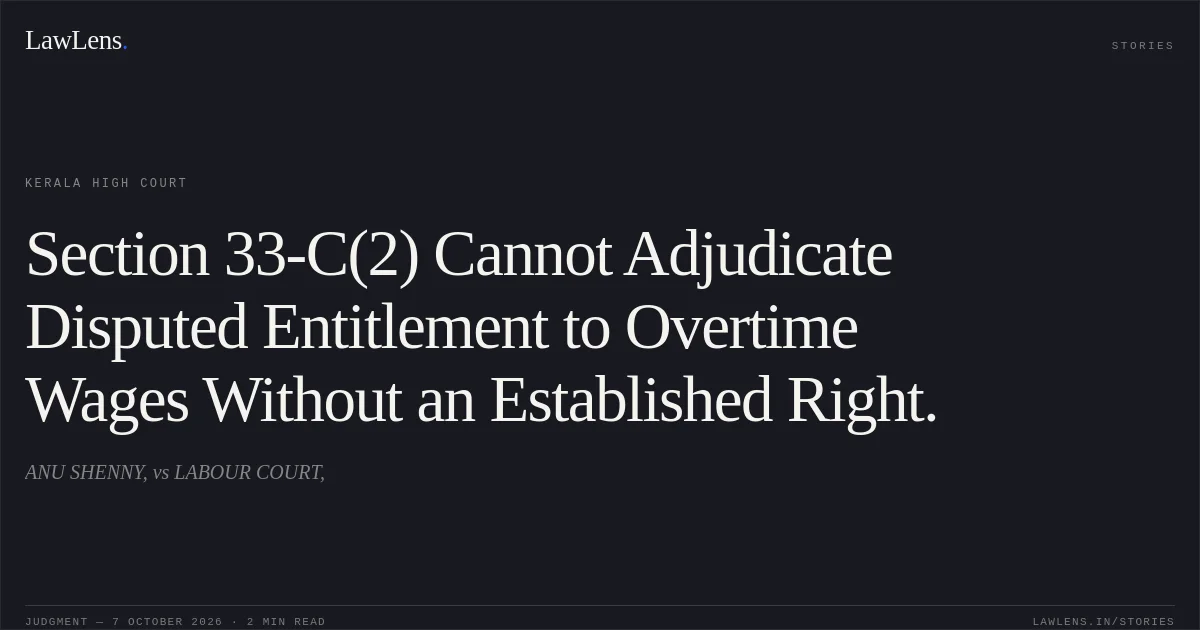
The petitioner, the management, challenged an order of the Labour Court allowing the second respondent-workman’s claim under Section 33-C(2) of the Industrial Disputes Act, 1947, for ₹3,58,782 in overtime wages, with interest upon default.
Source reference: para. 1The workman claimed that he had worked four hours of overtime per shift over a period of nearly six years.
Source reference: para. 3The management disputed that he had worked overtime.
Source reference: para. 3The Labour Court inferred from the management witness’s testimony that overtime work had been performed and allowed the claim.
Source reference: para. 7The management sought to have that order set aside on the ground that the disputed entitlement required adjudication beyond the Labour Court’s jurisdiction under Section 33-C(2).
Source reference: para. 3Issues
1. Whether a claim for overtime wages disputed by the management can be determined under Section 33-C(2) of the Industrial Disputes Act, 1947, when the claimed overtime work has not been admitted or otherwise established.
Source reference: para. 3, para. 62. Whether the Labour Court’s inference from the management witness’s testimony amounted to impermissible adjudication of disputed facts under Section 33-C(2).
Source reference: para. 7Law Applied
Section 33-C(2) of the Industrial Disputes Act, 1947, provides a mechanism for computing and enforcing an existing or established right; it does not empower the Labour Court to adjudicate a disputed entitlement requiring prior establishment of the right.
Source reference: para. 6In Municipal Corporation of Delhi v. Ganesh Razak, (1995) 1 SCC 235, the Supreme Court characterized the provision as execution-like and held that the Labour Court cannot adjudicate a disputed basis of entitlement.
Source reference: para. 3Central Bank of India Ltd. v. P.S. Rajagopalan, AIR 1964 SC 743, recognizes that an inquiry into the existence of a right may be incidental to computation; the Court distinguished such an inquiry from an adjudication essential to establish the right itself.
Source reference: para. 4, para. 6The judgment also referred to KMJ Public School v. Ance, 2020 (5) KLT 609, and D+H Solutions India Private Limited v. Jayakrishnan Ramachandran Nair, 2026 (2) KHC 51, concerning the limits of Section 33-C(2) where the underlying entitlement is disputed.
Source reference: para. 3Reasoning
The Court found that the management had not admitted that the workman performed overtime.
Source reference: para. 6Whether he had worked the claimed hours was therefore not an incidental question arising in computation; it was essential to establishing his entitlement to overtime wages.
Source reference: para. 6The workman’s pleaded claim was for work from 6 p.m. to 6 a.m., whereas the Labour Court relied on selected portions of the management witness’s testimony to infer different shift hours and overtime.
Source reference: para. 7The Court held that this selective assessment resolved disputed facts and went beyond the permissible scope of a Section 33-C(2) proceeding.
Source reference: para. 7It distinguished an incidental inquiry into the rate of wages, which may follow an admitted or established right, from an inquiry needed to establish whether overtime work occurred at all.
Source reference: para. 6Holding
The Court held that the disputed overtime entitlement could not be adjudicated in the workman’s Section 33-C(2) claim and that the Labour Court’s order was unsustainable.
It allowed the writ petition, set aside the Labour Court’s order dated 28 April 2025, and dismissed Claim Petition No. 32/2019.
Source reference: para. 8Acts & Sections Cited
2 provisions across 2 statutes referred to in this judgment. Linked provisions open on LawLens.
Industrial Disputes Act, 19471
Indian Evidence Act, 18721
Original Court PDF
ANU SHENNY,vsLABOUR COURT,
Click to open original judgment
Original judgment, available to read, download and summarize on LawLens.in