Facts
The National Highways Authority of India (NHAI) awarded the respondent an item-rate contract for short-term improvement and routine maintenance of specified sections of NH-2 in Uttar Pradesh.
Source reference: pp. 1–2The Letter of Acceptance dated 6 December 2012 and Contract Agreement dated 9 January 2013 recorded a contract value of ₹11,19,76,925, with the stipulated execution period being 25 January 2013 to 24 January 2014.
Source reference: pp. 1–2Disputes arose, following which an arbitral tribunal was constituted under the amended arbitration clause.
Source reference: pp. 2–3By award dated 13 July 2016, the Tribunal allowed claims relating to loss of profit, finance charges, final/EOT bills, security deposit and RO/HO overheads, while rejecting claims for idling charges and arbitration costs.
Source reference: pp. 2–3NHAI challenged the award under Section 34 of the Arbitration and Conciliation Act, 1996, principally in respect of loss of profit, finance charges, final/EOT bills, RO/HO overheads and interest.
Source reference: p. 3NHAI contended that the claims were waived or barred by acquiescence and estoppel, that the respondent had completed the contract, and that the Tribunal had ignored the contractual arrangement and relevant evidence.
Source reference: pp. 3–6The respondent maintained that NHAI had made available only part of the contracted work, and that the challenge impermissibly sought re-appreciation of evidence.
Source reference: pp. 7–9Issues
1. Whether the arbitral award was liable to be set aside under Section 34 of the Arbitration and Conciliation Act, 1996, on the ground that the Tribunal’s findings were perverse, patently illegal, contrary to the contract, or opposed to public policy?
Source reference: pp. 9–12, 23–252. Whether the Tribunal could award loss of profit on the unexecuted portion of the contract on the finding that NHAI failed to provide the remaining work fronts?
Source reference: pp. 15–213. Whether the Tribunal’s awards of finance charges and RO/HO overheads constituted impermissible double recovery or were unsupported by evidence?
Source reference: pp. 4–5, 8–9, 22–234. Whether the Tribunal erred in allowing the respondent’s claims for outstanding final and EOT bills despite NHAI’s alleged deductions and recoveries?
Source reference: pp. 5–6, 22–235. Whether the objections raised by NHAI required the Court to re-appreciate the evidence and substitute its own view for that of the Tribunal?
Source reference: pp. 9–14, 23–25Law Applied
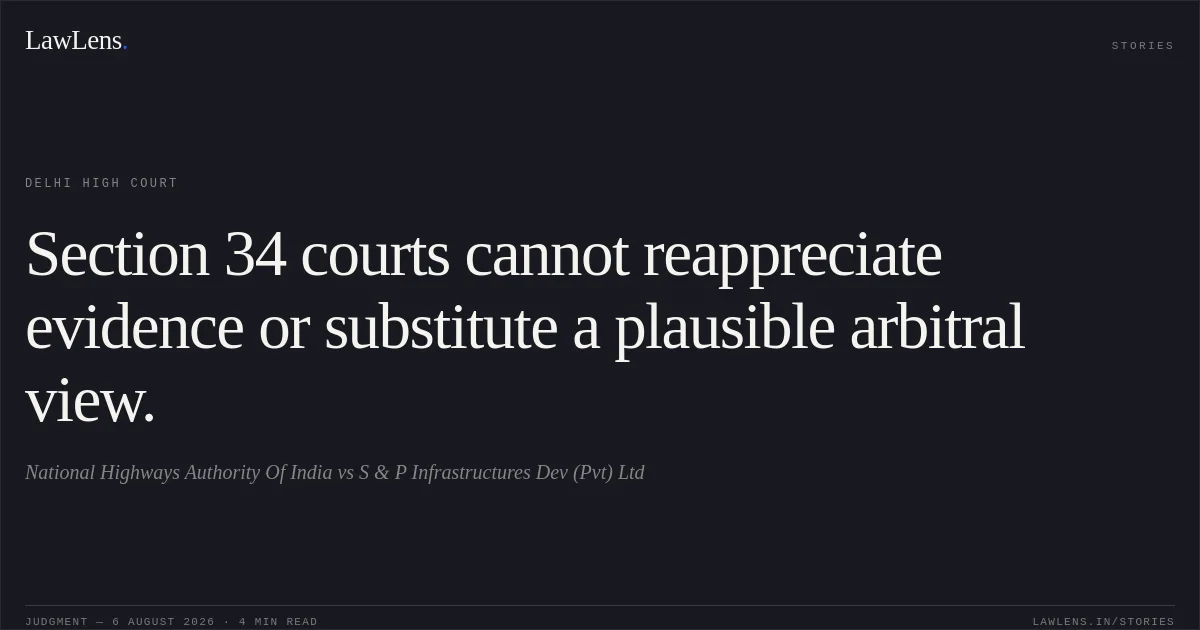
The Court applied Sections 34 and 34(2-A) of the Arbitration and Conciliation Act, 1996, holding that a Section 34 court does not sit as an appellate court and cannot re-appreciate evidence or substitute its interpretation merely because another view is possible.
Source reference: pp. 9–12Under the patent-illegality standard, interference is justified only where the award is based on no evidence, ignores vital evidence, adopts an impossible or irrational interpretation of the contract, violates the Arbitration Act or principles of natural justice, or is otherwise perverse.
Source reference: pp. 9–12Relying on Associate Builders v. Delhi Development Authority, DMRC Ltd. v. Delhi Airport Metro Express (P) Ltd., Parsa Kente Collieries Ltd. v. Rajasthan Rajya Vidyut Utpadan Nigam Ltd., Ssangyong Engineering & Construction Co. Ltd. v. NHAI, and P.R. Shah, Shares & Stock Brokers (P) Ltd. v. B.H.H. Securities (P) Ltd., the Court reiterated that the arbitral tribunal is the master of the evidence and that contractual interpretation primarily lies with the arbitrator unless the interpretation is one that no reasonable person could adopt.
Source reference: pp. 9–12, 23–25The Court also held that the Indian Evidence Act, 1872 does not strictly apply to arbitral proceedings by virtue of Sections 1 and 19 of the Arbitration and Conciliation Act, and that objections not raised before the Tribunal cannot ordinarily be introduced for the first time under Section 34.
Source reference: pp. 14–15Reasoning
The Court found that the Tribunal had reasonably concluded that the contract value was ₹11,19,76,925 and that the Evaluation Committee’s minutes were not part of the contractual documents or binding on the respondent.
Source reference: pp. 12–13, 17–20The Tribunal relied on NHAI’s office note recording that the contractor had completed the work and on the release of the performance guarantees, and found that the respondent had completed the entire work made available—valued at approximately ₹3.18 crore—but was prevented from executing the balance contractual work because NHAI did not provide the necessary work fronts.
Source reference: pp. 15–20The award of 10% loss of profit on the unexecuted balance was therefore a possible and evidence-based view, not a perverse or patently illegal conclusion.
Source reference: pp. 15–21The Court distinguished loss of profit on unexecuted contractual work from idling charges, observing that the latter required specific proof of actual idling and corresponding financial loss; consequently, rejection of idling charges did not contradict the grant of loss of profit.
Source reference: p. 21The objections to finance charges and RO/HO overheads concerned the Tribunal’s appreciation of evidence and interpretation of permissible overhead components, rather than any clear double recovery or disregard of the contract.
Source reference: pp. 22–23Similarly, the Tribunal’s determination of entitlement to final and EOT bills involved disputed deductions and recoveries within its fact-finding jurisdiction.
Source reference: pp. 22–23Since NHAI’s objections essentially invited a re-evaluation of evidence and merits, none established a statutory ground for interference under Section 34.
Source reference: pp. 23–25Holding
The Court held that the impugned award was reasoned, based on a plausible appreciation of the evidence, and did not suffer from patent illegality, perversity, conflict with public policy, or any other ground under Section 34 of the Arbitration and Conciliation Act, 1996.
NHAI’s petition challenging the awards of loss of profit, finance charges, final/EOT bills, RO/HO overheads and interest was accordingly dismissed.
Source reference: p. 26No order as to costs was made, and the pending applications were disposed of.
Source reference: p. 26Acts & Sections Cited
7 provisions across 3 statutes referred to in this judgment. Each provision opens on LawLens.
Arbitration and Conciliation Act, 19964
National Highways Authority of India Act, 19881
Indian Contract Act, 18722
Original Court PDF
National Highways Authority Of IndiavsS & P Infrastructures Dev (Pvt) Ltd
Click to open original judgment
Original judgment, available to read, download and summarize on LawLens.in