Facts
The dispute arose from Agreement No. 01/EE/PWD F-121/08-09 dated 9 April 2008, under which Afcons Infrastructure Limited was engaged by the PWD, Union of India, for construction works at Ghazipur Crossing, Delhi.
Source reference: paras. 2–6The stipulated completion period was 24 months, ending on 30 April 2010; the works were ultimately completed on 14 May 2012 after seven extensions of time, granted without levy of compensation or liquidated damages.
Source reference: paras. 2–6Afcons attributed the delay to non-availability of hindrance-free work fronts, utility shifting and delayed drawings, whereas the Union attributed it to inadequate mobilisation, deficient resources and other defaults by Afcons.
Source reference: para. 5The sole arbitrator awarded Afcons Rs. 8,85,89,316, including Rs. 6,59,64,546 under Claim Nos. 1–5 for additional expenditure during prolongation, Rs. 1,50,28,399 under Claim No. 8 for reduced rates applied to deviated quantities, and amounts under Claim No. 10 for two extra items, namely EI-II/1 and EI-II/2.
Source reference: paras. 9, 13, 16 and 18The Union challenged the award under Section 34 of the Arbitration and Conciliation Act, 1996, principally concerning Claim Nos. 1–5, Claim No. 8, the amounts awarded for EI-II/1 and EI-II/2 under Claim No. 10, and the rejection of Counter-Claim No. 2.
Source reference: paras. 10–11Issues
Whether the arbitrator’s finding that Afcons was entitled to compensation for additional expenditure arising from prolongation of the contract, notwithstanding Special Condition 3.52 barring claims for idle establishment, labour, machinery and equipment, disclosed patent illegality or perversity under Section 34?
Source reference: paras. 60–77Whether the quantification of Rs. 6,59,64,546 under Claim Nos. 1–5, based on a percentage-based overhead methodology, was unsupported by evidence or contrary to the contractual provisions concerning overheads and profits?
Source reference: paras. 78–103Whether the arbitrator erred in awarding Rs. 1,50,28,399 under Claim No. 8 after holding that prior notice under Clause 12.3 was required before applying reduced market rates to deviated quantities, and in rejecting the Union’s audit-based defence under Clause 29(ii)?
Source reference: paras. 104–115Whether the subsequent reduction of the rates for EI-II/1 and EI-II/2 under Claim No. 10, pursuant to an audit objection, entitled the Union to avoid the rates earlier determined and communicated under the contractual rate-analysis mechanism?
Source reference: paras. 116–127Whether the rejection of Counter-Claim No. 2, seeking recovery of alleged excess payment for bituminous mastic at Rs. 597.30 per square metre instead of Rs. 553.07, was liable to be set aside?
Source reference: paras. 128–140Law Applied
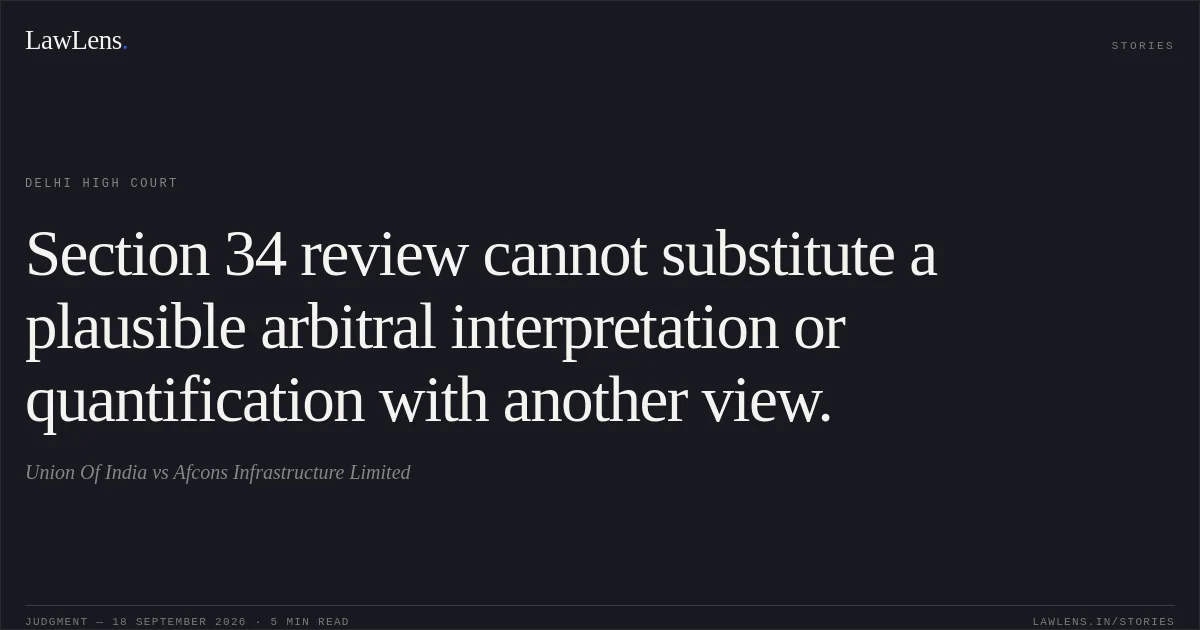
The Court applied Section 34 of the Arbitration and Conciliation Act, 1996, including Section 34(2A), under which a domestic award may be set aside for patent illegality apparent on its face, but not merely because of an erroneous application of law or reappreciation of evidence.
Source reference: paras. 46–50Section 28(3), requiring the arbitrator to decide in accordance with the contractual terms, was also relevant.
Source reference: no citationThe Court relied on Ssangyong Engineering & Construction Co. Ltd. v. NHAI, Dyna Technologies (P) Ltd. v. Crompton Greaves Ltd., and MMTC Ltd. v. Vedanta Ltd. for the principle that contractual interpretation and factual findings lie primarily within the arbitrator’s domain, subject to review where the award is irrational, unsupported by evidence or contrary to an express contractual prohibition.
Source reference: para. 49It further relied on Associate Builders v. DDA, McDermott International Inc. v. Burn Standard Co. Ltd., and Ramesh Kumar Jain v. Bharat Aluminium Company Ltd. for the limited scope of Section 34 review and the permissible use of formula-based methods for quantifying damages where there is an evidentiary foundation.
Source reference: paras. 51–56Unibros v. All India Radio, NHPC Ltd. v. Hindustan Construction Co. Ltd., Pragati Construction Consultants, and Ferro Concrete Construction were distinguished as cases involving absence of evidence or impermissible substitution of a formula for proof of loss.
Source reference: paras. 52–54 and 95–98Reasoning
The Court held that the arbitrator had considered the Union’s case on Afcons’ alleged defaults, the EOT material, the FOB-related delays and Special Condition 3.52, but found that the Union had not quantified any specific period attributable to Afcons.
Source reference: paras. 62–76Treating the claim as one for additional expenditure incurred while continuing performance, rather than a claim for idle resources, was a possible contractual interpretation and did not constitute patent illegality.
Source reference: paras. 68–77The quantification under Claim Nos. 1–5 was supported by Afcons’ revised computation, alternative percentage-based calculation, expenditure material, the 13.5-month limitation and a further 10% mitigation reduction; the Court therefore declined to substitute the Union’s proposed calculation.
Source reference: paras. 79–101For Claim No. 8, the arbitrator reasonably construed Clause 12.3 as requiring prior notice before determination of a lower rate and considered the Union’s own contemporaneous letter defending the original rate methodology under Clause 29(ii).
Source reference: paras. 108–114In relation to Claim No. 10, the rates for EI-II/1 and EI-II/2 had been determined by the Union, communicated to and accepted by Afcons before being reopened after audit; the arbitrator’s conclusion that a subsequent audit disagreement did not automatically establish recoverable overpayment was a permissible interpretation of Clauses 2(x), 2(xi) and 29(ii).
Source reference: paras. 117–126Finally, Counter-Claim No. 2 was correctly rejected because the arbitrator had already examined and upheld Rs. 597.30 per square metre as the proper rate while deciding Claim No. 9; challenging that conclusion would require impermissible reappreciation of the rate analysis.
Source reference: paras. 130–139Holding
The Court answered all issues against the Union.
It held that none of the challenged findings suffered from patent illegality, perversity, absence of evidence or an impossible contractual interpretation under Section 34.
Source reference: paras. 141–144The challenge to the award of Rs. 6,59,64,546 under Claim Nos. 1–5, Rs. 1,50,28,399 under Claim No. 8, Rs. 15,05,296 under Claim No. 10 for EI-II/1 and EI-II/2, and the rejection of Counter-Claim No. 2 was dismissed.
Source reference: paras. 145–146The arbitral award dated 22 May 2017, as corrected on 9 June 2017, remained undisturbed to that extent; pending applications were disposed of and there was no order as to costs.
Source reference: paras. 147–148Acts & Sections Cited
7 provisions across 1 statute referred to in this judgment. Each provision opens on LawLens.
Arbitration and Conciliation Act, 19967
Original Court PDF
Union Of IndiavsAfcons Infrastructure Limited
Click to open original judgment
Original judgment, available to read, download and summarize on LawLens.in