Facts
The petitioners (AIIMS Jodhpur) removed the respondent, a Nursing Officer, from service on 23.03.2023 following disciplinary proceedings.
Source reference: para. 2The respondent challenged this termination before the Industrial Disputes Tribunal and Labour Court, Jodhpur, under Section 33-A of the Industrial Disputes Act, 1947.
Source reference: para. 3During the proceedings, the respondent moved an application under Section 36 of the Act to restrain AIIMS from being represented by a legal practitioner.
Source reference: para. 3On 16.05.2024, the Tribunal allowed the application, despite the fact that the respondent was himself being represented by an enrolled advocate (Mr. Bhagirath Chandora) acting in the capacity of a trade union office bearer.
Source reference: para. 4-5, 14AIIMS filed the present writ petition challenging the Tribunal's restraining order.
Source reference: para. 1Issues
1. Whether Section 36 of the Industrial Disputes Act, 1947, imposes an absolute bar on representation by legal practitioners before the Labour Court/Tribunal.
Source reference: para. 122. Whether the Tribunal was justified in denying legal representation to the employer when the workman was effectively receiving legal assistance through a trained advocate acting as a union official.
Source reference: para. 12, 18Law Applied
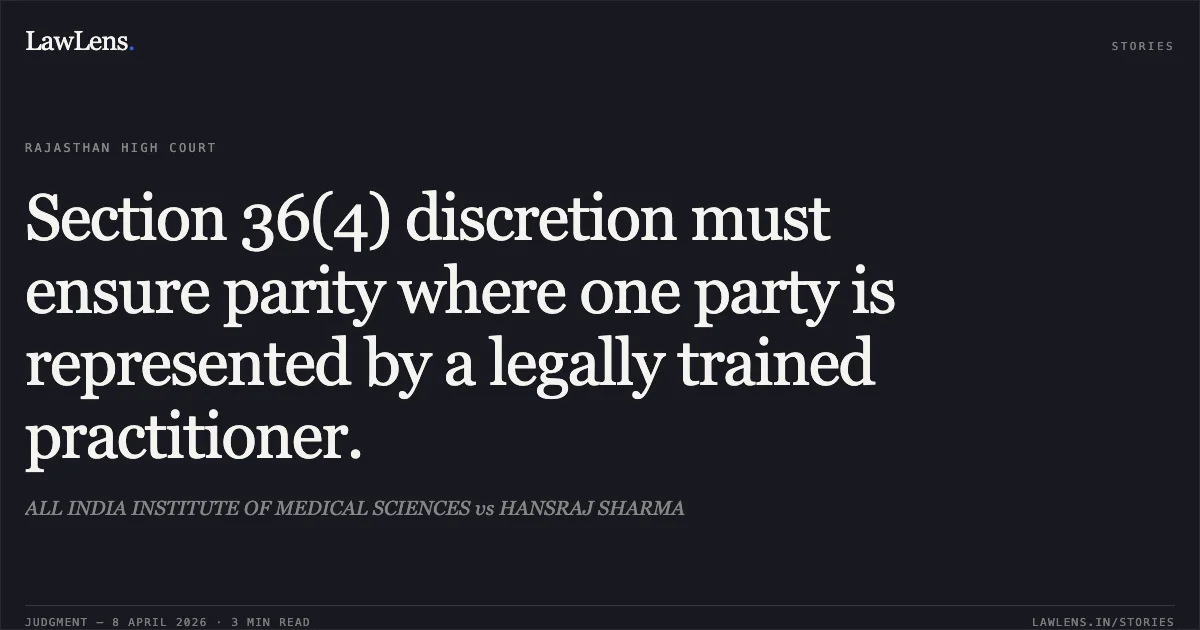
The court primarily applied Section 36 of the Industrial Disputes Act, 1947, noting that Section 36(4) permits representation by a legal practitioner with the consent of the opposite party and the leave of the Tribunal.
Source reference: para. 11, 13The court relied on the principle of parity and natural justice, citing the Bombay High Court in T.K. Varghese v. Nichimen Corporation, which held that discretion under Section 36 must ensure fairness between parties.
Source reference: para. 20It further applied the rationale from The Registrar, Anna University v. The Presiding Officer (Madras High Court) and G.M., IB Valley Area v. Central Govt. Industrial Tribunal (Orissa High Court), asserting that denying an employer counsel when the workman is assisted by a legally trained person violates Article 14 of the Constitution and creates manifest inequality.
Source reference: para. 20-21Reasoning
The court reasoned that Section 36(4) does not create an absolute prohibition but confers judicial discretion upon the Tribunal, which must be exercised based on sound principles rather than mechanically.
Source reference: para. 13, 16The court observed that the respondent’s representative, though labeled a union office bearer, was an active legal practitioner; thus, his professional status remained that of a legal expert providing technical assistance.
Source reference: para. 14The court held that allowing one party to benefit from legal expertise while denying it to the other results in "one-sided" adjudication and violates the principle of parity embedded in the concept of fairness.
Source reference: para. 15, 19The court distinguished precedents like Paradip Port Trust and Thyssen Krupp Industries, noting they did not address scenarios where the objecting party was itself already represented by a legal practitioner under a different guise.
Source reference: para. 18-19Holding
The Court concluded that the Tribunal failed to exercise its discretion judiciously, resulting in a denial of a fair opportunity to the petitioners.
The Court held that the statutory restriction under Section 36 cannot be used to permit one party to enjoy legal assistance while denying it to the other, especially when the objector is also utilizing a lawyer.
Source reference: para. 19The High Court quashed the Tribunal’s order dated 16.05.2024 and permitted AIIMS to be represented by Mr. K.S. Yadav or any other advocate of their choice.
Source reference: para. 23Acts & Sections Cited
2 provisions across 1 statute referred to in this judgment. Linked provisions open on LawLens.
Industrial Disputes Act, 19472
Original Court PDF
ALL INDIA INSTITUTE OF MEDICAL SCIENCESvsHANSRAJ SHARMA
Click to open original judgment
Original judgment, available to read, download and summarize on LawLens.in