Facts
The Appellant and Respondent entered into a General Agreement dated 16 December 2022 for jointly developing and operating a restaurant at Lodhi Colony, Delhi. The Appellant was responsible for interiors, equipment, kitchen operations and raw materials, while the Respondent was responsible for sales, billing, licences and receipt of an agreed monthly amount.
Source reference: p.2, para. 2(a)–(b)The Appellant claimed to have invested approximately ₹5 crore in the premises and paid a refundable security/performance deposit of ₹22 lakh under Clause 3.19 of the Agreement.
Source reference: p.2, para. 2(a)–(b)In February–March 2026, disputes arose concerning an alleged escalation of payment terms, the Respondent’s locking of the first floor, blocking of the restaurant’s bank account and alleged interference with business operations. The Respondent subsequently terminated the Agreement on 10 April 2026 and locked the Appellant out of the premises, leaving certain equipment at the site.
Source reference: pp.2–4, para. 2(c)–(i)In proceedings under Section 9 of the Arbitration and Conciliation Act, 1996 (“Arbitration Act”), the High Court appointed a Local Commissioner to prepare an inventory and appointed a Sole Arbitrator under Section 17 of the Arbitration Act.
Source reference: pp.4–5, para. 2(i)–(m)By order dated 18 June 2026, the Arbitral Tribunal restrained the Respondent from selling, transferring, alienating, creating third-party rights in, dismantling or materially altering the items recorded in the Local Commissioner’s inventory, but declined to order their removal or immediate refund of the ₹22 lakh deposit. The Appellant challenged that order under Section 37(2)(b) of the Arbitration Act.
Source reference: p.8, para. 2(s); p.1, para. 1Issues
Whether the High Court, exercising appellate jurisdiction under Section 37(2)(b) of the Arbitration Act, should interfere with the Arbitral Tribunal’s discretionary refusal to permit removal of the disputed equipment at the interim stage
Source reference: pp.13–20, paras. 12–15, 17–20Whether the Appellant had established a sufficient prima facie ownership or contractual entitlement to remove the equipment on the basis of invoices and the fact that the articles were physically movable
Source reference: pp.20–22, paras. 13–16Whether the Appellant was entitled to immediate refund or protection of the ₹22 lakh security/performance deposit under Clause 3.19 of the Agreement, notwithstanding the pending disputes concerning termination and settlement of accounts
Source reference: pp.23–24, paras. 21–22Law Applied
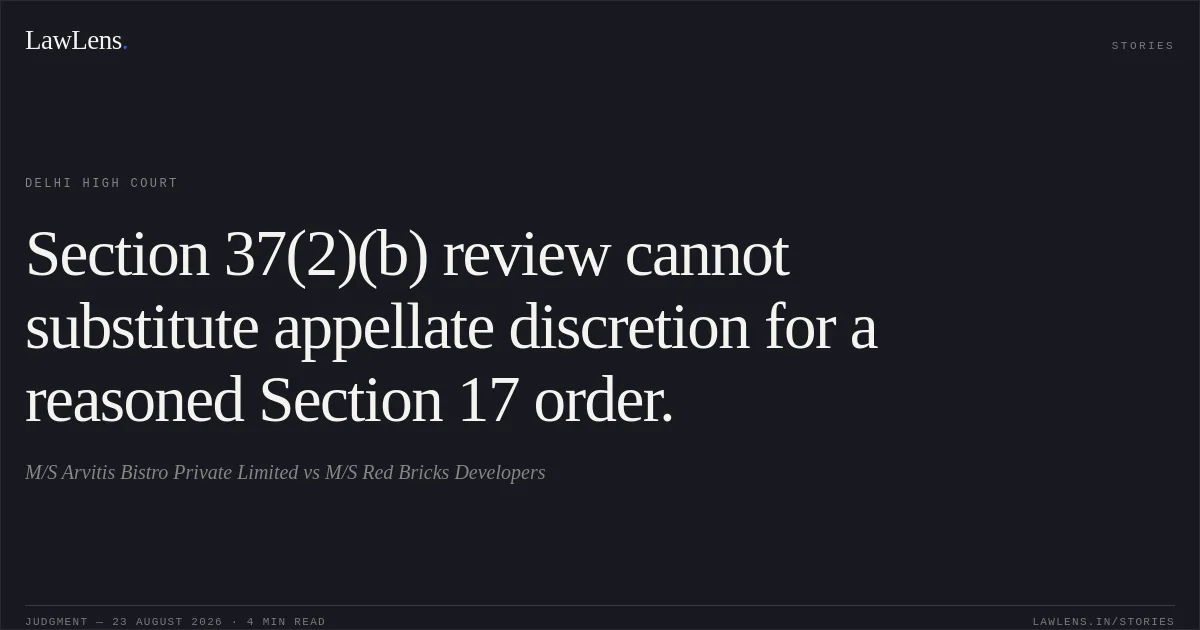
Section 37(2)(b) of the Arbitration Act permits an appeal against an order granting or refusing an interim measure under Section 17, but the appellate court must exercise that jurisdiction with restraint and should not substitute its view merely because another view is possible.
Source reference: pp.13–17, para. 12Section 5 of the Arbitration Act embodies the legislative policy of minimal judicial intervention in arbitral proceedings.
Source reference: pp.15–17, para. 12Under Section 17(1), an arbitral tribunal has powers analogous to those of a court to grant interim measures, including preservation, custody and protection of property, securing amounts in dispute and granting injunctions.
Source reference: pp.17–19, para. 12The principles governing interim protection under Sections 9 and 17 are informed by the ordinary principles applicable to interim injunctions, as recognised in Arvind Constructions Co. (P) Ltd. v. Kalinga Mining Corporation and Adhunik Steels Ltd. v. Orissa Manganese and Minerals (P) Ltd.
Source reference: pp.19–20, para. 12Relying on Dinesh Gupta v. Anand Gupta , the Court held that interference under Section 37(2)(b), particularly with discretionary interim orders, is warranted only where the tribunal’s decision is based on no material, is perverse, arbitrary or manifestly unreasonable.
Source reference: pp.13–18, para. 12Reasoning
The Court held that the dispute was not resolved merely by determining whether coffee machines, refrigerators, wine chillers and similar articles were physically movable. Under Clause 3 of the Agreement, the relevant questions were whether the specific articles had been brought into the premises by the Appellant and whether the Agreement entitled the Appellant to remove them.
Source reference: pp.20–21, paras. 13–14Although the Appellant relied on GST-compliant invoices, the Respondent disputed whether those invoices corresponded to the equipment found at the premises and referred to discrepancies and the Appellant’s other restaurant operation. The Court therefore found that ownership, identification of the equipment and contractual entitlement required fuller evidentiary examination.
Source reference: p.21, para. 15Since removal would be a mandatory and potentially irreversible form of relief that would alter the existing position, the Tribunal was justified in preserving the equipment rather than releasing it to the Appellant merely on the basis of invoices or an indemnity offer.
Source reference: pp.21–23, paras. 16–19The earlier High Court direction to consider ownership expeditiously did not require the Tribunal to decide the issue in the Appellant’s favour or without evidence.
Source reference: p.23, para. 20As to the security deposit, Clause 3.19 referred both to premature termination and settlement of accounts. Because the parties’ respective claims and liabilities arising from termination remained disputed, immediate payment would have granted substantial monetary relief before final adjudication; financial hardship could not independently establish entitlement to such interim payment.
Source reference: pp.23–24, paras. 21–22Holding
The High Court held that the Arbitral Tribunal had neither acted perversely nor exercised its discretion unreasonably in preserving the disputed equipment and declining to order its removal or the immediate refund of the ₹22 lakh deposit.
The appeal under Section 37(2)(b) was dismissed, along with the pending applications.
Source reference: p.25, paras. 27–28The Court clarified that it had expressed no final opinion on ownership or entitlement to the equipment, the validity or consequences of termination, or the Appellant’s entitlement to the security deposit; those issues remained open for determination by the Arbitral Tribunal in accordance with law.
Source reference: p.25, para. 29Acts & Sections Cited
7 provisions across 2 statutes referred to in this judgment. Each provision opens on LawLens.
Arbitration and Conciliation Act, 19966
Indian Partnership Act, 19321
Original Court PDF
M/S Arvitis Bistro Private LimitedvsM/S Red Bricks Developers
Click to open original judgment
Original judgment, available to read, download and summarize on LawLens.in