Facts
Hariom Projects Pvt. Ltd. was awarded a contract by the Union of India for providing administrative and training infrastructure at NDA Khadakwasla. Disputes arose concerning payment adjustments, escalation calculations, design issues, and workmanship. A Dispute Resolution Board rejected the respondent’s claims, following which the respondent invoked arbitration and sought appointment of an arbitrator
Source reference: para. 3.1–3.2The respondent filed an application under Section 9 of the Arbitration and Conciliation Act, 1996, seeking interim protection, including an injunction against cancellation or termination of the contract. The District Judge dismissed the application on 15 October 2025, and the respondent filed an appeal under Section 37 of the Act before the High Court
Source reference: para. 3.3–3.4During the pendency of the Section 37 appeal, the Union terminated the work order. The High Court stayed the termination and subsequently appointed Maj. Gen. R.K. Mattu as the sole arbitrator with the consent of the parties. It directed that the existing status quo continue temporarily and remitted the proceedings pending before it to the Arbitral Tribunal to be treated as an application under Section 17 of the Act
Source reference: paras. 3.4, 4, 8The Union challenged only the direction converting or remitting the Section 37 appellate proceedings into Section 17 proceedings; it did not challenge the appointment of the arbitrator
Source reference: para. 5.1During the pendency of the appeal before the Supreme Court, the Tribunal proceeded with the matter and the parties entered into a Supplementary Agreement dated 24 April 2026
Source reference: paras. 6, 12Issues
Whether the High Court, while exercising statutory appellate jurisdiction under Section 37(1)(b) of the Arbitration and Conciliation Act, 1996 against rejection of an application under Section 9, could—by consent of the parties—remit the appellate proceedings to a subsequently constituted Arbitral Tribunal and direct the Tribunal to treat them as an application under Section 17 of the Act?
Source reference: para. 2Whether proceedings under Section 37, arising from an order under Section 9, could be treated as proceedings under Section 17 before the Arbitral Tribunal merely because the Tribunal had subsequently been constituted?
Source reference: paras. 9–10Law Applied
The Court applied the statutory scheme of Sections 9, 17 and 37 of the Arbitration and Conciliation Act, 1996. Section 9 empowers a Court to grant interim measures; Section 17 empowers the Arbitral Tribunal to grant interim measures after its constitution; and Section 37(1)(b) provides a statutory appeal to the competent Court against an order granting or refusing relief under Section 9.
Source reference: para. 9The appellate jurisdiction under Section 37 is vested exclusively in the “Court” as defined in Section 2(1)(e), whereas an Arbitral Tribunal exercising power under Section 17 does not possess appellate or supervisory jurisdiction over a judicial order passed under Section 9. These distinct statutory powers cannot be interchanged or transferred merely by consent of the parties or by remitting the appellate proceedings to the Tribunal
Source reference: para. 9Upon constitution of the Tribunal, a party may independently approach it under Section 17 for appropriate interim measures, subject to the subsequent facts and reliefs sought
Source reference: para. 10Reasoning
The Section 37 proceedings before the High Court were a statutory appeal against the District Judge’s refusal to grant relief under Section 9. Their determination therefore required the exercise of appellate jurisdiction vested in the Court, not the exercise of the Tribunal’s original power to grant interim measures under Section 17
Source reference: para. 9The Tribunal could not, by virtue of its subsequent constitution or the parties’ consent, examine the subject matter of the pending statutory appeal or reconsider the order passed by the competent Court under Section 9. The High Court could, at most, have granted the respondent liberty to file an independent Section 17 application before the Tribunal
Source reference: para. 10Further, the specific relief seeking restraint against termination had been overtaken by the Union’s termination of the contract on 3 January 2026; any consequential protection had to be considered in light of that subsequent event and the relief then specifically sought
Source reference: para. 10Since the Tribunal had already commenced proceedings and the parties had entered into a Supplementary Agreement, the Supreme Court preserved the Tribunal’s constitution and allowed the parties to raise all legally permissible contentions before it
Source reference: para. 12Holding
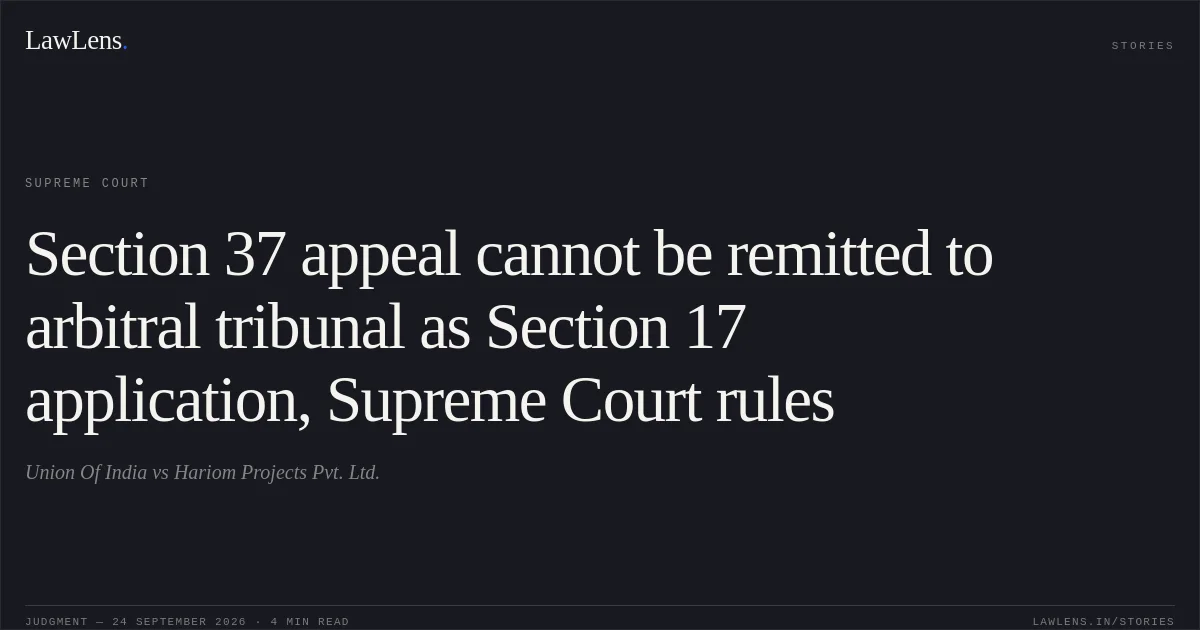
The Supreme Court held that the High Court could not remit proceedings pending under Section 37 to the Arbitral Tribunal and direct that they be treated as an application under Section 17. The appellate jurisdiction under Section 37 and the Tribunal’s interim-measures jurisdiction under Section 17 are distinct and cannot be converted into one another, even with the parties’ consent
The impugned order was set aside to that limited extent. However, because the Tribunal had already been constituted, had proceeded with the disputes, and the parties had entered into a Supplementary Agreement, the Tribunal’s constitution was left undisturbed. The parties were granted liberty to raise all contentions permissible in law before the Tribunal, and the appeal was disposed of accordingly
Source reference: paras. 11–13Acts & Sections Cited
5 provisions across 1 statute referred to in this judgment. Each provision opens on LawLens.
Arbitration and Conciliation Act, 19965
Original Court PDF
Union Of IndiavsHariom Projects Pvt. Ltd.
Click to open original judgment
Original judgment, available to read, download and summarize on LawLens.in