Facts
The Delhi Jal Board (“DJB”) awarded Digvijay Sanitations a contract for laying and jointing internal sewer lines in several Naveen Shahdara colonies for a contract value of ₹75,42,803, with the work scheduled to commence on 1 November 2001 and be completed by 30 January 2003.
Source reference: p.2The work was completed on 26 December 2003 after a delay of approximately eleven months, during which disputes arose concerning departmental hindrances, non-availability of sites, delayed payments, deductions, prolongation losses and escalation in prices.
Source reference: p.2The respondent invoked arbitration on 7 April 2008.
Source reference: p.2The sole arbitrator rejected certain claims but awarded amounts towards refund of deductions, prolongation expenses, escalation damages, interest on delayed payment of the final bill and security deposit, pendente lite and future interest, and arbitration costs.
Source reference: pp.2–4DJB’s objections under Section 34 of the Arbitration and Conciliation Act, 1996 were dismissed by the Additional District Judge on 19 January 2019.
Source reference: p.1DJB consequently preferred the present appeal under Section 37 of the Arbitration Act.
Source reference: p.1Issues
1. Whether the arbitrator’s findings attributing the delay to DJB were perverse or contrary to the contractual exclusionary provisions contained in Clause 24 of the General Conditions and Special Condition No. 1?
Source reference: pp.8–102. Whether the award of ₹33,354 towards refund of deductions for non-testing of pipe joints was contrary to Special Conditions Nos. 13 and 43 requiring hydraulic testing?
Source reference: p.103. Whether compensation for prolongation expenses and tools and plant charges was unsupported by evidence or impermissibly quantified?
Source reference: pp.10–114. Whether escalation damages could be awarded under Section 73 of the Indian Contract Act, 1872 by using the Clause 10CC formula when Clause 10CC was not incorporated into the contract?
Source reference: pp.11–125. Whether the arbitrator could award interest on delayed payment of the final bill, security deposit, and the awarded amounts under Section 31(7) of the Arbitration Act?
Source reference: pp.12–136. Whether the award and the judgment dismissing the Section 34 objections disclosed patent illegality, perversity, or any other ground warranting interference under Section 37?
Source reference: pp.6–8, 13Law Applied
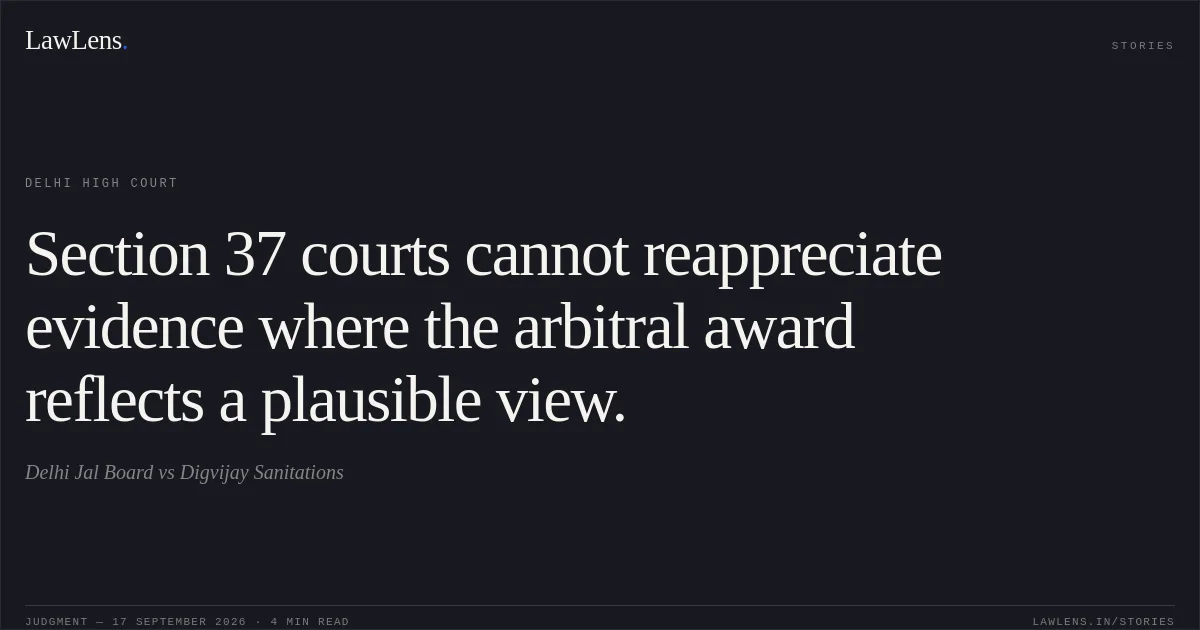
The Court held that the scope of interference under Section 37 is narrower than an appellate review on merits and cannot travel beyond the limitations prescribed by Section 34 of the Arbitration Act; the Court must not independently reassess evidence or substitute its view for a plausible arbitral interpretation, as stated in MMTC Ltd. v. Vedanta Ltd., (2019) 4 SCC 163.
Source reference: p.7An award may be interfered with only on recognised grounds such as contravention of the fundamental policy of Indian law, basic notions of justice or morality, or patent illegality, as reiterated in Haryana Tourism Ltd. v. Kandhari Beverages Ltd., (2022) 3 SCC 237.
Source reference: pp.7–8Under Section 73 of the Indian Contract Act, damages may be awarded for loss caused by contractual breach, and the Clause 10CC formula may be used as an objective method for computing escalation damages even when Clause 10CC is not contractually incorporated, following DDA v. Swastic Construction Co., 2021:DHC:2708, affirmed in 2021:DHC:4409-DB.
Source reference: pp.11–12Section 31(7) of the Arbitration Act confers discretion on the arbitral tribunal to award interest in the absence of an express contractual prohibition.
Source reference: p.13Reasoning
The Court found that the arbitrator’s attribution of delay to DJB was based on contemporaneous records, particularly the Hindrance Register maintained by DJB itself, which recognised 312 days of delay as justified by departmental hindrances.
Source reference: pp.8–9The recorded obstacles included delayed road-cutting permission, municipal elections, festivals and public resistance, encroachments, and delayed shifting of existing water lines.
Source reference: p.8The contractual clauses concerning phased or progressive handing over of sites could not be construed as authorising repeated and prolonged stoppages of work caused by departmental defaults; the arbitrator’s interpretation was therefore plausible and not perverse.
Source reference: pp.9–10Regarding the testing deduction, the respondent had conducted smoke testing pursuant to a specific direction in the Site Order Book, and the testing was supported by third-party inspection reports.
Source reference: p.10Since DJB neither required subsequent hydraulic testing nor incurred any testing expenditure, the refund of the deduction was held justified.
Source reference: p.10The prolongation award was also considered reasoned and conservative because the arbitrator excluded 48 days falling within the contractual period, disallowed unskilled labour charges, and awarded only the cost of minimum supervisory staff and essential tools and plant based on standard DSR rates.
Source reference: pp.10–11The escalation award was not treated as an award under Clause 10CC but as damages under Section 73 of the Contract Act.
Source reference: pp.11–12Reliance on the Clause 10CC formula merely provided an objective basis for quantification and did not amount to rewriting the contract.
Source reference: pp.11–12Finally, the award of interest on the final bill and security deposit was upheld because DJB’s Engineer-in-Charge remained responsible for preparing and processing the bills under Clause 8, and Section 31(7) empowered the arbitrator to award interest in the absence of an express bar.
Source reference: p.12–13None of these findings disclosed patent illegality or perversity warranting interference under Section 37.
Source reference: p.13Holding
The Court answered the issues against DJB and held that the arbitrator had adopted a plausible and evidence-based interpretation of the contract.
The awards relating to departmental delay, refund of testing deductions, prolongation expenses, escalation damages, interest, and arbitration costs were upheld.
Source reference: p.13The judgment dated 19 January 2019 dismissing DJB’s Section 34 objections was affirmed, and the appeal under Section 37 was dismissed.
Source reference: p.13The pending application was also disposed of.
Source reference: p.13Acts & Sections Cited
4 provisions across 2 statutes referred to in this judgment. Each provision opens on LawLens.
Arbitration and Conciliation Act, 19963
Indian Contract Act, 18721
Original Court PDF
Delhi Jal BoardvsDigvijay Sanitations
Click to open original judgment
Original judgment, available to read, download and summarize on LawLens.in