Facts
On August 13, 2000, two constables (PW-1 and PW-2) of the Government Railway Police (GRP) intercepted an illicit liquor consignment at the railway departure yard
Source reference: para 3A group of approximately 10–11 persons, including the appellants, arrived in a Jeep armed with knives and sticks to reclaim the liquor
Source reference: para 3, 50The group assaulted the constables; PW-2 sustained multiple life-threatening stab wounds to the stomach and chest requiring emergency surgery
Source reference: para 4, 23, 27PW-1 sustained simple injuries
Source reference: para 26The accused forcibly took the liquor cartons and fled
Source reference: para 3, 50The Trial Court convicted the appellants under Sections 148, 307/149, 324/149, and 395/397 of the IPC, sentencing them to seven years of rigorous imprisonment
Source reference: para 2The appellants challenged the conviction on grounds of misidentification, lack of motive, and medical evidence allegedly contradicting the gravity required for Section 307
Source reference: para 8-15Issues
1. Whether the conviction under Section 307 (Attempt to Murder) was justified based on the medical evidence and the nature of injuries inflicted on the public servants
Source reference: para 19, 362. Whether the appellants can be held vicariously liable under Section 149 for the common object of the unlawful assembly
Source reference: para 493. Whether the conviction under Section 397 (Dacoity with use of deadly weapons) is sustainable against all members of the assembly via constructive liability
Source reference: para 54-56Law Applied
The Court applied Section 307 IPC (Attempt to Murder), emphasizing that the intention or knowledge of the accused is paramount, regardless of whether the injury is fatal
Source reference: para 38, 41It relied on Balu Sudam Khalde v. State of Maharashtra regarding the high evidentiary value of injured witnesses
Source reference: para 31For vicarious liability, it applied Section 149 IPC, noting that membership in an unlawful assembly with a common object suffices for conviction
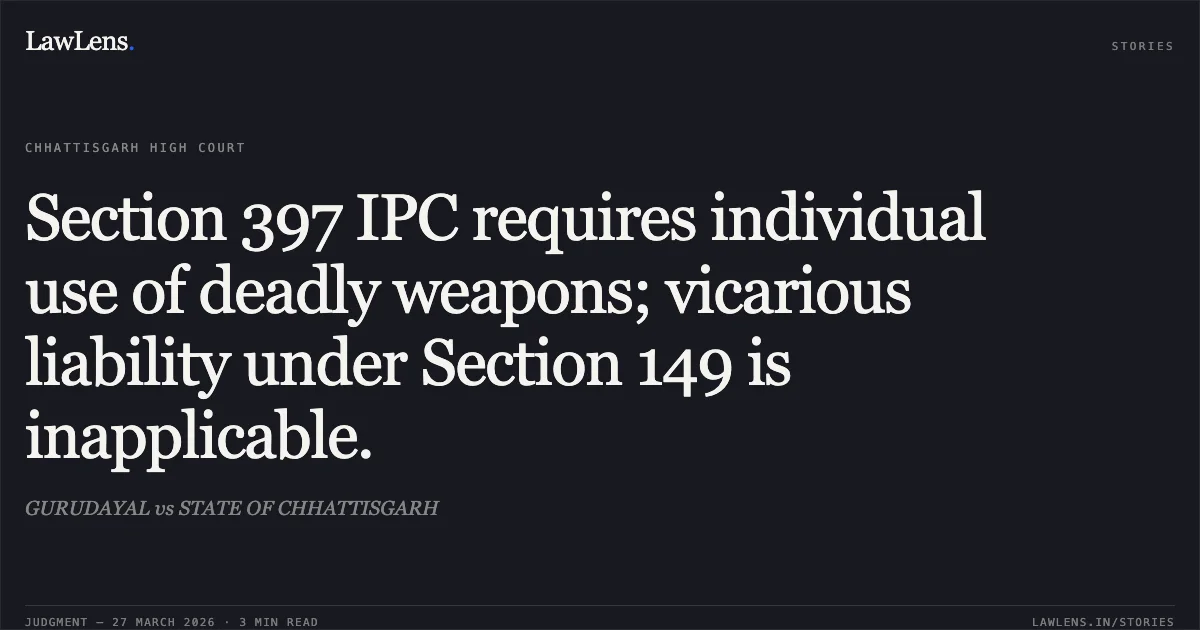
Source reference: para 49, 52the Court applied the principle from Ganesan v. State, which establishes that Section 397 creates individual liability for the "offender" who uses a deadly weapon and cannot be applied vicariously through Section 149
Source reference: para 56Reasoning
The Court upheld the conviction under Section 307 IPC, reasoning that the use of knives on vital parts (stomach/chest) and the medical testimony of PW-16—stating PW-2 would have died without surgery—clearly established the intent to cause death
Source reference: para 37-40, 43the Court found the injured witnesses' testimonies (PW-1 and PW-2) consistent and reliable, noting that even if an accused (like Hasnen) was not named in the FIR, specific overt acts were attributed to him during evidence
Source reference: para 34-35The Court affirmed the application of Section 149 IPC, finding the appellants were part of an unlawful assembly whose common object was to forcibly recover seized liquor from police custody
Source reference: para 51-53Following Ganesan, it held that since the Trial Court failed to specify which individual offender used the deadly weapon during the dacoity, the collective conviction under Section 397 was legally unsustainable, though the base charge of dacoity under Section 395 remained proved
Source reference: para 56-57Holding
The High Court partly allowed the appeals. It affirmed the convictions under Sections 307, 148, 324, and 395 IPC
It set aside the conviction under Section 397 IPC, acquitting the appellants of that specific charge as constructive liability does not apply to it
Source reference: para 57the Court reduced the sentence for Sections 307 and 395 IPC from seven years to four years of rigorous imprisonment, with sentences to run concurrently
Source reference: para 59The appellants were directed to surrender within two months to serve the remaining sentence
Source reference: para 61Original Court PDF
GURUDAYALvsSTATE OF CHHATTISGARH
Click to open original judgment
Original judgment, available to read, download and summarize on LawLens.in