Facts
The appellants challenged their conviction by the Special Judge, SC/ST (Prevention of Atrocities) Cases, Pali, for offences under Sections 341/34, 323/34, 325/34 and 427/34 IPC.
Source reference: paras. 1, 2.4The trial court had acquitted them of the charge under Section 459 IPC and offences under Sections 3(1)(x) and 3(2)(v) of the SC/ST Act.
Source reference: paras. 1, 2.4The prosecution arose from a 2014 incident in which the complainant alleged that the appellants entered his home, assaulted family members and damaged property.
Source reference: para. 2On appeal, the appellants disputed the conviction and alternatively sought release on probation, relying on their status as first offenders and the passage of time.
Source reference: para. 5Issues
Whether the trial court’s convictions under Sections 341/34, 323/34, 325/34 and 427/34 IPC warranted appellate interference.
Source reference: paras. 8.1–8.4Whether, while maintaining those convictions, the appellants should receive the benefit of Section 4 of the Probation of Offenders Act, 1958 instead of serving their substantive sentences.
Source reference: paras. 8.5–8.17Law Applied
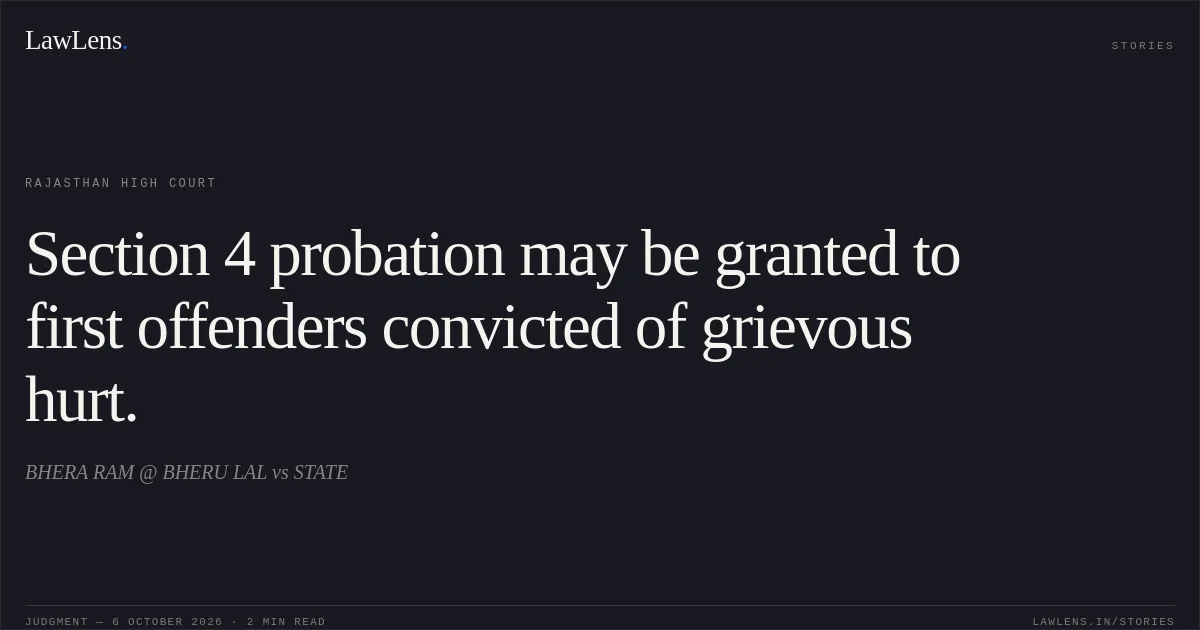
Section 4 of the Probation of Offenders Act, 1958 empowers a court, in an appropriate case, to release an offender on probation of good conduct rather than impose immediate imprisonment, having regard to the circumstances of the case, the nature of the offence and the offender’s character.
Source reference: para. 8.11The sentencing inquiry must consider both the gravity of the proved offence and the offender’s antecedents and circumstances; probation is not automatic merely because the offender has no prior conviction.
Source reference: paras. 8.6, 8.13The court also noted that Section 325 IPC permits imprisonment up to seven years, but that the statutory maximum does not by itself preclude probation.
Source reference: para. 8.10Reasoning
The High Court found no material infirmity or perversity in the trial court’s assessment of the evidence and therefore declined to disturb the convictions.
Source reference: paras. 8.1–8.4In considering sentence, it weighed the appellants’ first-offender status, the absence of prior convictions or subsequent criminal activity on the record, the 2014 date of the occurrence, their acquittal on the graver charges, and the concurrent sentences, the longest of which was three years.
Source reference: paras. 8.7–8.9, 8.12–8.15Although the proved conduct included causing grievous hurt, the Court concluded that probation, subject to lawful safeguards, offered an appropriate opportunity for reformation without erasing the findings of guilt.
Source reference: paras. 8.13–8.17Holding
The appeal was partly allowed.
The convictions under Sections 341/34, 323/34, 325/34 and 427/34 IPC were affirmed, but each appellant was released on probation of good conduct under Section 4 of the Probation of Offenders Act, 1958, on furnishing a personal bond of Rs. 2,000 with one surety for the like amount and undertaking to maintain peace and good behaviour and to appear and receive sentence if called upon during the probation period.
Source reference: paras. 9–9.2The fines remained operative, and the trial court was directed to give effect to the order and impose any appropriate lawful conditions.
Source reference: paras. 9.3–9.4Acts & Sections Cited
11 provisions across 4 statutes referred to in this judgment. Each provision opens on LawLens.
Indian Penal Code, 18608
Scheduled Castes and the Scheduled Tribes (Prevention of Atrocities) Act, 19891
Code of Criminal Procedure, 19731
Probation of Offenders Act, 19581
Original Court PDF
BHERA RAM @ BHERU LALvsSTATE
Click to open original judgment
Original judgment, available to read, download and summarize on LawLens.in