Facts
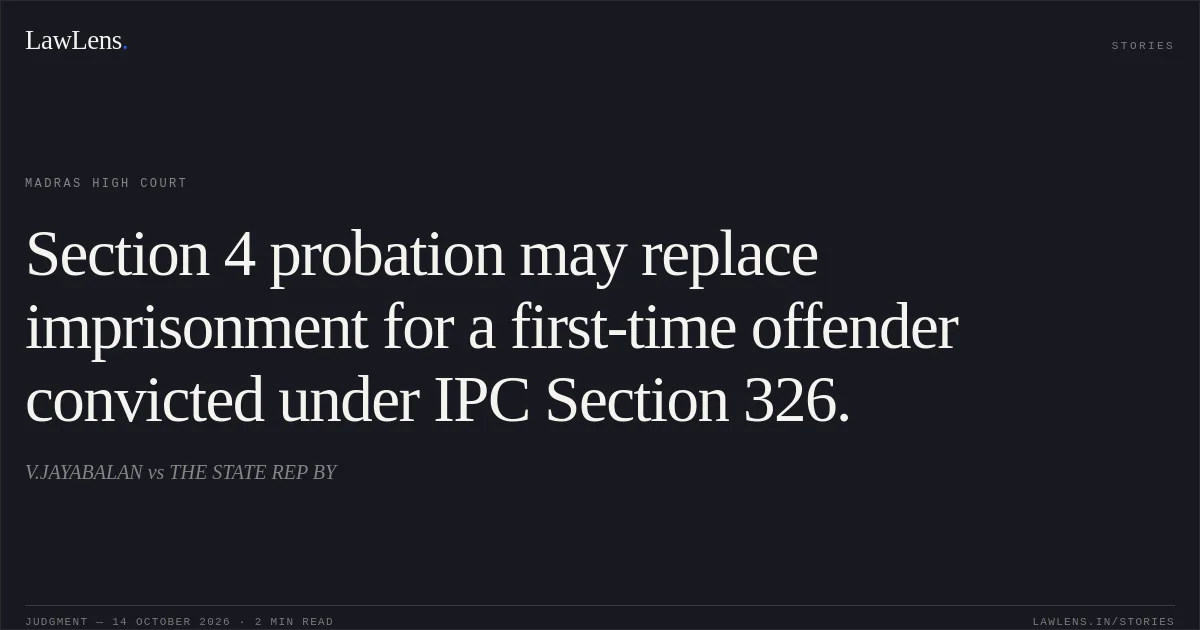
The petitioner was convicted under Section 326 IPC for causing grievous injuries to a co-worker with a rod and sentenced to three years’ imprisonment and a fine. He was acquitted of the charges under Sections 341, 294(b) and 506(ii) IPC; the appellate court affirmed the conviction and sentence
Source reference: p.2–3In revision, the petitioner did not press the challenge on merits and sought release on probation under Section 4 of the Probation of Offenders Act, 1958, relying on the passage of time, his status as a first offender and the absence of subsequent criminal antecedents
Source reference: p.3–4The State opposed interference with the conviction but accepted that probation could be considered subject to statutory conditions
Source reference: p.4Issues
Whether the petitioner, convicted under Section 326 IPC, could be released on probation under Section 4 of the Probation of Offenders Act, 1958
Source reference: p.10–11Whether the circumstances of the case justified modifying the custodial sentence while maintaining the conviction
Source reference: p.12Law Applied
Section 4 of the Probation of Offenders Act, 1958 permits a court to release a person found guilty of an offence not punishable with death or imprisonment for life on probation of good conduct, instead of sentencing the person at once. The discretion must be exercised having regard to the circumstances of the case, including the nature of the offence and the offender’s character; the court must also be satisfied as to the offender’s or surety’s fixed place of abode or regular occupation.
Source reference: p.6, 10Ratan Lal v. State of Punjab recognises the Act’s rehabilitative purpose, while Ved Prakash v. State of Haryana emphasises the sentencing court’s duty to consider relevant personal and social circumstances.
Source reference: p.6–7Sitaram Paswan v. State of Bihar confirms that probation is discretionary and may be considered at the appellate or revisional stage, with due regard to the offence’s gravity and its impact on the victim. The Court also referred to Mohd. Hashim v. State of U.P. and other authorities concerning the application of probation.
Source reference: p.9–11Reasoning
Section 326 IPC was not punishable with death or imprisonment for life, so Section 4 was available for consideration.
Source reference: p.10The Court acknowledged the seriousness of the offence: the petitioner had caused grievous injuries and the victim was treated as an inpatient. It nevertheless considered that the incident occurred in 2014, the petitioner had no prior conviction, and no criminal antecedents between the parties had been reported in the intervening period. In light of those circumstances and the Act’s rehabilitative purpose, the Court found probation appropriate, without disturbing the conviction.
Source reference: p.12–13Holding
The revision was partly allowed. The conviction under Section 326 IPC was maintained, but the custodial sentence was modified: the petitioner was released on probation under Section 4 for six months, subject to filing a personal bond and two sureties of ₹20,000 each and undertaking to maintain peace and good behaviour and commit no offence.
The bond and sureties were to be filed before the District Probation Officer within three months; breach of the conditions would require the petitioner to undergo the original sentence.
Source reference: p.12–13Acts & Sections Cited
16 provisions across 3 statutes referred to in this judgment. Each provision opens on LawLens.
Indian Penal Code, 1860
Code of Criminal Procedure, 19732
Original Court PDF
V.JAYABALANvsTHE STATE REP BY
Click to open original judgment
Original judgment, available to read, download and summarize on LawLens.in