Facts
The complainant alleged that the appellant developed a relationship with his daughter, took her to a bamboo grove, and sexually assaulted her by force and intimidation.
Source reference: pp. 3–4, paras. 3–7The victim subsequently became pregnant and delivered twin male children.
Source reference: pp. 3–4, paras. 3–7On the complainant’s petition, Matia P.S. Case No. 31/2013 was registered under Sections 376, 506 and 34 IPC; after investigation, a charge-sheet was filed and charges under Sections 376 and 506 IPC were framed.
Source reference: pp. 3–4, paras. 3–7The prosecution examined seven witnesses, including the victim.
Source reference: pp. 2–3, para. 2The trial court acquitted the appellant of the offences under Sections 376 and 506 IPC but convicted him under Section 417 IPC, sentencing him to three months’ rigorous imprisonment and a fine of ₹3,000, with a default sentence of 23 months’ rigorous imprisonment.
Source reference: pp. 2–3, para. 2The appellant challenged the conviction under Section 374(2) CrPC.
Source reference: no citationIssues
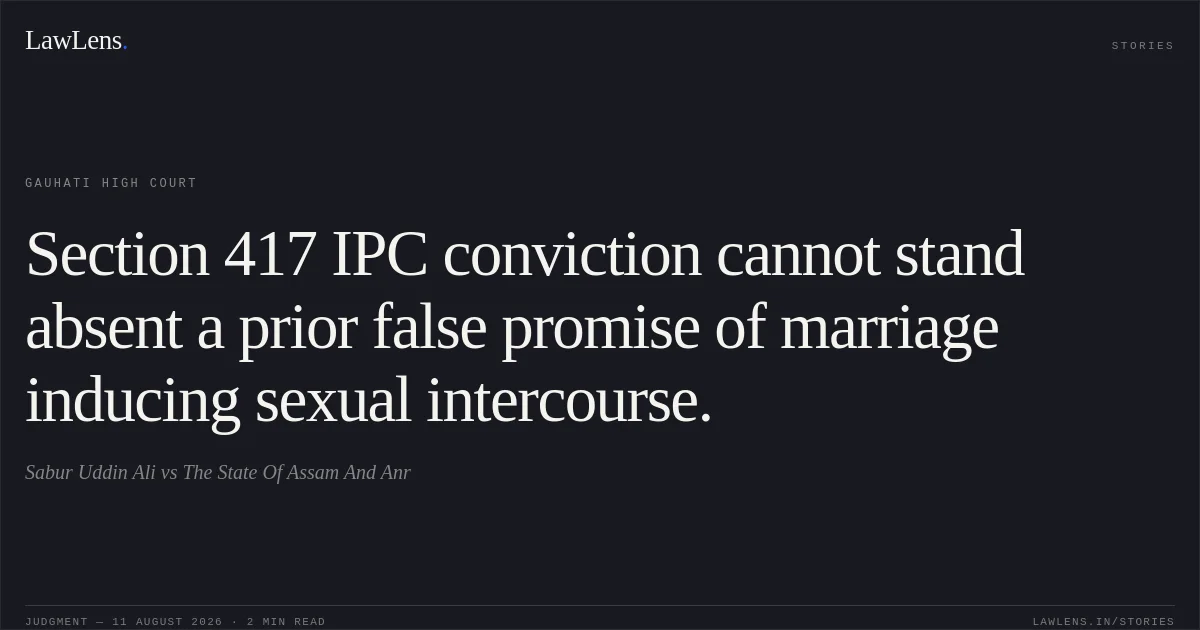
Whether the evidence established that the appellant deceived or dishonestly induced the victim, within the meaning of Section 417 IPC, by making a false promise of marriage before the sexual relationship.
Source reference: pp. 6–7, paras. 19–22Whether the evidence supported the prosecution allegations under Sections 376 and 506 IPC, notwithstanding the trial court’s acquittal on those charges.
Source reference: p. 6, paras. 17–18Law Applied
The Court considered Section 417 IPC, which penalises cheating, including deception and dishonest or fraudulent inducement; Sections 376 and 506 IPC concerning rape and criminal intimidation; and Section 374(2) CrPC governing appeals against convictions.
Source reference: no citationRelying on Pramod Suryabhan Pawar v. State of Maharashtra, (2019) 9 SCC 608, as quoted in Sh. Nabajyoti Deuri v. State of Assam, 2025 (7) GLT 1129, the Court held that a promise to marry amounts to a false promise vitiating consent only where it was made in bad faith, with no intention of being fulfilled at the time it was given, and where the promise had a direct nexus with the woman’s decision to engage in the sexual act.
Source reference: p. 7, para. 21A mere subsequent breach of a promise is insufficient to establish such deception.
Source reference: p. 7, para. 21Reasoning
The Court found that the victim’s testimony did not establish any promise of marriage preceding the sexual intercourse.
Source reference: pp. 6–7, paras. 20–22According to her evidence, the appellant initially proposed sexual intercourse; her allegation of a promise to marry arose only after the incident, when the appellant allegedly asked her not to disclose the matter and subsequently failed to marry her.
Source reference: pp. 6–7, paras. 20–22Consequently, the essential nexus between a false promise of marriage and the sexual act was absent.
Source reference: pp. 6–7, paras. 20–22The Court also accepted the trial court’s assessment that the evidence, including the testimony that the appellant and the victim were found together in a compromising position, indicated consensual conduct and did not sufficiently establish rape or criminal intimidation.
Source reference: p. 6, paras. 17–18Since the prosecution failed to prove deception or dishonest inducement, the conviction under Section 417 IPC could not stand.
Source reference: no citationHolding
The appeal was allowed.
The Gauhati High Court set aside the appellant’s conviction and sentence under Section 417 IPC, directed that he be set at liberty forthwith, and discharged any subsisting bail bond.
Source reference: p. 7, paras. 23–25The matter was disposed of and the lower-court record was directed to be returned.
Source reference: p. 8, para. 26Acts & Sections Cited
8 provisions across 2 statutes referred to in this judgment. Each provision opens on LawLens.
Code of Criminal Procedure, 19733
Indian Penal Code, 18605
Original Court PDF
Sabur Uddin AlivsThe State Of Assam And Anr
Click to open original judgment
Original judgment, available to read, download and summarize on LawLens.in