Facts
The Appellant, a film producer, borrowed funds from the second respondent (complainant) to produce a movie, promising a 30% share in profits
Source reference: para. 3Subsequently, additional funds were lent on the promise of an increased profit share (totaling 47%)
Source reference: para. 3The movie was completed and released
Source reference: para. 17Prior to the release, the complainant objected, leading the Appellant to issue two post-dated cheques of Rs. 24 lakhs each toward the return of the principal amount
Source reference: para. 3, 16These cheques were dishonored due to insufficient funds
Source reference: para. 3A police report was filed under Sections 406 and 420 of the IPC
Source reference: para. 2The High Court of Madras quashed the charge under Section 406 but declined to quash the proceedings under Section 420, stating that the existence of dishonest intention was a matter for trial
Source reference: para. 5, 10The Appellant moved the Supreme Court contending the dispute was purely civil.
Source reference: no citationIssues
Whether the failure to fulfill a promise of profit-sharing in a high-risk investment, such as movie production, prima facie constitutes the offense of cheating under Section 420 IPC
Source reference: para. 11, 15, 17Whether the dishonor of post-dated cheques issued to discharge an existing liability, rather than to induce the initial parting of property, is sufficient to establish dishonest intention at the inception of a transaction
Source reference: para. 18, 19Law Applied
The Court applied Section 415 of the IPC, which defines cheating as requiring a fraudulent or dishonest deception that induces a person to deliver property
Source reference: para. 12It relied on Iridium India Telecom Ltd. v. Motorola Inc., which established that deception is a necessary ingredient and must produce the inducement
Source reference: para. 12The Court further applied the principle from Vesa Holdings Private Limited v. State of Kerala, holding that a breach of contract only amounts to cheating if dishonest intention existed at the very inception; a subsequent development of such intention does not suffice
Source reference: para. 14the Court noted that under Section 482 of the CrPC, criminal proceedings may be quashed if a purely civil cause of action is given a criminal color
Source reference: para. 15, 20Reasoning
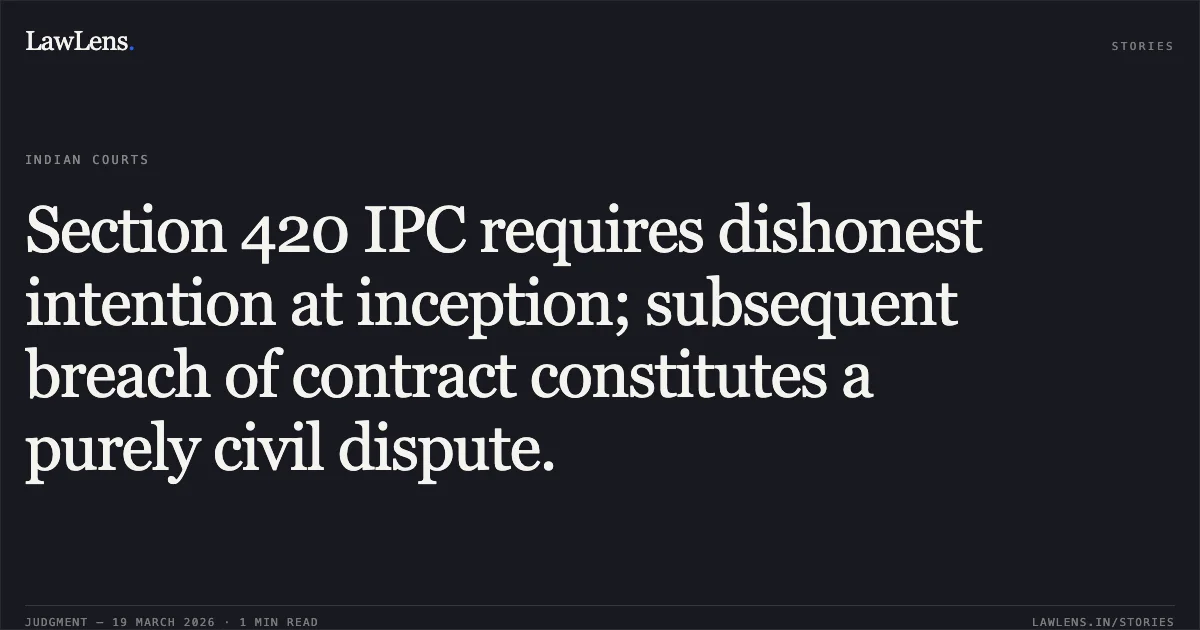
The Court observed that for an offense under Section 420 IPC, dishonest intention must exist at the time the promise is made
Source reference: para. 13In the present case, the Appellant utilized the funds for their intended purpose—making and releasing the movie—which negates the claim that the initial promise was false
Source reference: para. 17, 19The Court emphasized that movie production is a high-risk business where profit is not guaranteed; an investor sharing in profits inherently accepts the risk of zero returns
Source reference: para. 17Regarding the dishonored cheques, the Court reasoned that since they were post-dated and issued to discharge an existing obligation (to resolve the complainant’s objection to the movie's release), they did not serve as the inducement for the complainant to initially part with money
Source reference: para. 18, 19Furthermore, the dishonor of a post-dated cheque does not ipso facto prove initial dishonest intention, as the drawer may reasonably believe funds will be available by the future date
Source reference: para. 18The Court concluded that the High Court failed to recognize the commercial nature of the transaction and the lack of evidence showing inception-stage deception
Source reference: para. 17, 20Holding
The Supreme Court held that the allegations disclosed only a civil cause of action and that the materials failed to indicate any dishonest intention from the inception of the transaction
The Court answered that a mere failure to keep a promise subsequently cannot be the sole basis for a cheating charge, especially in high-risk ventures where fulfillment is not entirely within the promisor's control
Source reference: para. 13, 15The appeal was allowed, the High Court’s order was set aside in part, and the criminal proceedings under Section 420 IPC were quashed
Source reference: para. 21Acts & Sections Cited
6 provisions across 3 statutes referred to in this judgment. Each provision opens on LawLens.
Indian Penal Code, 18603
Code of Criminal Procedure, 19732
Negotiable Instruments Act, 18811
Original Court PDF
V. GanesanvsState Rep By The Sub Inspector Of Police
Click to open original judgment
Original judgment, available to read, download and summarize on LawLens.in