Facts
The respondents obtained an eviction order against the petitioners in RCOP No.1 of 2016.
Source reference: paras. 2–3; p.1–3The petitioners contested the proceedings on the ground that no landlord–tenant relationship existed, asserting that the first petitioner occupied the property as a mortgagee.
Source reference: paras. 2–3; p.1–3The Rent Controller rejected the objection, and the Appellate Authority confirmed the eviction order in RCA No.1 of 2021.
Source reference: paras. 2–3; p.1–3The petitioners thereafter challenged the decision before the High Court in C.R.P.(MD) No.763 of 2024, where the Court rejected the mortgage-based contention and held that the mortgage executed between the landlord and Mallika, rather than the tenant Ramakrishna Pandian, did not alter the tenant’s status.
Source reference: paras. 2–3; p.1–3During execution proceedings in E.P. No.23 of 2023, the petitioners filed an unnumbered application under Section 47 CPC, again contending that the eviction order was a nullity for want of a landlord–tenant relationship.
Source reference: paras. 1, 3–4; p.1–4The Executing Court dismissed the application at the unnumbered stage, leading to the present revision under Section 115 CPC.
Source reference: paras. 1, 3–4; p.1–4Issues
1. Whether the Executing Court was justified in dismissing the petitioners’ Section 47 CPC application at the unnumbered stage on the ground that it raised an issue already decided in earlier proceedings.
Source reference: paras. 1, 4, 6; p.1, 3–52. Whether the petitioners could re-agitate in execution the contention that no landlord–tenant relationship existed and that the eviction order was therefore a nullity.
Source reference: paras. 3–4; p.2–43. Whether the principle that an execution application under Section 47 CPC should ordinarily be numbered prevented the Executing Court from rejecting an application that was ex facie a re-litigation and abuse of process.
Source reference: paras. 5–6; p.4–5Law Applied
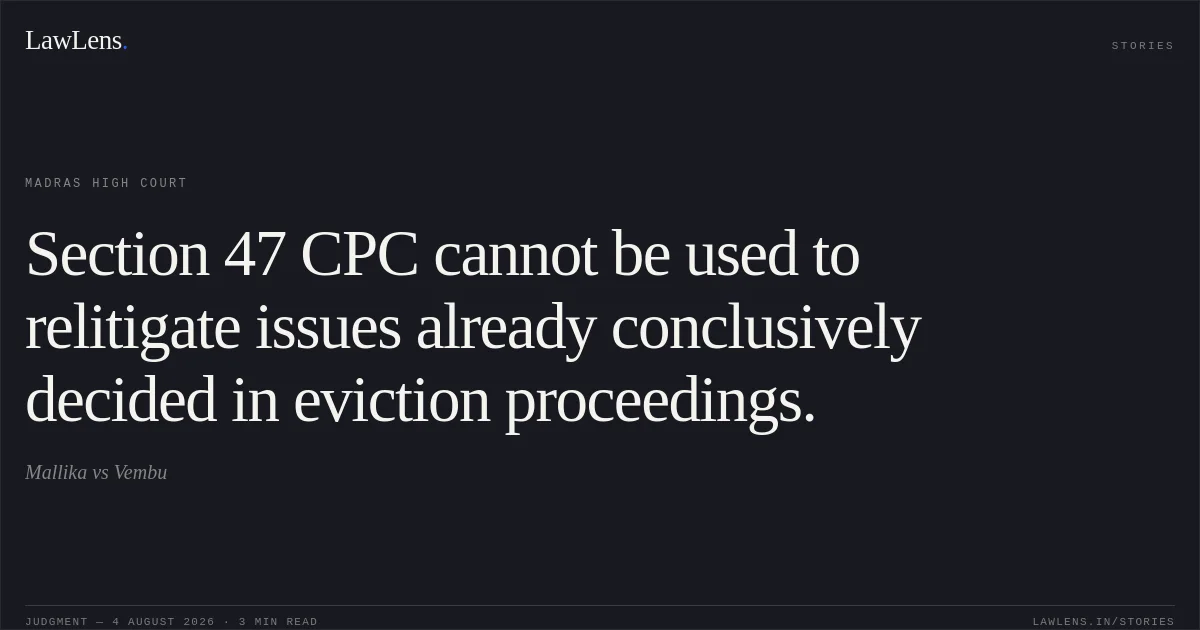
The Court applied Section 47 CPC, under which questions relating to the execution, discharge, or satisfaction of a decree must be determined by the executing court, but only questions not already adjudicated in the substantive proceedings can ordinarily be raised at the execution stage.
Source reference: paras. 4, 6; p.3–5The Court relied on the principle of res judicata and the rule against re-litigation, holding that issues previously raised and finally decided cannot be reopened through a Section 47 application.
Source reference: no citationRelying on A.V. Hanifa, 1992 II MLJ 325, as quoted in Rajamanickam v. Balasubramanian, 2011 (2) LW 113, the Court held that a party cannot raise at execution either an issue already decided at trial or an issue that ought to have been raised earlier.
Source reference: para. 4; p.3–4The Court also considered K. Venkatesan v. E. Hemantharaj, CDJ 2016 MHC 5629, cited by the petitioners on the issue of rejecting a Section 47 application without numbering, but distinguished its application where the proposed application is plainly repetitive and abusive.
Source reference: paras. 5–6; p.4–5Reasoning
The High Court found that the precise objection relied upon in the Section 47 application—absence of a landlord–tenant relationship due to Mallika’s alleged status as mortgagee—had already been raised before the Rent Controller, the Appellate Authority, and the High Court in the earlier revision.
Source reference: para. 3; p.2–3In C.R.P.(MD) No.763 of 2024, the Court had specifically held that the mortgage was between the landlord and Mallika, whereas Ramakrishna Pandian continued to occupy the property in the capacity of tenant; consequently, the alleged merger of interests did not arise.
Source reference: para. 3; p.2–3Since that determination had become final, the petitioners were barred by res judicata and the rule against re-litigation from raising the same issue before the Executing Court.
Source reference: paras. 4–6; p.3–5The Section 47 application did not present a new question concerning execution, discharge, or satisfaction of the eviction order; it merely sought to reopen the merits of an issue already conclusively decided.
Source reference: paras. 4–6; p.3–5The Court therefore held that the application was a re-litigation and an abuse of process, and that the Executing Court was not required to number it before rejecting it.
Source reference: paras. 4–6; p.3–5Holding
The Court held that the petitioners could not re-agitate, under Section 47 CPC, their previously rejected contention that no landlord–tenant relationship existed.
The Executing Court was justified in dismissing the application at the unnumbered stage because it was ex facie barred by res judicata and constituted an abuse of process.
Source reference: para. 7; p.5–6The civil revision petition was dismissed, with no order as to costs, and the connected miscellaneous petition was closed.
Source reference: para. 7; p.5–6Acts & Sections Cited
2 provisions across 1 statute referred to in this judgment. Each provision opens on LawLens.
Code of Civil Procedure, 19082
Original Court PDF
MallikavsVembu
Click to open original judgment
Original judgment, available to read, download and summarize on LawLens.in