Facts
The Appellant-Authority acquired 80.92 acres of land between 1982 and 1985 for developing an inter-city bus and truck terminal in Chennai.
Source reference: para 3.1While 64.80 acres were utilized for the notified purpose, 16.12 acres (including the 5.06 acres in dispute) remained undeveloped.
Source reference: para 3.1In 2005, the Appellant earmarked this residual land for relocating "Gunny Bag shops" to alleviate health hazards in residential areas.
Source reference: para 3.2The Respondent-landowners sought re-conveyance of the unused land under Section 48-B of the Land Acquisition Act, 1894 (as applicable in Tamil Nadu), which the State rejected in 2006.
Source reference: para 3.3-3.4A Single Judge of the High Court initially ruled that relocating shops was not a "public purpose" and directed the State to consider forfeiture under Section 16-B and subsequent re-conveyance.
Source reference: para 3.7On appeal, a Division Bench of the High Court directed the actual re-conveyance of the land, holding that the State could not introduce a "fresh reason" for public purpose after two decades.
Source reference: para 3.12-3.13Issues
1. Whether the High Court was justified in relying upon Section 16-B read with Section 48-B of the LA Act to enforce a perceived right of Respondent-landowners seeking re-conveyance of lawfully acquired land vested in the State.
Source reference: para 4(I)2. Whether the Courts, in the exercise of judicial review, can prescribe a time limit for the utilization of acquired land for a public purpose or for changing the public purpose for which the land may be used.
Source reference: para 4(II)Law Applied
The Court interpreted Section 16-B of the LA Act (Tamil Nadu Amendment), which provides the State an enabling power to forfeit land as a penalty if not used for the acquired purpose.
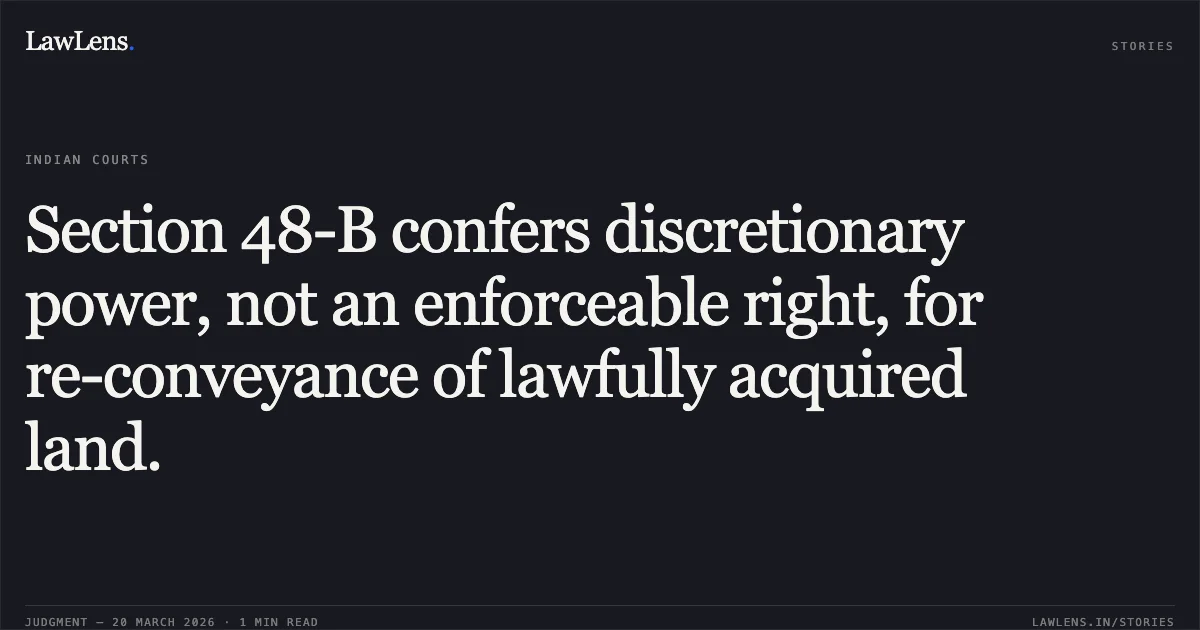
Source reference: para 5It further applied Section 48-B (Tamil Nadu Amendment), which grants the State discretion to transfer land back to the original owner only if it is satisfied the land is not required for the original purpose or any other public purpose.
Source reference: para 7-8The Court relied on T.N. Housing Board v. Keeravani Ammal (2007), establishing that Section 48-B must be strictly construed and does not create an enforceable right for the owner.
Source reference: para 9Additionally, the principle from Nandkishor Babulal Agrawal v. State of Maharashtra (2023) was applied, affirming that once land vests in the State, the public purpose can be changed, and no fixed time limit exists for its utilization.
Source reference: para 15Reasoning
The Court reasoned that Section 48-B is a discretionary enabling provision, not a mandatory right.
Source reference: para 8For the provision to trigger, a two-pronged condition must be met: the land must not be required for the original purpose and it must not be required for "any other public purpose".
Source reference: para 8In this case, although the original relocation of shops was questioned, the State subsequently decided to utilize the land for a truck parking yard, which complements the original bus terminal project.
Source reference: para 11The High Court erred by ignoring that the State never declared the land "unsuitable" for public use.
Source reference: para 12The Court rejected the High Court’s logic that a lapse of 20 years precludes the State from changing the public purpose, noting that planning agencies often hold land in a "reserve pool" for future urban needs.
Source reference: para 15, 17Judicial review under Section 48-B is limited to examining whether the State's refusal was arbitrary or mala fide, which was not proven here.
Source reference: para 18-19Holding
The Supreme Court allowed the appeals and set aside the High Court's judgments.
It held that Section 48-B does not clothe an expropriated owner with a right to seek re-conveyance and that the State retains the power to divert land for any bona fide public use regardless of the delay in utilization.
Source reference: para 16, 18The State’s decision to refuse re-conveyance was upheld.
Source reference: para 22The Court further clarified that the acquisition did not lapse under Section 24(2) of the 2013 Act because compensation had been duly deposited and offered, making any retention of possession by the owners inconsequential.
Source reference: para 21The Respondents remain entitled only to the original compensation deposited with the Authority.
Source reference: para 23Acts & Sections Cited
2 provisions across 2 statutes referred to in this judgment. Each provision opens on LawLens.
Code of Civil Procedure, 19081
Right to Fair Compensation and Transparency in Land Acquisition, Rehabilitation and Resettlement Act, 20131
Original Court PDF
Chennai Metropolitan Development Authority, Rep. By Its Member SecretaryvsDhamalingam And Ors. Etc. Etc.
Click to open original judgment
Original judgment, available to read, download and summarize on LawLens.in