Facts
The applicant sought bail in Case Crime No. 324 of 2025, registered at Police Station Sikandarabad, District Bulandshahr, under Sections 318(4), 338, 336(3), 340(2) and 61 of the Bharatiya Nyaya Sanhita, 2023.
Source reference: paras. 2–4His first bail application had been rejected on 28 January 2026.
Source reference: paras. 2–4He contended that he was neither the purchaser nor a witness to the disputed sale deed; the purchaser was his wife, who had obtained anticipatory bail, and a co-accused had also been granted bail.
Source reference: para. 5He further relied on the expiry of 60 days from the first date fixed for evidence under Section 480(6) of the Bharatiya Nagarik Suraksha Sanhita, 2023 (BNSS).
Source reference: para. 5The State opposed bail, arguing that the applicant was a conspirator and that the trial’s delay arose from adjournments sought by co-accused.
Source reference: para. 6The applicant had no criminal history, the charge-sheet had been filed, and he had been in custody since 22 November 2025.
Source reference: para. 5Issues
Whether expiry of 60 days from the first date fixed for evidence creates an absolute right to bail under Section 480(6) BNSS.
Source reference: paras. 8–15Whether, notwithstanding that provision and the alleged trial delay, the applicant was entitled to bail on the facts of the case.
Source reference: paras. 7, 14–16Law Applied
Section 480(6) BNSS provides for release on bail where a Magistrate-triable case is not concluded within 60 days from the first date fixed for evidence and the accused has remained in custody throughout that period, unless the Magistrate records reasons to direct otherwise.
Source reference: para. 8Relying on Subhelal alias Sushil Sahu v. State of Chhattisgarh, (2025) 5 SCC 140, the Court held that the corresponding provision, Section 437(6) CrPC, is not mandatory and does not confer an absolute or indefeasible right to bail; relevant considerations include whether delay is attributable to the accused, the risk of interference with evidence or absconding, and continuous custody during the relevant period.
Source reference: paras. 10–12, 15The Court also referred to Kapil Wadhawan v. Central Bureau of Investigation, 2025 SCC OnLine SC 3038, and Maya Tiwari v. State of U.P., 2024 SCC OnLine All 6765, in considering the grant of bail.
Source reference: para. 16Reasoning
The Court rejected the argument that Section 480(6) BNSS made bail automatic: the provision’s discretion to refuse bail for recorded reasons qualifies its initial direction, and delay attributable to the accused may weigh against release.
Source reference: paras. 9–15Although the order sheet showed that the trial had been delayed by adjournments sought by co-accused, the Court assessed bail independently on the overall circumstances.
Source reference: para. 16It noted that the applicant was neither the vendee nor a witness to the sale deed, that his wife—the purchaser—and another co-accused had been granted bail, and that the applicant had no criminal history.
Source reference: paras. 7, 16Considering those circumstances, the nature of the offence and evidence, and the other factors identified in the judgment, the Court found him entitled to bail.
Source reference: paras. 7, 16Holding
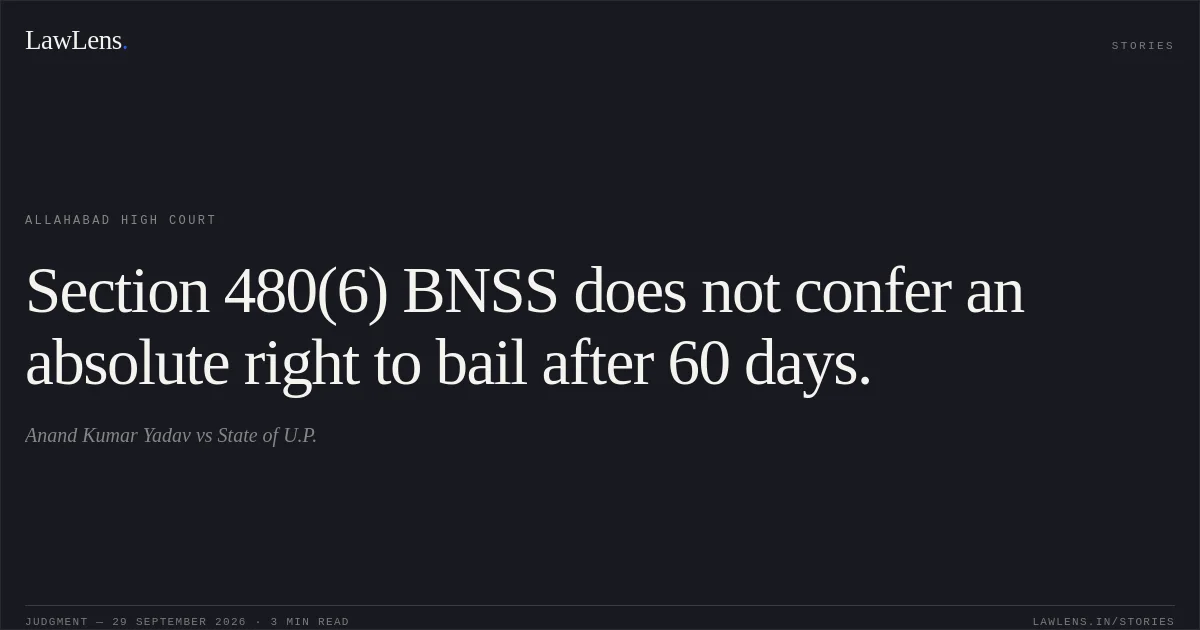
The Court held that Section 480(6) BNSS does not confer an automatic right to bail merely because 60 days have elapsed from the first date fixed for evidence.
Nevertheless, it allowed the application and directed the applicant’s release on a personal bond and two sureties, subject to conditions including non-interference with witnesses or evidence, cooperation in the trial without seeking adjournments, and refraining from criminal activity.
Source reference: paras. 15–18The Court also directed verification of the applicant’s and sureties’ identity and residence documents and transmission of the release order through the prescribed systems.
Source reference: paras. 19–23Acts & Sections Cited
7 provisions across 3 statutes referred to in this judgment. Each provision opens on LawLens.
Bharatiya Nyaya Sanhita, 20235
Bharatiya Nagarik Suraksha Sanhita, 20231
Code of Criminal Procedure, 19731
Original Court PDF
Anand Kumar YadavvsState of U.P.
Click to open original judgment
Original judgment, available to read, download and summarize on LawLens.in