01Facts
The petitioners sought to quash proceedings in C.C. No. 294/2019, arising from Crime No. 49/2019, for offences under Sections 143, 147, 148, 323, 324, 504 and 506 read with Section 149 of the IPC
p. 3The complaint and charge sheet alleged that, during a dispute over land, the petitioners assaulted and threatened the complainants; two complainants received medical attention, and eyewitnesses and the treating doctor were cited during the investigation
p. 4The petitioners relied on the parties’ civil dispute, related proceedings and wound certificates, and contended that the complaint was false and intended to harass them
pp. 5–7The State opposed quashing, submitting that the evidence and injuries raised matters for trial
pp. 7–802Issues
i.1. Whether the proceedings should be quashed under Section 482 of the Cr.P.C. because the dispute arose from a civil land dispute and the complaint was allegedly false
pp. 5–7ii.2. Whether the High Court could assess the defence and evidentiary material, including the wound certificates and witness statements, at the quashing stage
pp. 7–903Law Applied
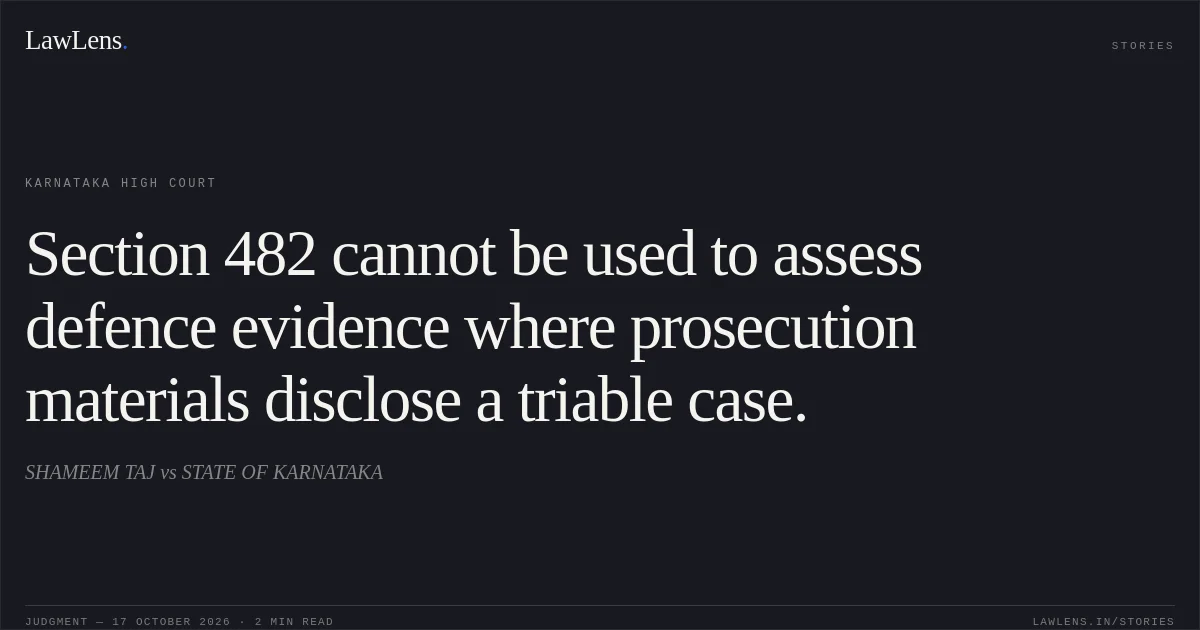
The Court applied Section 482 of the Cr.P.C., under which the High Court’s power to quash criminal proceedings is limited.
pp. 7–9At that stage, the Court does not assess the defence or weigh evidence that is for the trial court to consider.
pp. 7–9The Court also treated the applicability of the charged offences, in light of the injuries and other evidence, as a matter for trial
pp. 7–9No precedent was cited.
pp. 7–9Provisions in the judgment · 12 · Linked ones open on LawLens
Code of Criminal Procedure, 1973 Section 482
Indian Penal Code, 1860 11 provisions
Section 143Section 147Section 148Section 323Section 324Section 504Section 506Section 149Section 447Section 448Section 42704Reasoning
The Court noted the civil dispute and the petitioners’ contention that the complaint was retaliatory, but found that the record also included wound certificates, statements from eyewitnesses and evidence that the complainants had received medical treatment
pp. 7–8Although one certificate recorded no external injuries and the other described simple injuries, the Court held that the significance of those materials—and whether the allegations established the charged offences—could not be determined by weighing evidence under Section 482
pp. 8–9Those matters were for the trial court.
pp. 8–905Holding
The Court declined to quash the proceedings, holding that the petitioners had not established grounds for exercising the High Court’s inherent jurisdiction under Section 482 of the Cr.P.C.
p. 9The criminal petition was dismissed
p. 9Original Court PDF
SHAMEEM TAJvsSTATE OF KARNATAKA
Click to open original judgment
Original judgment, available to read, download and summarize on LawLens.in