Facts
The applicant initially moved an application under Section 156(3) Cr.P.C. alleging that private respondents committed cheating and forgery by misrepresenting land ownership, causing a loss of ₹42 lakhs
Source reference: para. 5The Magistrate treated the application as a complaint case and, following statements under Sections 200 and 202 Cr.P.C., issued a summoning order on 14.03.2024 only under Sections 420 and 506 I.P.C.
Source reference: para. 4, 5The applicant approached the High Court seeking modification of this order to include Sections 120-B, 406, 467, and 468 I.P.C.
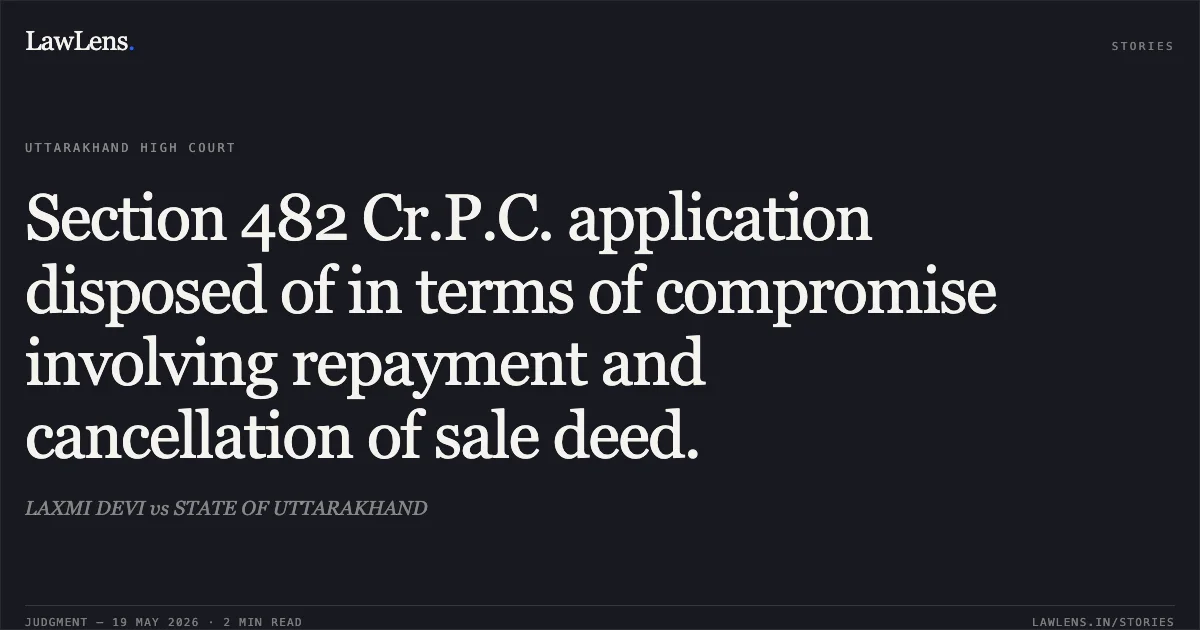
Source reference: para. 4During the pendency of this application, the parties entered into a compromise deed involving the payment of ₹34 lakhs via cheques and the cancellation of a sale deed dated 16.05.2023
Source reference: para. 6, 8Issues
1. Whether the summoning order dated 14.03.2024 should be modified to include additional sections of the I.P.C. based on available material
Source reference: para. 42. Whether the criminal proceedings can be disposed of in light of an amicable settlement/compromise between the parties
Source reference: para. 9Law Applied
The court exercised its inherent powers under Section 482 of the Code of Criminal Procedure (Cr.P.C.), which allows the High Court to pass orders to prevent abuse of the process of any court or otherwise to secure the ends of justice
Source reference: para. 4, 10The court applied the principle that where parties have voluntarily and amicably settled a private dispute (typically involving civil overtones like property transactions), the court may dispose of the proceedings in terms of such compromise to maintain harmony between the parties
Source reference: para. 9Reasoning
The Court perused the record and the compromise deed submitted by the parties
Source reference: para. 7, 8It noted that respondent nos. 2, 4, 5, and 6 agreed to pay ₹34 lakhs through four cheques and undertook to ensure sufficient funds
Source reference: para. 8(i)Furthermore, the parties agreed to seek cancellation of the disputed sale deed in a competent court
Source reference: para. 8(ii)The Court observed that because the parties had settled their grievances and established a mechanism for restitution and legal rectification (including a recall provision in case of breach), continuing the litigation on the merits of the summoning order was no longer necessary to secure the ends of justice
Source reference: para. 9, 13Holding
The Court disposed of the application under Section 482 Cr.P.C. in terms of the compromise deed
It held that no further orders were required regarding the modification of the summoning order given the settlement
Source reference: para. 9The Court directed that the compromise deed form part of the record and Clarified that the applicant may move to recall the order if the respondents fail to honor the payment conditions
Source reference: para. 11, 8(iv)The Registry was directed to paginate the deed, and it was noted that this order shall not influence any other independent proceedings between the parties
Source reference: para. 12, 13Acts & Sections Cited
9 provisions across 2 statutes referred to in this judgment. Each provision opens on LawLens.
Code of Criminal Procedure, 19734
Indian Penal Code, 18605
Original Court PDF
LAXMI DEVIvsSTATE OF UTTARAKHAND
Click to open original judgment
Original judgment, available to read, download and summarize on LawLens.in