Facts
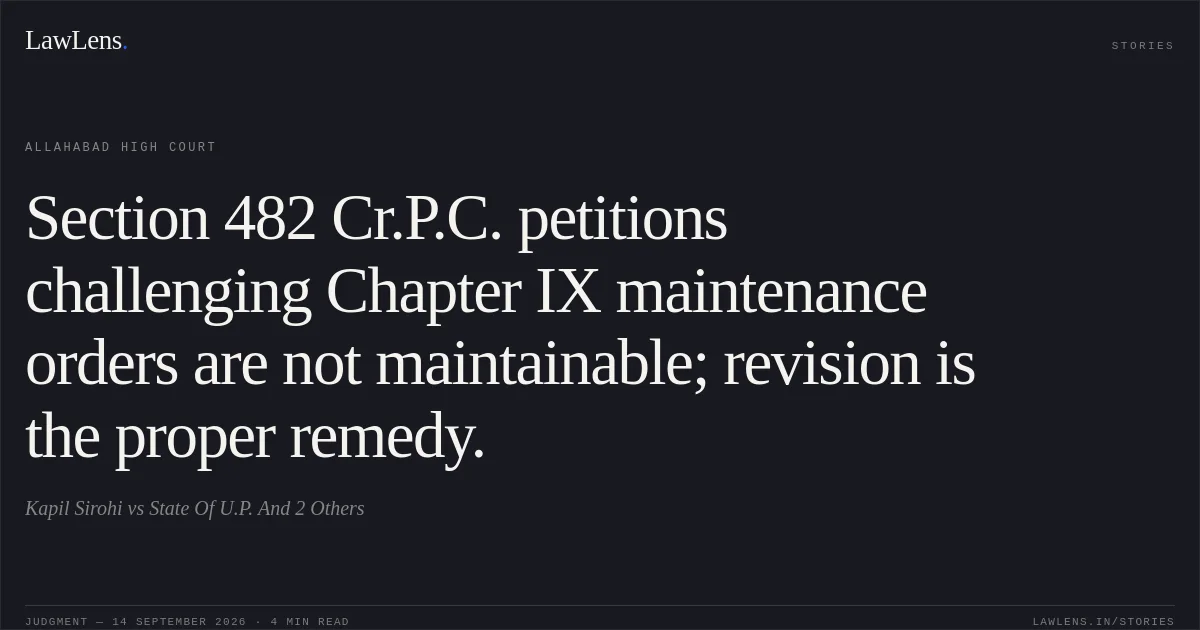
The applicant, Kapil Sirohi, filed an application under Section 482 Cr.P.C. seeking quashing of the proceedings and the order dated 10 July 2023 passed by the Principal Judge, Family Court, Mathura, in Maintenance Case No. 679 of 2018, Smt. Rakhi and Another v. Kapil Sirohi, under Section 125 Cr.P.C.
Source reference: para. 2By the impugned order, the applicant was directed to pay interim maintenance of ₹5,000 per month to opposite party no. 2, his wife, and ₹3,000 per month to opposite party no. 3, his son, purportedly pursuant to a compromise dated 19 July 2023.
Source reference: para. 2The applicant contended that the Family Court had incorrectly assessed his income and had failed to consider his actual financial capacity.
Source reference: para. 3The wife opposed the application, submitting that the order was lawful and that the applicant had an efficacious alternative remedy by way of revision under Section 19(4) of the Family Courts Act, 1984, read with Section 397 Cr.P.C.
Source reference: para. 4Issues
1. Whether an application under Section 482 Cr.P.C. is maintainable to challenge an order granting interim maintenance under Section 125 Cr.P.C. when a statutory revisional remedy is available under Section 19(4) of the Family Courts Act, 1984?
Source reference: paras. 4–8, 13–152. Whether the High Court may exercise its inherent jurisdiction under Section 482 Cr.P.C. to re-examine the Family Court’s assessment of the applicant’s income and financial capacity in maintenance proceedings?
Source reference: paras. 3, 8–9, 13–153. Whether the Section 482 petition should be dismissed with liberty to the applicant to pursue the appropriate remedy of revision?
Source reference: paras. 13–16Law Applied
The Court applied Sections 125–128 Cr.P.C., which govern maintenance proceedings, interim maintenance, alteration of allowance and enforcement of maintenance orders.
Source reference: paras. 5–6Section 19(4) of the Family Courts Act, 1984 empowers the High Court to call for and examine the record of proceedings in which a Family Court has passed an order under Chapter IX Cr.P.C., subject to the statutory limitations stated therein.
Source reference: para. 7Section 397 Cr.P.C. provides the ordinary revisional jurisdiction to examine the correctness, legality, propriety and regularity of orders of inferior criminal courts.
Source reference: para. 6Relying on Madhu Limaye v. State of Maharashtra, Rajan Kumar Machananda v. State of Karnataka, Dharampal v. Ramshri, Krishnan v. Krishnaveni, and Sanjeev Kapoor v. Chandana Kapoor, the Court held that inherent powers under Section 482 Cr.P.C. should be exercised sparingly, cannot ordinarily be invoked where a specific statutory remedy exists, and cannot be used to circumvent a statutory bar or as a second revision in disguise.
Source reference: para. 9At the same time, relying on Akanksha Arora v. Tanay Maben, the Court recognised that nomenclature is not decisive and that a Section 482 petition may, in an appropriate case, be converted into a revision to advance substantive justice.
Source reference: para. 9The Court also relied on Ashu Jain v. State of U.P. and Nitish Kumar v. Neha Kumari for the proposition that an order granting maintenance is not merely interlocutory and is appropriately challengeable through revisional jurisdiction.
Source reference: para. 9Reasoning
The Court characterised the impugned order as an order arising from proceedings under Chapter IX Cr.P.C. and held that the specific revisional mechanism under Section 19(4) of the Family Courts Act, read with Section 397 Cr.P.C., was the appropriate remedy.
Source reference: paras. 7, 13–15The applicant’s challenge principally concerned the Family Court’s assessment of his income and financial capacity, which involved examination of factual matters and did not disclose circumstances warranting exceptional exercise of inherent jurisdiction.
Source reference: paras. 3, 8–9The Court held that Section 482 Cr.P.C. could not be invoked merely by changing the nomenclature of a revision petition, because doing so would undermine the statutory scheme and permit a second or parallel revisional remedy.
Source reference: para. 9It further distinguished challenges to ordinary criminal proceedings from challenges to orders under Chapter IX, observing that the latter have a distinct statutory framework and that the appropriate challenge to orders under Sections 125–128 Cr.P.C. lies in revision.
Source reference: paras. 11–15Although the Court acknowledged that a Section 482 petition may sometimes be converted into a revision, it did not undertake such conversion in the present case and instead granted liberty to the applicant to pursue the appropriate remedy.
Source reference: paras. 9, 16Holding
The High Court held that a petition under Section 482 Cr.P.C. challenging an order passed under Section 125 Cr.P.C. was not maintainable where the statutory remedy of revision under Section 19(4) of the Family Courts Act, 1984, read with Section 397 Cr.P.C., was available.
The Court declined to re-appreciate the Family Court’s assessment of the applicant’s financial capacity in the exercise of inherent jurisdiction.
Source reference: paras. 13–15Accordingly, the application was dismissed as not maintainable, while liberty was granted to the applicant to pursue the appropriate legal remedy by filing a revision, if so advised.
Source reference: para. 16Acts & Sections Cited
20 provisions across 4 statutes referred to in this judgment. Each provision opens on LawLens.
Code of Criminal Procedure, 1973
Indian Penal Code, 18601
Family Courts Act, 19841
Bharatiya Nagarik Suraksha Sanhita, 20238
Original Court PDF
Kapil SirohivsState Of U.P. And 2 Others
Click to open original judgment
Original judgment, available to read, download and summarize on LawLens.in
![A senior employee’s pay must be stepped up when a junior in the same cadre and post draws higher pay.. Nirmal Dev vs N E Rly.. CAT - ['Allahabad']. LawLens](/stories/thumbnails/a-senior-employees-pay-must-be-stepped-up-when-a-junior-in-the-same-cadre-and-post-draws-h-9f64fdc124814a90ad0adf013f00b440.webp)