01Facts
The opposite party no. 2 alleged that, in August 2018, Shyamal Sarkar represented that he could secure a Group “D” government job and induced him to pay an aggregate sum of ₹16,28,000.
¶ 4–6When the promised employment did not materialise, the accused allegedly delivered forged appointment letters and, upon demand for repayment, executed agreements and issued three signed cheques, which were dishonoured for insufficient funds or closure of the accounts.
¶ 4–6An earlier proceeding before Shyampukur Police Station had been quashed on territorial-jurisdictional grounds, without adjudication on merits.
¶ 6, 14Subsequently, Lake Town Police Station Case No. 53 of 2023 was registered under Sections 420/406/467/468/471/120B IPC, and a charge-sheet was filed on 30 September 2024 in G.R. Case No. 323 of 2023.
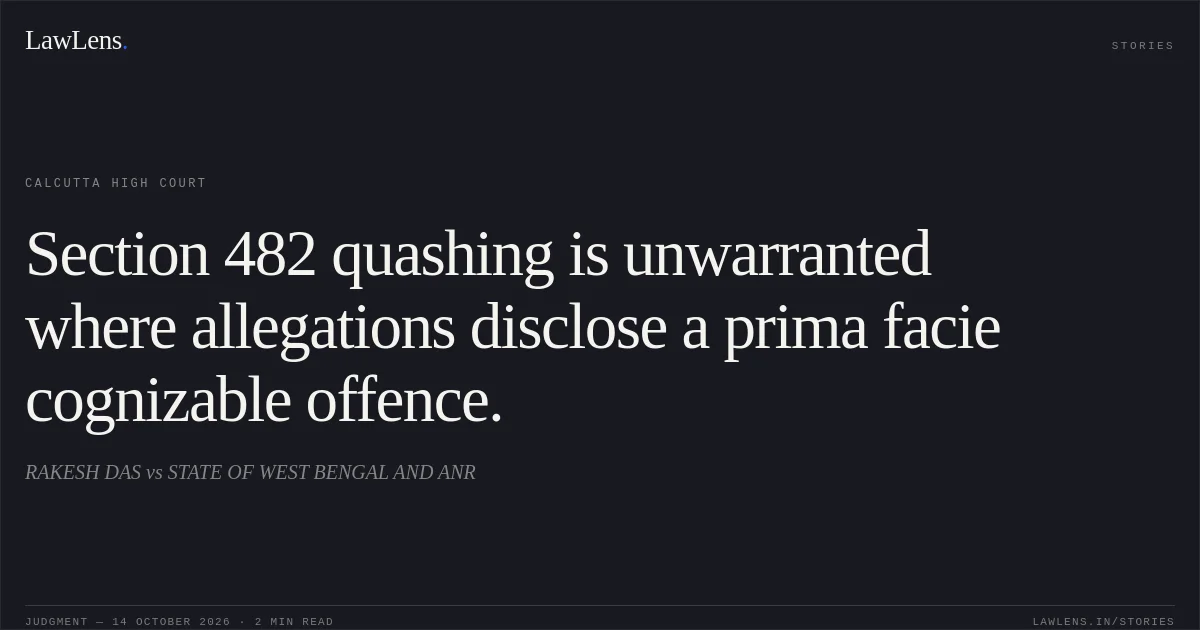
¶ 6, 14The petitioner sought quashing of the proceedings under Section 482 CrPC, contending that she had been implicated merely because she was the principal accused’s wife, that the allegations were improbable, that the earlier proceeding had already been quashed, and that Sections 406 and 420 IPC were mutually inconsistent.
¶ 7–902Issues
i.Whether the agreement bearing the petitioner’s signature, the signed cheque leaves, witness material, and allegations of financial fraud and forgery disclosed sufficient prima facie material to warrant a full-fledged trial, thereby precluding quashing under Section 482 CrPC?
¶ 13(i)ii.Whether the earlier territorial-jurisdictional history and the simultaneous invocation of Sections 406 and 420 IPC vitiated the criminal proceeding at the threshold?
¶ 13(ii)03Law Applied
The Court applied Section 482 CrPC, observing that inherent powers must be exercised sparingly, with caution and judicial restraint, and that the High Court cannot conduct a mini-trial or assess the reliability of disputed evidence at the quashing stage.
¶ 1, 14, 16The Court considered Sections 420, 406, 467, 468, 471 and 120B IPC, holding that the inclusion of overlapping or potentially inconsistent offences in an FIR or charge-sheet does not, by itself, invalidate the prosecution; the precise ingredients and appropriate charges are matters for the trial court.
¶ 18–19Relying principally on State of Haryana v. Bhajan Lal, 1992 Supp (1) SCC 335, the Court reiterated that quashing should be confined to exceptional cases and that the Court should not inquire into the genuineness or reliability of allegations at the threshold.
¶ 16It also relied on Sujit Biswas v. State of Assam, (2013) 12 SCC 406, Neeharika Infrastructure Pvt. Ltd. v. State of Maharashtra, (2020) 10 SCC 118, Sanjay Kumar Rai v. State of Uttar Pradesh, (2022) 15 SCC 720, and CBI v. Aryan Singh, (2023) 18 SCC 399, for the principle that criminal proceedings supported by prima facie material should not be prematurely terminated and that disputed factual and charge-related questions should be examined at trial.
¶ 17–19Provisions in the judgment · 10 · Linked ones open on LawLens
Code of Criminal Procedure, 1973 Section 161Section 482
Indian Penal Code, 1860 Section 406Section 409Section 420Section 465Section 467Section 468Section 471Section 474
04Reasoning
The Court found that the petitioner’s signatures on the agreements and cheques, together with the dishonour of those cheques, the statement of Md. Hamim Rahman under Section 161 CrPC, and the alleged shifting of residential addresses and telephone numbers, constituted prima facie material connecting her with the alleged fraudulent transaction.
¶ 10–11, 15Determining whether those signatures established participation, connivance, or merely an innocent association would require evidentiary examination and could not be resolved under Section 482 CrPC.
¶ 14–17The earlier Shyampukur proceeding had been quashed only because of territorial jurisdiction and had not resulted in an adjudication on the merits; accordingly, it did not bar a fresh proceeding before the police station having jurisdiction over the subsequent transactions and execution of documents.
¶ 6, 14, 20Similarly, the alleged inconsistency between Sections 406 and 420 IPC did not render the FIR or charge-sheet void, since the trial court could determine the appropriate charges after considering the charge-sheet and evidence.
¶ 18–2005Holding
The Court answered both issues against the petitioner. It held that the allegations and documentary materials disclosed prima facie, triable offences and that neither the prior territorial-jurisdictional quashing nor the inclusion of Sections 406 and 420 IPC justified interference at the threshold.
¶ 20–21C.R.R. No. 2047 of 2023 was dismissed; any interim order was vacated, there was no order as to costs, and the trial court was directed to proceed expeditiously in accordance with law without granting unnecessary adjournments.
¶ 22–27Original Court PDF
RUMA SARKARvsSTATE OF WEST BENGAL AND ANR
Click to open original judgment
Original judgment, available to read, download and summarize on LawLens.in