Facts
The petitioner sought quashing of the cognizance order dated 24 July 2017 passed in Hayaghat P.S. Case No. 02 of 2016, whereby cognizance was taken under Sections 341, 323, 307 and 504/34 IPC.
Source reference: paras. 2, 4The prosecution alleged that the petitioner, along with Ganga Mandal and Sunil Kumar, entered the informant’s courtyard; the petitioner allegedly assaulted the informant’s head with a farsa, while co-accused persons allegedly caused further injuries, threatened the informant’s wife and removed articles.
Source reference: paras. 2, 4During the pendency of the proceedings, the parties entered into a family settlement, restored cordial relations and filed formal compromise petitions before the court below.
Source reference: paras. 5–9The informant stated that he did not wish to pursue the prosecution further.
Source reference: paras. 5–9The investigation had concluded, the petitioner was not sent up for trial by the police, and the medical material indicated simple injury.
Source reference: paras. 18, 20Issues
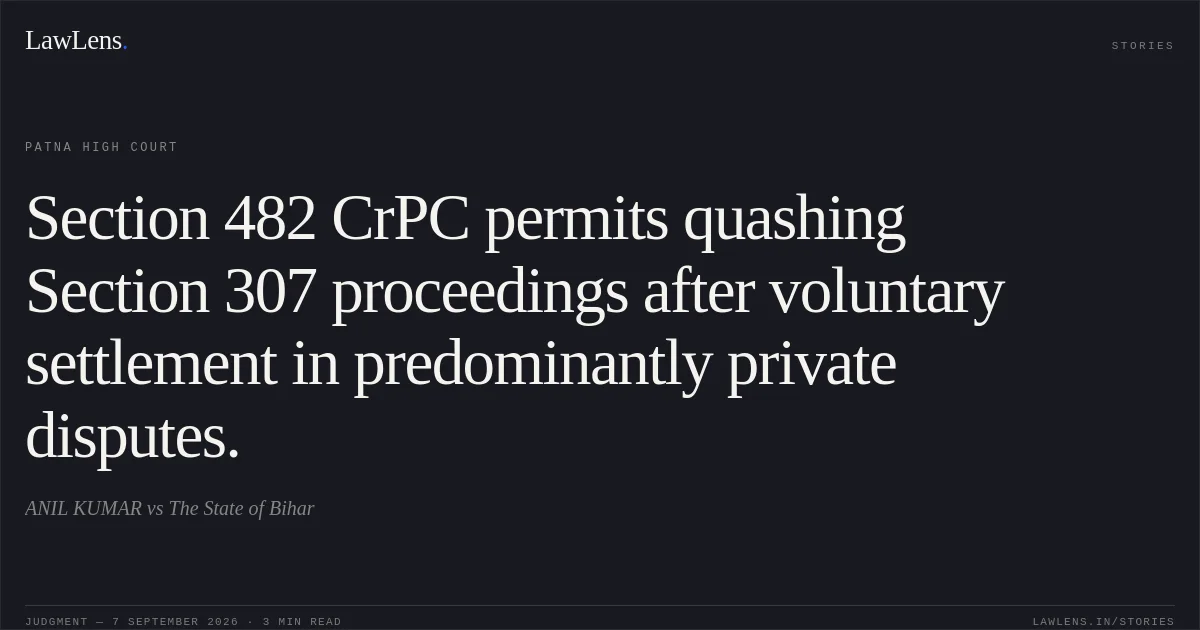
Whether the High Court could exercise its inherent jurisdiction under Section 482 Cr.P.C. to quash proceedings involving non-compoundable offences, including Section 307 IPC, after the parties had voluntarily settled their dispute.
Source reference: paras. 14–17, 21Whether, considering the nature of the injury, the investigation report, the petitioner’s non-submission for trial and the subsequent compromise, continuation of the criminal proceeding would amount to an abuse of the process of law.
Source reference: paras. 18–21, 27–32Law Applied
Section 482 Cr.P.C. empowers the High Court to prevent abuse of the process of court and secure the ends of justice, including quashing proceedings for non-compoundable offences where the dispute is predominantly private, family or civil in nature and the parties have genuinely resolved it; however, such power should ordinarily not be exercised for heinous offences having serious societal impact.
Source reference: paras. 14–17Relying on Narinder Singh v. State of Punjab, (2014) 6 SCC 466, and State of M.P. v. Laxmi Narayan, (2019) 5 SCC 688, the Court held that the mere inclusion of Section 307 IPC is not conclusive.
Source reference: paras. 15–17The Court may examine the nature and situs of the injury, the weapon used, the surrounding circumstances and the material collected during investigation.
Source reference: paras. 15–17Under the principle discussed from Naushey Ali v. State of U.P., 2025 SCC OnLine SC 292, Section 307 IPC allegations do not automatically bar quashing after settlement.
Source reference: paras. 19–20The principle from State of Himachal Pradesh v. Shamsher Singh, 2025 INSC 503, was also recognised: grievous injury is not indispensable for Section 307 IPC; the decisive consideration is the requisite intention or knowledge to cause death, assessed from the surrounding circumstances.
Source reference: paras. 19–20Reasoning
The Court treated the dispute as essentially personal and familial rather than one involving overriding public interest.
Source reference: para. 27Although Section 307 IPC was alleged, the medical material showed simple injury, the petitioner had not been sent up for trial by the investigating agency, and the circumstances did not demonstrate the kind of clear homicidal intention present in cases involving serious weapons or multiple grievous injuries.
Source reference: paras. 18–20, 29–30The Court expressly declined to hold that simple injury alone excluded Section 307 IPC; instead, it assessed the entire factual matrix, including the investigation material and the surrounding circumstances.
Source reference: para. 21The two-stage settlement—first through relatives and well-wishers and subsequently through formal compromise petitions signed by the parties—demonstrated a consistent, voluntary resolution of the dispute.
Source reference: paras. 22–31Since the informant no longer wished to prosecute and continuation of the case would serve no meaningful purpose, the proceedings were found to constitute an abuse of process.
Source reference: paras. 22–31Holding
The Court answered the issues in favour of the petitioner and exercised its inherent jurisdiction under Section 482 Cr.P.C.
It quashed and set aside the cognizance order dated 24 July 2017 in Hayaghat P.S. Case No. 02 of 2016, G.R. No. 70 of 2016, together with all consequential criminal proceedings, insofar as they related to Anil Kumar.
Source reference: para. 33The order was expressly confined to the petitioner and did not affect proceedings, if any, against the other accused persons.
Source reference: para. 34The application was accordingly allowed.
Source reference: para. 35Acts & Sections Cited
6 provisions across 2 statutes referred to in this judgment. Each provision opens on LawLens.
Indian Penal Code, 18605
Code of Criminal Procedure, 19731
Original Court PDF
ANIL KUMARvsThe State of Bihar
Click to open original judgment
Original judgment, available to read, download and summarize on LawLens.in