Facts
The de facto complainant alleged that Accused No. 1, her maternal uncle’s son, repeatedly had sexual intercourse with her on the promise of marriage, procured or compelled her to consume tablets resulting in abortions, and subsequently refused to marry her.
Source reference: p.2When she approached his family members—Accused Nos. 2 to 6, who are the petitioners in the present proceedings—for intervention, they allegedly abused her, refused to support the proposed marriage, and drove her away.
Source reference: p.4, para.6The police initially registered Crime No.17 of 2020 for offences under Sections 294(b), 417 and 376 IPC and Section 4 of the Tamil Nadu Prohibition of Harassment of Women Act.
Source reference: p.2–3, para.2The petitioners, being Accused Nos.2 to 6, invoked Section 482 CrPC seeking quashing of the proceedings in S.C. No.37 of 2023 pending before the Magalir Neethimandram, Fast Track Mahila Court, Tiruvannamalai.
Source reference: p.1; p.3, para.3Issues
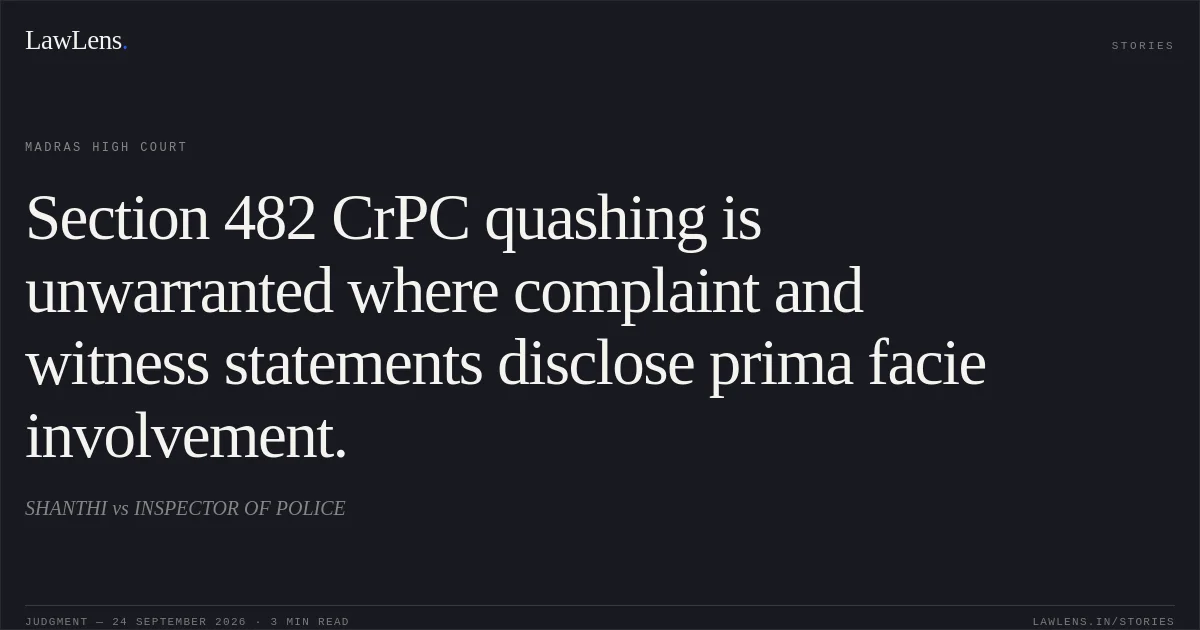
Whether the complaint, witness statements under Section 161 CrPC, and other materials disclosed prima facie involvement of Accused Nos.2 to 6 in the offence under Section 4 of the Tamil Nadu Prohibition of Harassment of Women Act.
Source reference: p.3, para.3; p.4–5, paras.6–8Whether the High Court should exercise its inherent jurisdiction under Section 482 CrPC to quash the criminal proceedings against Accused Nos.2 to 6 at the pre-trial stage.
Source reference: p.5, para.7; p.5, para.8Law Applied
The Court applied Section 482 CrPC, which preserves the High Court’s inherent power to prevent abuse of process and secure the ends of justice, while recognising that such jurisdiction is not ordinarily exercised to determine the truth or falsity of disputed allegations at the threshold.
Source reference: p.5, para.7The Court considered the prosecution provisions under Sections 376(2)(n), 417 and 312 IPC and Section 4 of the Tamil Nadu Prohibition of Harassment of Women Act, particularly the allegation that Accused Nos.2 to 6 harassed and abused the complainant when she sought their intervention concerning the proposed marriage.
Source reference: p.2–3, para.2The governing principle was that, in a petition for quashing, the Court must examine whether the materials disclose a prima facie case, and not conduct a detailed appreciation of evidence or decide the ultimate guilt of the accused.
Source reference: p.5, para.7Reasoning
The Court found that the complainant’s complaint and statement specifically attributed overt acts to Accused Nos.2 to 6, alleging that they abused her, rejected the proposed marriage, and drove her out of the accused family’s house.
Source reference: p.4, para.6The Court also noted that the complainant and other witnesses had referred to the petitioners’ involvement in their statements.
Source reference: p.4–5, paras.6–8Applying the limited scope of Section 482 CrPC, the Court held that these materials were sufficient to establish a prima facie case under Section 4 of the Tamil Nadu Prohibition of Harassment of Women Act.
Source reference: p.5, paras.7–8Whether the allegations were ultimately true was a matter for trial and could not be determined in the quashing proceedings.
Source reference: p.5, paras.7–8Holding
The High Court answered the issues against the petitioners.
It held that prima facie materials existed to proceed against Accused Nos.2 to 6 and that the case did not warrant exercise of the inherent power under Section 482 CrPC.
Source reference: p.5, para.8Accordingly, the Criminal Original Petition was dismissed, and the proceedings in S.C. No.37 of 2023 before the Magalir Neethimandram, Fast Track Mahila Court, Tiruvannamalai, were allowed to continue.
Source reference: p.5, para.8; p.6Acts & Sections Cited
6 provisions across 2 statutes referred to in this judgment. Each provision opens on LawLens.
Code of Criminal Procedure, 19732
Indian Penal Code, 18604
Original Court PDF
SHANTHIvsINSPECTOR OF POLICE
Click to open original judgment
Original judgment, available to read, download and summarize on LawLens.in