01Facts
The petitioner (accused No.1, appearing in person) and respondent No.2 (complainant, wife) were married on 10.03.2008 at Dharmasthala and the reception was held on 12.03.2008.
¶ 3.2–3.3 · ¶ 17Respondent No.2 alleged dowry demands (a Skoda car, a Mumbai apartment, a vacant site, and cash for business), physical and mental harassment, the petitioner's extramarital relationship, and filthy abuse.
¶ 3.3–3.7She lodged a complaint on 27.01.2010, registered as Crime No. 44/2010 at Bannerghatta P.S. under Sections 498A, 324, 120B, 506, 307, 420 and 114 IPC and Sections 3 and 4 of the Dowry Prohibition Act.
¶ 3.1The police filed a charge sheet, and the Trial Magistrate committed the case to the Sessions Court.
¶ 3.8–3.9The Sessions Judge discharged the accused of the Section 307 IPC offence and remitted the matter for trial of the remaining offences in C.C. No. 1854/2010.
¶ 3.11–3.12Accused No.2 (the petitioner's father) died during pendency and the proceedings against him abated.
¶ 5The petitioner sought quashing of the FIR, charge sheet, committal order and all proceedings under Articles 226–227 of the Constitution and Section 482 CrPC.
¶ 2He contended that material facts were suppressed at the time of marriage, that Sections 11 and 12 Hindu Marriage Act proceedings are pending, and that he has won 19 of 21 cases filed against him.
¶ 6–8He relied on a letter dated 11.01.2010 written by respondent No.2 as showing no contemporaneous allegation of dowry or harassment.
¶ 15, 30–31Mediation failed.
¶ 47A separate I.A. No. 4/2025 sought action against respondent No.2 for allegedly concocted documents.
¶ 10, 5402Issues
i.1. Whether the FIR, charge sheet, committal order and proceedings in C.C. No. 1854/2010 can be quashed under Section 482 CrPC on the basis of the petitioner's material, without a mini-trial.
¶ 22, 37, 53ii.2. Whether the letter dated 11.01.2010 constitutes "sterling and impeccable" material sufficient to justify quashing.
¶ 41–42iii.3. Whether the disputed allegations (dowry demand, harassment, witness credibility, and the petitioner's multiple litigation record) can be decided at this stage.
¶ 20, 43–44, 49–50iv.4. Whether the discharge of the Section 307 IPC charge warrants quashing of the remaining charges.
¶ 51–52v.5. Whether criminal contempt or action should be initiated against respondent No.2 for allegedly concocted documents.
¶ 54–5703Law Applied
The court's reasoning rests on Section 482 CrPC and the inherent power of the High Court to prevent abuse of process and secure the ends of justice, which must be exercised sparingly.
It applied the four-step test from Prashant Bharti v. State (NCT of Delhi), (2013) 9 SCC 293, which itself draws on Rajiv Thapar v. Madan Lal Kapoor, (2013) 3 SCC 330.
¶ 38–39Under that test, quashing is permissible only if the accused's material is of "sterling and impeccable quality," rules out the complaint's assertions, is not refutable by the prosecution, and continuation would be an abuse of process.
¶ 39The court relied on the principle that the High Court cannot conduct a mini-trial or assess the veracity of disputed facts in quashing proceedings.
¶ 20, 37It referred to State of Haryana v. Bhajan Lal, 1992 SCC (Supp) 1 (categories for quashing), which the petitioner invoked.
¶ 22The judgment also refers to Sushil Kumar Sharma, Preeti Gupta, Kahkashan Kausar and Rajesh Chaddha (as cited by the parties), but the court's operative reasoning rests on the Prashant Bharti test and the mini-trial bar.
¶ 9, 14, 23The court relied on the principle that criminal contempt for documents requires prior adjudication and, in this case, the sanction of the Advocate General.
¶ 55–57Provisions in the judgment · 27 · Linked ones open on LawLens
Code of Criminal Procedure, 1973 11 provisions
Section 482Section 227Section 228Section 154Section 164Section 156Section 155Section 340Section 239Section 341Section 195Indian Penal Code, 1860 9 provisions
Section 324Section 506Section 307Section 420Section 114Section 323Section 376Section 466Section 468Dowry Prohibition Act, 1961 Section 3Section 4
Hindu Marriage Act, 1955 Section 11Section 12Section 23
Protection of Children from Sexual Offences Act, 2012 Section 22
Contempt of Courts Act, 1971 Section 12
04Reasoning
The court first noted that the marriage, the reception, and respondent No.2's joining the matrimonial home are undisputed.
¶ 17–18It held that whether the alleged dowry demand was made, and whether the complaint was lodged with an intent to harass, cannot be decided without a mini-trial.
¶ 20Applying the Prashant Bharti test, the court held that the letter dated 11.01.2010 is at most a defence to be tested at trial. Its contents do not disclose dowry demands or harassment, but a wife attempting reconciliation would not ordinarily mention such matters. Respondent No.2 can be called upon to explain that omission at trial.
¶ 33–36The letter therefore did not meet the "sterling and impeccable quality" requirement and could not rule out the allegations.
¶ 41–42Demand of dowry, physical and mental harassment, and non-joining of the wife after childbirth were held to be matters for adjudication by evidence.
¶ 43The court also held that the credibility of the prosecution witnesses is a trial issue and that the material was not too weak to proceed.
¶ 44–45The court relied on the long pendency of the dispute since 2010, the failed mediation, and the petitioner's conduct as indicative of an interest in delay.
¶ 46–47Litigation outcomes in other cases (19 of 21) were treated as trial considerations.
¶ 49The Section 307 discharge did not justify quashing the rest of the case, as a discharge on one offence does not entitle the accused to quashing of the others.
¶ 51–52On I.A. No. 4/2025, the court held that the documents were certified copies, no Advocate General sanction had been obtained, and a contempt or prosecution claim could not be entertained at this stage, though the petitioner remains free to pursue it later if the documents are shown to be false.
¶ 54–5705Holding
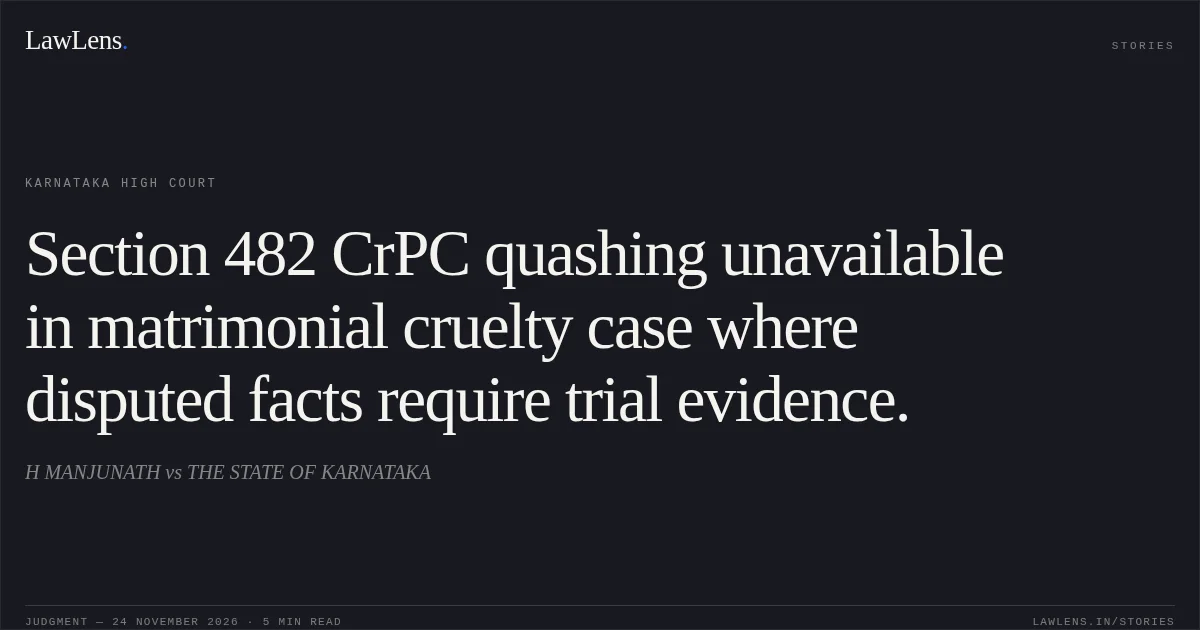
The material on record is not sufficient to quash the pending criminal proceedings, and the petitioner's grounds raise triable issues that must be decided by the Trial Magistrate on evidence.
¶ 48, 53The letter dated 11.01.2010 is not "sterling and impeccable" material and cannot rule out the allegations; it is at most a defence to be tested at trial.
¶ 41–42The petition is dismissed.
¶ 58The observations made in the order do not affect the rights of either party in the pending trial.
¶ 58(ii)Pending interlocutory applications, including I.A. No. 4/2025, are consigned to records, and the petitioner may pursue action against the documents at a later stage if they are established as false. The trial in C.C. No. 1854/2010 shall proceed.
¶ 57, 58(iii)Original Court PDF
H MANJUNATHvsTHE STATE OF KARNATAKA
Click to open original judgment
Original judgment, available to read, download and summarize on LawLens.in