01Facts
Deceased Ramani was the legally wedded wife of PW1 Kumara Shetty.
¶ 3The prosecution alleged that accused No. 1 (the appellant) had sexual intercourse with her for 3 to 4 years before 18.09.2012, knowing she was PW1's wife.
¶ 3It was further alleged that accused Nos. 1 to 5 harassed Ramani and criminally intimidated her to vacate Devanahalli, and that on 18.09.2012 she consumed pesticide and died on 19.09.2012.
¶ 3The Sub-Inspector charge-sheeted the accused under Sections 306, 497 and 506 read with 34 IPC.
¶ 3The prosecution examined 17 witnesses and marked 23 exhibits.
¶ 4The trial court (V Addl. District and Sessions Judge, Devanahalli, S.C. No. 88/2013) acquitted all five accused under Sections 306 and 506 r/w 34 IPC, but convicted accused No. 1 under Section 497 IPC and sentenced him to two years' rigorous imprisonment and a fine of ₹25,000 by judgment dated 29.04.2015 and sentence dated 02.05.2015.
¶ 4The State did not appeal the acquittals.
¶ 9Accused No. 1 alone appealed.
¶ 402Issues
i.1. Whether the conviction of accused No. 1 under Section 497 IPC can be sustained after the Supreme Court in Joseph Shine struck down that provision as unconstitutional.
¶ 9 · ¶ 11ii.2. Whether the declaration of unconstitutionality of Section 497 IPC applies retrospectively to pending proceedings, including the present appeal.
¶ 1003Law Applied
The court relied on Joseph Shine v. Union of India, AIR 2018 SC 4898, which held that Section 497 IPC is unconstitutional as violative of Articles 14, 15 and 21 of the Constitution, that Section 198(2) CrPC is unconstitutional insofar as it applies to adultery under Section 497, and that Sowmithri Vishnu (AIR 1985 SC 1618) and W. Kalyani (AIR 2012 SC 497) stand overruled.
¶ 9On retrospectivity, the court followed Maj. Gen. A.S. Gaurava v. S.N. Thakur, AIR 1986 SC 1440, which holds that a declaration of law by the Supreme Court applies to all pending proceedings with retrospective effect.
¶ 10The court also relied on the Delhi High Court in Ashok Kumar Singh v. State (decided 17.04.2025), the Telangana High Court in Satyam Sudarshan v. State of Telangana (03.08.2022), and the Punjab and Haryana High Court in Chetan Kumar v. State of Punjab, 2019 SCC OnLine P 6290, which applied the Joseph Shine ruling to pending Section 497 cases.
¶ 5 · ¶ 10The State did not dispute these authorities.
¶ 6Provisions in the judgment · 7 · Linked ones open on LawLens
Code of Criminal Procedure, 1973 Section 374Section 313Section 198
Indian Penal Code, 1860 Section 306Section 497Section 506Section 34
04Reasoning
The appellant's counsel contended that Joseph Shine invalidated Section 497 IPC and that the Delhi High Court had applied that ruling to pending matters.
¶ 5The State conceded the position.
¶ 6The court held that the declaration of unconstitutionality is retrospective and governs pending proceedings, relying on Gaurava and the decisions following it.
¶ 10Because the sole basis of the conviction was Section 497 IPC, which no longer exists in constitutional law, the impugned conviction could not be sustained.
¶ 11The acquittals under Sections 306 and 506 r/w 34 IPC were not challenged by the State and were therefore not disturbed.
¶ 9The court did not separately examine the evidence on the merits of the Section 497 charge, as the conviction fell on the legal ground alone.
¶ 1105Holding
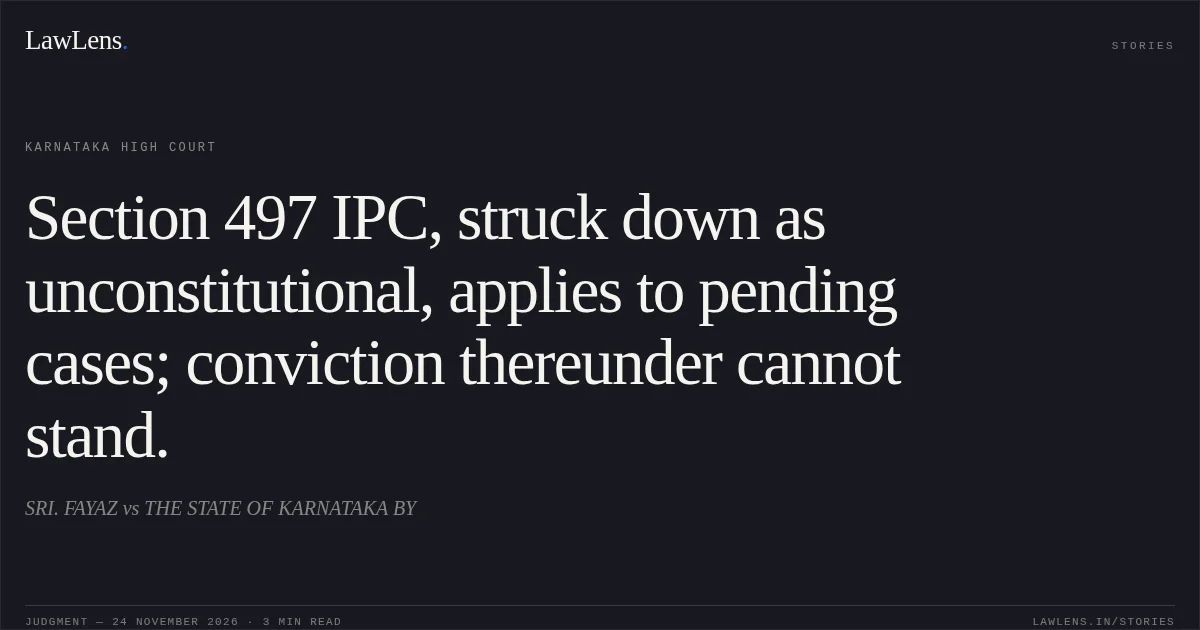
Point No. 1 is answered in the affirmative: the impugned conviction cannot be sustained because Section 497 IPC has been struck down as unconstitutional and the declaration applies to pending proceedings.
¶ 10 · ¶ 11The appeal is allowed. The judgment of conviction and order on sentence dated 29.04.2015 in S.C. No. 88/2013 are set aside, and accused No. 1 is acquitted of the offence under Section 497 IPC. The trial court is directed to refund any fine deposited by accused No. 1. The Registry is directed to transmit the trial court records along with a copy of the judgment to the concerned court.
¶ 12Original Court PDF
SRI. FAYAZvsTHE STATE OF KARNATAKA BY
Click to open original judgment
Original judgment, available to read, download and summarize on LawLens.in