01Facts
The petitioners (accused Nos. 2 and 3) were alleged to have threatened Sandeep, a witness in S.C. No. 1319 of 2024 (arising from Crime No. 250 of 2024, including an offence under Section 302 IPC).
p. 3The second respondent, an Assistant Sub-Inspector, was on court-monitoring duty in that case when examination of witnesses was scheduled on 24.06.2026.
p. 3On 25.06.2026, Sandeep, a cashier at a restaurant in Tumakuru, was allegedly taken into a car by one Akarsh and two unknown persons. The person in the rear seat allegedly questioned him about his court deposition, and another person allegedly joined a WhatsApp conference call and instructed him to depose in a particular manner.
pp. 3–5On 27.06.2026, the complainant lodged a complaint, registered as Crime No. 298 of 2026 at Kamakshipalya P.S. under Sections 232, 61(1) and 238 BNS against Akarsh and unknown persons.
p. 5On 01.07.2026, the petitioners, along with accused No. 1, were taken into custody and produced before the concerned Court.
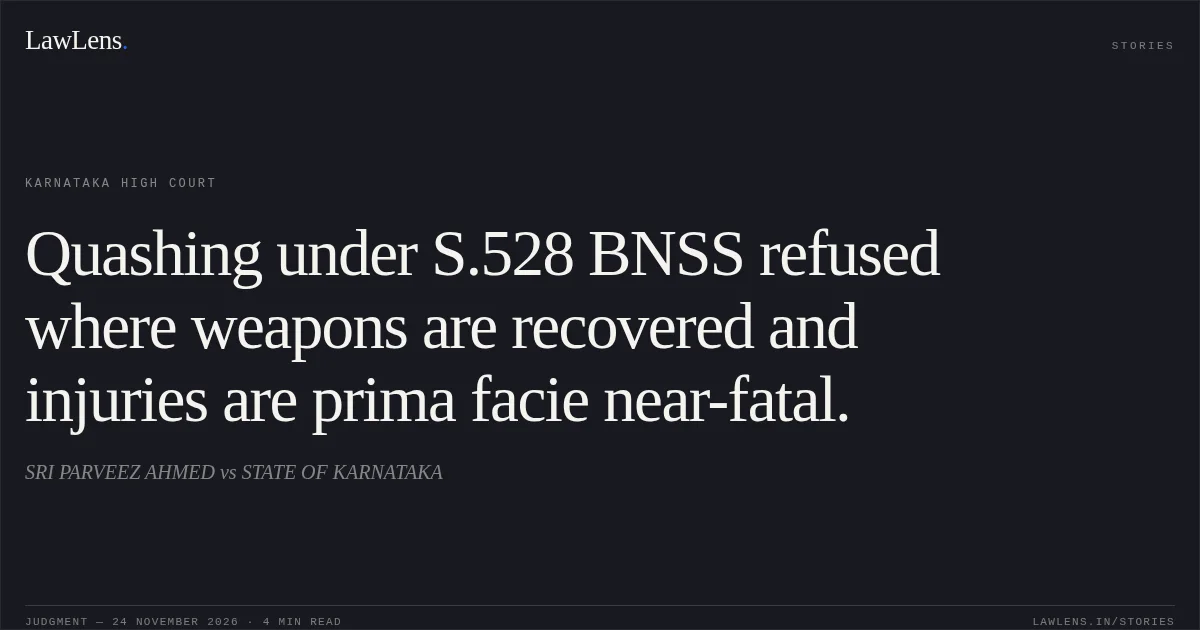
pp. 5–6The petitioners sought quashment of the FIR and of further investigation under Section 528 BNSS.
p. 2 / cover02Issues
i.1. Whether there is procedural aberration in the registration of Crime No. 298 of 2026 that warrants its quashment, including whether the offence under Section 232 BNS (Section 195-A IPC) required a complaint under Section 195(1)(b)(i) CrPC / Section 340 CrPC or prior Magistrate permission under Section 174(2) BNSS / Section 155(2) CrPC.
p. 8ii.2. Whether the ingredients of Section 232 BNS are made out such that the proceedings must be quashed at the threshold.
pp. 24–25 / para. 903Law Applied
Section 232 BNS mirrors Section 195-A IPC and penalises threatening a person with injury with intent to cause that person to give false evidence, with enhanced punishment where an innocent person is convicted as a result.
pp. 8–9Section 195(1)(b)(i) CrPC and Section 340 CrPC require a court's complaint for specified offences committed in relation to court proceedings.
p. 9 / no citationSections 154, 155(2) and 156 CrPC (corresponding to Sections 173, 174 and 175 BNSS) provide that cognizable offences may be registered without Magistrate permission, while non-cognizable offences require it.
p. 9 / no citationIn State of Kerala v. Suni, 2025 SCC OnLine SC 2295, Section 195-A IPC is a cognizable offence, the complaint route under Section 195-A CrPC is only an additional remedy, and the Section 195(1)(b)(i) procedure does not apply.
pp. 23–24In Salib v. State of U.P., (2023) 20 SCC 194, the ingredients of Section 195-A must be assessed against the threat's purpose of inducing false evidence before a court.
pp. 25–26In Ramlal Dhakad v. State of M.P., 2024 SCC OnLine MP 9707, the offence is complete on the threat itself and ingredients are a matter for trial.
pp. 27–29Section 528 BNSS governs the High Court's inherent power to quash proceedings.
p. 25 / no citationProvisions in the judgment · 38 · Linked ones open on LawLens
Bharatiya Nagarik Suraksha Sanhita, 2023 Section 528Section 232Section 215Section 379Section 174
Bharatiya Nyaya Sanhita, 2023 Section 232Section 61Section 238
Indian Penal Code, 1860 20 provisions
Section 191Section 192Section 193Section 194Section 195Section 196Section 197Section 198Section 199Section 200Section 205Section 206Section 207Section 208Section 209Section 210Section 211Section 228Section 323Section 452Code of Criminal Procedure, 1973 9 provisions
Section 155Section 195Section 340Section 2Section 154Section 156Section 190Section 482Section 227Drugs and Cosmetics Act, 1940 Section 32
04Reasoning
On the procedural challenge, the Court reasoned that Suni conclusively settled that Section 195-A IPC/232 BNS is cognizable and is not subject to the Section 195(1)(b)(i) CrPC complaint bar.
pp. 23–24Because the offence is cognizable, police registration under Section 154 CrPC is valid, and no Magistrate permission under Section 155(2) CrPC or Section 174(2) BNSS was required. The Court therefore rejected the petitioners' procedural objection.
p. 24On the merits, the Court relied on Salib and Ramlal Dhakad to hold that the ingredients of Section 232 BNS, including the threat and intent to procure false evidence, are matters requiring investigation and trial. The Court noted that the proceedings were still at the investigation stage.
pp. 25–29The Court did not expressly address the petitioners' reliance on the Madhya Pradesh High Court's decision in Shailendra Sharma v. Indus Residency Pvt. Ltd., and it recorded the State's contention that the petitioners do not deny involvement without treating that as a determinative ground.
pp. 6 / pp.7–805Holding
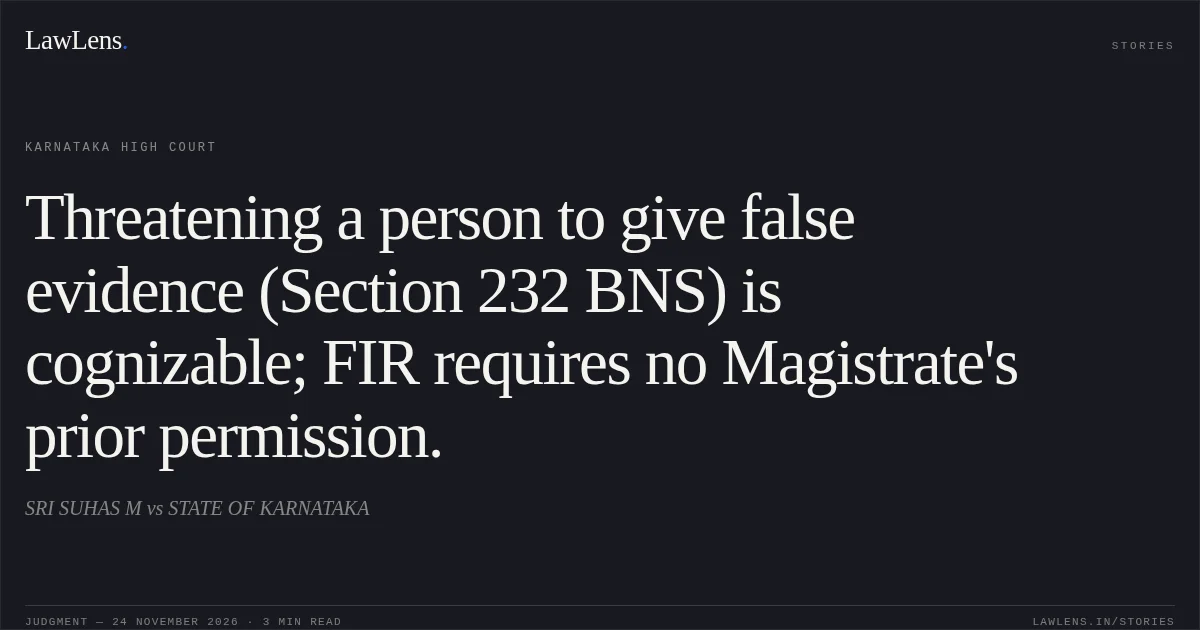
The offence under Section 232 BNS is cognizable, so registration without a court complaint or Magistrate permission is not procedurally defective.
p. 24Whether the ingredients are made out is a matter for investigation and trial, and quashment at the threshold is not warranted under Section 528 BNSS.
p. 29 / para. 9The petition was dismissed. Any interim order was dissolved, and the petitioners were left to avail such remedies as are available in law.
p. 30 / para. 10Original Court PDF
SRI SUHAS MvsSTATE OF KARNATAKA
Click to open original judgment
Original judgment, available to read, download and summarize on LawLens.in