01Facts
On 14.07.2009, the appellant (accused no. 1) and accused no. 2 were allegedly found near the sea shore at Subhash Nagar, Ullal, in possession of 1.400 kg of ganja for sale.
¶ 10 · p. 7On seeing the police, both attempted to flee; accused no. 1 was caught holding a parcel of ganja and accused no. 2 escaped.
¶ 10 · p. 7PW-1, the Police Inspector, testified that information was received by phone at about 09:30 a.m. and recorded in the station diary.
¶ 11 · pp. 7–8PW-1 stated that the seizure mahazar (Ex.P1) was drawn in the presence of panchas.
¶ 11 · p. 8Panchas PW-2 and PW-3 partly supported the prosecution and were declared hostile; their Section 161 CrPC statements (Exs.P8, P9) were denied.
¶ 11 · pp. 8–9PW-4 and PW-5 deposed to the seizure.
¶ 12 · p. 9The FIR (Ex.P3) recorded the property as 1 kg, while Ex.P1 recorded 1.400 kg; the General Diary reference was 10/14:30 hours.
¶ 13 · pp. 9–10 · ¶ 14 · p. 10The trial court convicted accused no. 1 under Section 8(c) r/w 20(b)(ii)(B) of the NDPS Act and sentenced him to two years' rigorous imprisonment and a fine of ₹10,000, and acquitted accused no. 2.
¶ 3(d) · p. 4The appellant challenged the conviction.
¶ 1 · p. 102Issues
i.1. Whether the appellant/accused no. 1 has made out grounds to interfere with the conviction and sentence passed by the trial court.
¶ 8 · p. 6ii.2. Whether the prosecution proved the seizure of ganja from the appellant's possession, given the inconsistencies between the FIR, the seizure mahazar, and the testimony of the panch witnesses.
¶ 5 · pp. 4–5 · ¶ 13 · pp. 9–10 · ¶ 15 · p. 11iii.3. Whether non-compliance with the procedural safeguards (Section 42 NDPS Act; Sections 100 and 102 CrPC) vitiates the prosecution case.
¶ 14 · pp. 10–1103Law Applied
The court relied on Sections 8(c) and 20(b)(ii)(B) of the NDPS Act as the charging provisions.
¶ 1 · p. 1 · ¶ 3(d) · p. 4The court treated Section 42 NDPS Act as requiring the investigating officer to show compliance with the mandatory procedure on receipt of information and recording of it, and Sections 100 and 102 CrPC as requiring compliance with search, seizure, and reporting procedure.
¶ 14 · pp. 10–11The court held that the prosecution must establish, through cogent, convincing and corroborative evidence, that the seized property was recovered from the accused.
¶ 15 · p. 11The appellant invoked Sections 50 and 52A NDPS Act, but the court did not expressly decide them.
¶ 4 · p. 4The appellant cited Suresh v. State of M.P. (2013) 1 SCC 550, Ashok Kumar Sharma v. State of Rajasthan (2013) 2 SCC 67, State of Rajasthan v. Parmanand (2014) 5 SCC 345, and Abdul Rajik v. State of M.P. (2026) 10 SCR 180; the judgment does not discuss their holdings.
¶ 6 · pp. 5–6Provisions in the judgment · 9 · Linked ones open on LawLens
Code of Criminal Procedure, 1973 Section 100Section 102Section 161Section 313Section 374
Narcotic Drugs and Psychotropic Substances Act, 1985 Section 8Section 20Section 42Section 50
04Reasoning
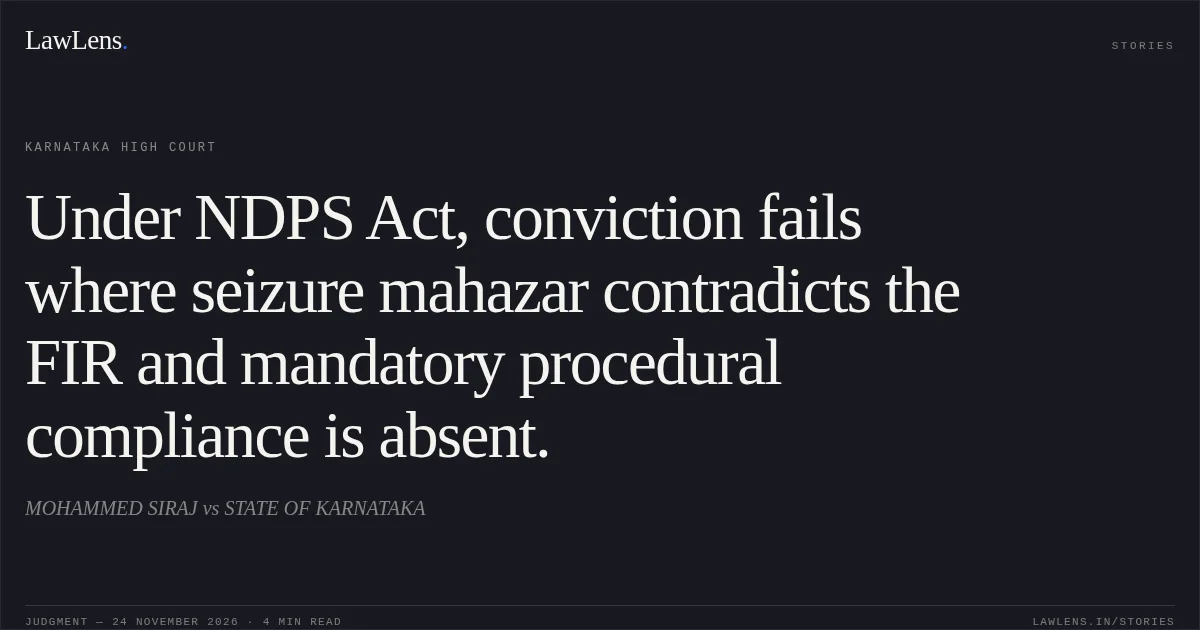
The court examined the record and identified multiple defects in the prosecution case. First, the seized quantity in the FIR (1 kg) did not match the quantity in the seizure mahazar (1.400 kg).
¶ 13 · pp. 9–10Second, the mahazar (Ex.P1) was recorded between 11:15 and 13:15 hours, yet the General Diary entry was made at 10/14:30 hours, after the seizure and arrest. The court therefore concluded that the information recorded in the GD could not be shown to have been received at 09:40 a.m. as alleged.
¶ 14 · pp. 10–11Third, the investigating officer had not produced the GD extract and had not shown compliance with Section 42 NDPS Act, Section 100 CrPC, or Section 102 CrPC.
¶ 14 · pp. 10–11Fourth, the independent panch witnesses did not support the prosecution, and their Section 161 statements were denied.
¶ 11 · pp. 8–9 · ¶ 15 · p. 11Because PW-1's testimony was not corroborated by independent witnesses and the seizure record was internally inconsistent, the court held that the evidence did not meet the standard required for conviction. The trial court's conviction was therefore held unsustainable in law.
¶ 15 · p. 11The judgment does not expressly address the appellant's argument that PW-3 did not see who possessed the ganja, nor the appellant's argument that the seizure took place at the police station, though these points are embedded in the appellant's submissions.
¶ 5 · pp. 4–505Holding
The court answered Point No. 1 in the affirmative, holding that the appellant had made out grounds to interfere, because the prosecution failed to prove the seizure and possession through cogent, convincing and corroborative evidence.
¶ 15 · p. 11 · ¶ 9 · p. 6The appeal was allowed. The conviction dated 16.12.2014 and sentence dated 17.12.2014 in Special Case No. 25/2009 were set aside, and the appellant was acquitted under Section 8(c) r/w 20(b)(ii)(B) NDPS Act.
¶ 16 · pp. 11–12The bail bond was cancelled, the trial court was directed to refund any fine deposited, and the Registry was directed to send the judgment and TCR to the trial court.
¶ 16 · p. 12Original Court PDF
MOHAMMED SIRAJvsSTATE OF KARNATAKA
Click to open original judgment
Original judgment, available to read, download and summarize on LawLens.in