01Facts
The complainant and accused were relatives.
The complainant alleged that the accused borrowed ₹2,00,000 in cash on 30.04.2016, withdrawn from her husband's bank account, and a further ₹1,00,000 transferred to the accused's bank account on 16.01.2017, totalling ₹3,00,000 repayable within three months.
¶ 3–4On non-repayment, the accused issued Cheque No. 915929 dated 03.06.2017 for ₹3,00,000 drawn on Canara Bank.
¶ 5The cheque was returned unpaid on 05.06.2017 with the endorsement "Payment stopped by drawer".
¶ 5A legal notice dated 24.06.2017 was served on 27.06.2017, and the accused replied on 28.06.2017 (Ex.P6).
¶ 6The complainant filed a complaint under Section 200 CrPC.
¶ 6–7The IV JMFC, Mysuru, convicted the accused under Section 138 NI Act on 07.03.2020, imposing a fine of ₹3,05,000 (default: six months' SI), with ₹1,00,000 directed as compensation to the complainant under Section 357 CrPC.
¶ 6–7The accused's defence was that the cheque was security for a chit amount of ₹1,30,000 and an insurance sum of ₹60,000, which she claimed had been fully paid, and that the complainant had not returned the cheque despite requests, claiming it was lost.
¶ 10(i)The VI Additional District Judge, Mysuru, dismissed Criminal Appeal No. 129 of 2020 on 21.09.2021.
¶ 8The Appellate Court rectified the compensation clause to ₹3,00,000 for the complainant and ₹5,000 for the State, under Sections 362 and 386 CrPC.
¶ 802Issues
i.1. Whether the accused rebutted the presumptions under Sections 118 and 139 NI Act so as to warrant interference with the concurrent findings of the Courts below.
¶ 12(i)ii.2. Whether the Appellate Court was justified in rectifying the clerical or arithmetical error in the operative portion of the sentence order.
¶ 12(ii)03Law Applied
Section 138 NI Act, under which dishonour of a cheque for insufficiency of funds or stopped payment, followed by non-payment after statutory notice, constitutes the offence.
¶ 14Sections 118 and 139 NI Act, under which a cheque is presumed to have been issued for consideration, and the holder is presumed to hold it for a legally enforceable debt.
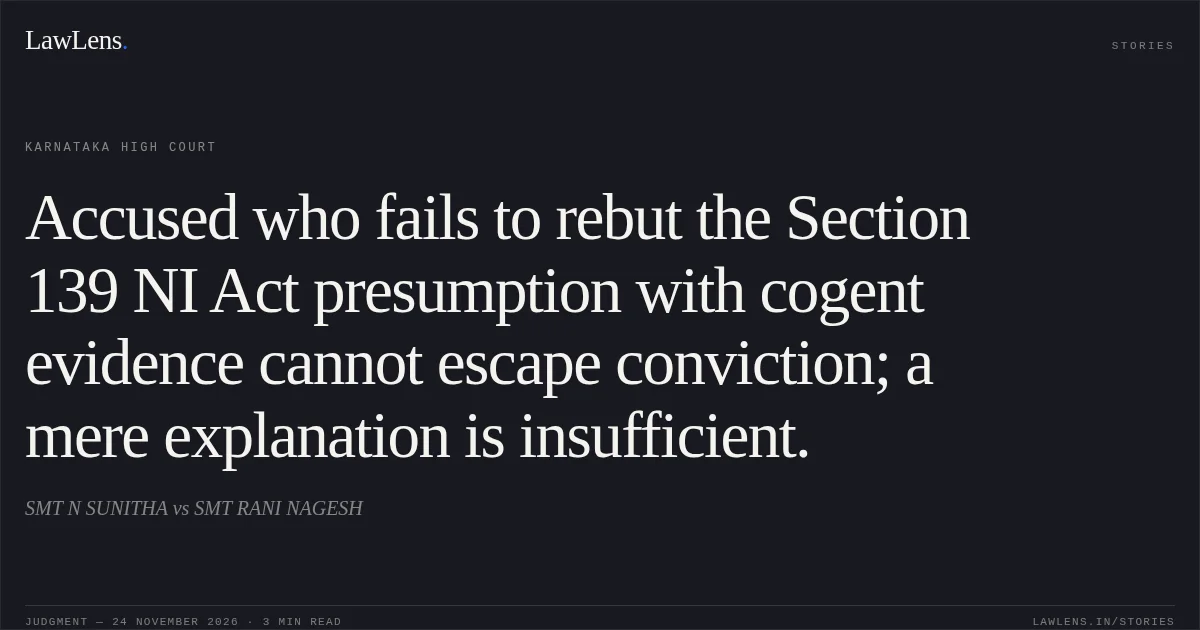
¶ 11(i), 15The Section 139 presumption is one of law, not fact, the onus of rebuttal lies on the accused, and rebuttal evidence must be sufficient, cogent and establish the defence beyond reasonable doubt; a mere explanation is insufficient.
¶ 16Section 362 CrPC, which bars alteration of a judgment after signing but expressly saves correction of clerical or arithmetical errors.
¶ 17Section 386 CrPC, which vests the Appellate Court with the powers of the Trial Court.
¶ 17No precedents are cited in the judgment.
Provisions in the judgment · 9 · Linked ones open on LawLens
Code of Criminal Procedure, 1973 Section 397Section 401Section 200Section 357Section 362Section 386
Negotiable Instruments Act, 1881 Section 138Section 118Section 139
04Reasoning
The complainant's financial capacity was established by Exs.P7 and P8 (gold-pledge documents) and the passbook entries showing a ₹1,98,000 withdrawal from her husband's account, so the sum was not beyond her means.
¶ 13The alleged inconsistencies in PW1's evidence were treated as minor and not going to the root of the case.
¶ 14The chit-transaction defence failed because the accused led no evidence of subscribership or payments, and no other chit members were examined.
¶ 14–15The claim that the cheque was lost was held unproven: a stop-payment instruction citing loss would have been expected, and no notice seeking return of the cheque was issued.
¶ 15The accused therefore failed to probabilise her defence.
¶ 15–16The Trial Court had imposed a ₹3,05,000 fine but mis-apportioned ₹2,00,000 of it in the operative part, which was a clerical or arithmetical error.
¶ 17–18The Appellate Court neither enhanced the sentence nor altered the total fine or default term; it merely aligned the apportionment with the Trial Court's intent, causing no prejudice to the accused, while preventing injustice to the complainant.
¶ 17–1805Holding
Issue 1 is answered in the negative: the Section 118/139 presumptions were not rebutted, and the concurrent findings are neither perverse nor contrary to the record, so no revisional interference is warranted.
¶ 15–16Issue 2 is answered in the negative: the Appellate Court's correction under Sections 362 and 386 CrPC was lawful.
¶ 17–18The Criminal Revision Petition is dismissed, and the conviction and sentence under Section 138 NI Act, as modified by the Appellate Court, are confirmed.
¶ 19–20(i)–(ii)The amount deposited by the accused before the Trial Court is to be released to the complainant.
¶ 20(iii)The Registry is directed to transmit the Trial Court records.
¶ 20Original Court PDF
SMT N SUNITHAvsSMT RANI NAGESH
Click to open original judgment
Original judgment, available to read, download and summarize on LawLens.in