Facts
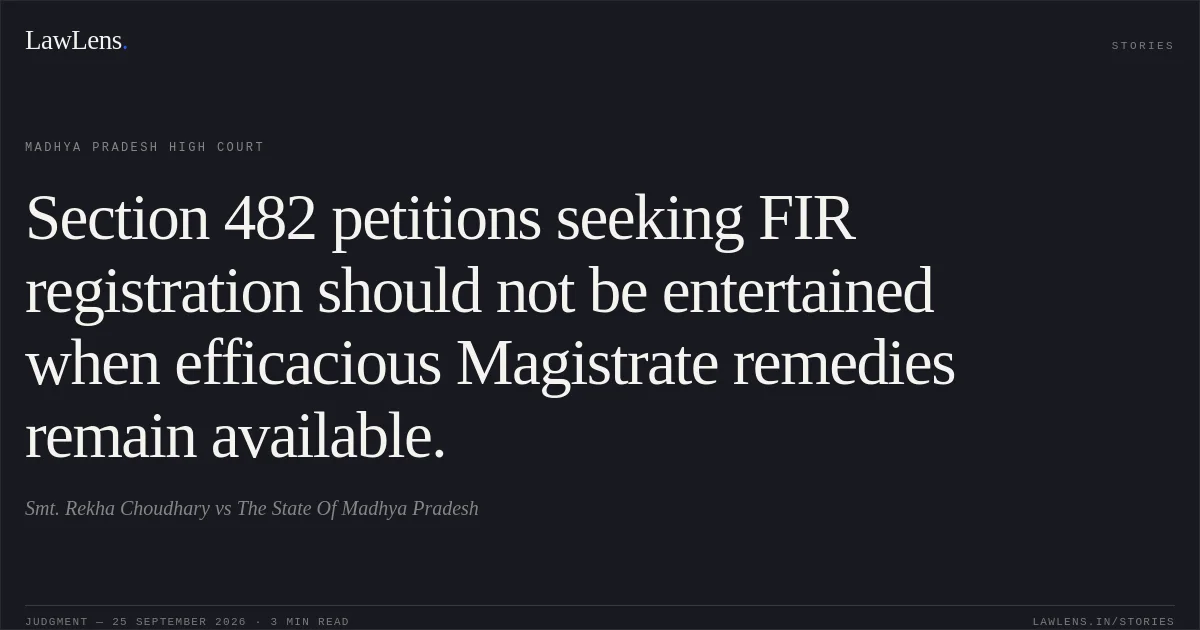
The petitioner invoked Section 482 of the Code of Criminal Procedure, 1973, seeking directions to the authorities to decide her representations and to register an FIR against Respondents 5 to 9 for offences under Sections 420, 466, 467, 468, 469, 471 and 120-B IPC.
Source reference: para. 1The petitioner’s husband, who was employed in the Health Department at Narsinghpur, died on 6 January 2018. According to the petitioner, she was recorded as the nominee in his service records, but Respondents 5 to 9 allegedly prepared a forged and fabricated will in relation to his property or service benefits.
Source reference: para. 2She submitted complaints and representations to the Commissioner, Jabalpur; the Collector and Superintendent of Police, Narsinghpur; and the Station House Officer, Police Station Singhpur, but alleged that no action was taken.
Source reference: para. 2The State opposed the petition on the ground that the petitioner had an efficacious alternative remedy before the competent Magistrate under Sections 156(3), 200 and 202 CrPC.
Source reference: para. 3Issues
Whether the High Court should exercise its inherent jurisdiction under Section 482 CrPC to direct the police authorities to register an FIR and decide the petitioner’s representations when statutory remedies under the CrPC were available?
Source reference: paras. 1, 3–4, 9Whether the petitioner should be relegated to the remedy of approaching the jurisdictional Magistrate under Section 156(3) CrPC or by filing a complaint under Section 200 CrPC?
Source reference: paras. 5–10Law Applied
The Court applied Section 482 CrPC governing the High Court’s inherent jurisdiction and held that such jurisdiction should ordinarily not be invoked merely because the police has failed to register an FIR or has allegedly conducted an improper investigation.
Source reference: para. 5Under Section 154(3) CrPC, an aggrieved person may approach the Superintendent of Police; thereafter, Section 156(3) CrPC empowers the Magistrate to direct registration of an FIR, order a proper investigation, and monitor the investigation where necessary.
Source reference: para. 5The Court relied principally on Sakiri Vasu v. State of U.P., (2008) 2 SCC 409, and Sudhir Bhaskarrao Tambe v. Hemant Yashwant Dhage, (2016) 6 SCC 277, as reiterated in M. Subramaniam v. S. Janaki, which establish that the Magistrate is the appropriate forum for grievances concerning non-registration or defective investigation.
Source reference: paras. 5–6The Court also relied on Shweta Bhadoriya v. State of M.P., (2017) 1 MPLJ (Cri) 338, and the principles restated in Ashwini Kumar Upadhyay v. Union of India, reported in 2026 LiveLaw (SC) 437, concerning the statutory remedies under Sections 154(3), 156(3) and 200 CrPC and their corresponding provisions under the BNSS.
Source reference: paras. 7–8Reasoning
The petitioner’s grievance essentially concerned alleged police inaction in registering an FIR and acting upon her complaints. Applying Sakiri Vasu and the subsequent authorities, the Court held that the Magistrate possesses wide supervisory powers under Section 156(3) CrPC, including the power to direct registration of an FIR, order a proper investigation and monitor its progress.
Source reference: paras. 5–8Since the petitioner had approached the High Court without first availing herself of this efficacious statutory remedy, the Court declined to exercise its inherent jurisdiction under Section 482 CrPC.
Source reference: para. 9The existence of an alternative remedy was therefore treated as a sufficient reason to refuse direct intervention in the present circumstances.
Source reference: para. 9Holding
The petition was dismissed because the petitioner had not availed herself of the alternative remedies available under the CrPC/BNSS.
The Court granted liberty to the petitioner to approach the competent Magistrate under the applicable provisions of the CrPC/BNSS for redressal of her grievance, including seeking appropriate directions regarding registration of an FIR and investigation.
Source reference: para. 10Acts & Sections Cited
24 provisions across 3 statutes referred to in this judgment. Each provision opens on LawLens.
Code of Criminal Procedure, 1973
Indian Penal Code, 18606
Bharatiya Nagarik Suraksha Sanhita, 20237
Original Court PDF
Smt. Rekha ChoudharyvsThe State Of Madhya Pradesh
Click to open original judgment
Original judgment, available to read, download and summarize on LawLens.in