Facts
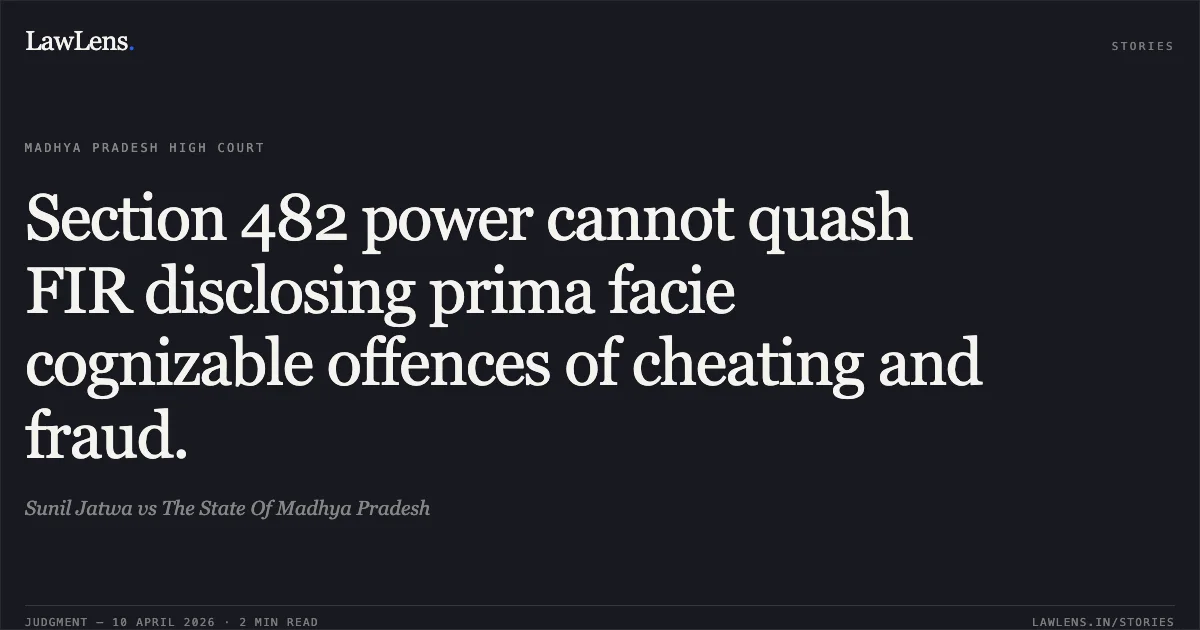
The petitioner sought the quashing of FIR No. 111 of 2021, registered at Police Station Shajapur Kotwali under Sections 420, 120-B, and 406 of the IPC.
Source reference: para. 1The complainants (Deepak Jatav, Seema Sonti, and Mohan Giri) alleged that the petitioner, Sunil Jatwa, induced them to pay varying sums (totaling approximately ₹2,94,600/-) for plots in a residential colony.
Source reference: para. 2Despite issuing receipts and executing sale agreements, the petitioner failed to execute the sale deeds or allow the complainants access to the property.
Source reference: para. 2The petitioner argued that the dispute was purely civil, the FIR was maliciously motivated by a police officer, and that he had partially refunded one respondent.
Source reference: para. 3-4The investigation remained pending as the petitioner was previously absconding.
Source reference: para. 2Issues
Whether the allegations in the FIR, taken at face value, disclose the commission of a cognizable offence justifying the exercise of inherent powers under Section 482 of the CrPC.
Source reference: para. 7-8Whether the dispute is purely civil in nature or a criminal act of cheating and breach of trust.
Source reference: para. 4, 11Law Applied
Section 482 of the Code of Criminal Procedure regarding the inherent powers of the High Court to quash proceedings.
Source reference: para. 1The court relied on the landmark guidelines established in State of Haryana v. Ch. Bhajan Lal (1992), which categories instances where quashing is permissible, such as when allegations do not prima facie constitute an offence or are maliciously instituted.
Source reference: para. 7The court further cited Neeharika Infrastructure v. State of Maharashtra (2021), emphasizing that courts must not enter into the merits of allegations or interfere with the lawful power of investigating agencies during a quashing petition.
Source reference: para. 8The court applied the test from Madhavrao Jiwajirao Scindia v. Sambhajirao Chandrojirao Angre (1988), stating that quashing is appropriate only when the chances of conviction are bleak and the prosecution serves an oblique purpose.
Source reference: para. 9Reasoning
The court examined the FIR and materials on record, noting specific allegations that the petitioner received money and executed sale agreements but failed to fulfill his obligations.
Source reference: para. 11Applying the Bhajan Lal and Neeharika Infrastructure standards, the court held that it cannot delve into the merits of the petitioner's defense—specifically the claims of false implication by a Sub-Inspector—as these are matters for trial.
Source reference: para. 11The court observed that the petitioner’s act of absconding had already hampered the investigation.
Source reference: para. 11Since the uncontroverted allegations in the FIR prima facie established the petitioner's complicity in the alleged offences of cheating and criminal breach of trust, the court determined that the matter was not a simple civil dispute and did not warrant the exercise of inherent jurisdiction.
Source reference: para. 11-12Holding
The High Court dismissed the petition, holding that quashing the FIR at this stage would constitute an abuse of the process of the court.
The court answered that the material on record prima facie showed the petitioner's involvement in a cognizable offence, and therefore, no grounds existed for invoking Section 482 of the CrPC.
Source reference: para. 12The prayer for quashing the FIR and consequential proceedings was denied.
Source reference: para. 12Acts & Sections Cited
5 provisions across 2 statutes referred to in this judgment. Each provision opens on LawLens.
Indian Penal Code, 18602
Code of Criminal Procedure, 19733
Original Court PDF
Sunil JatwavsThe State Of Madhya Pradesh
Click to open original judgment
Original judgment, available to read, download and summarize on LawLens.in