Facts
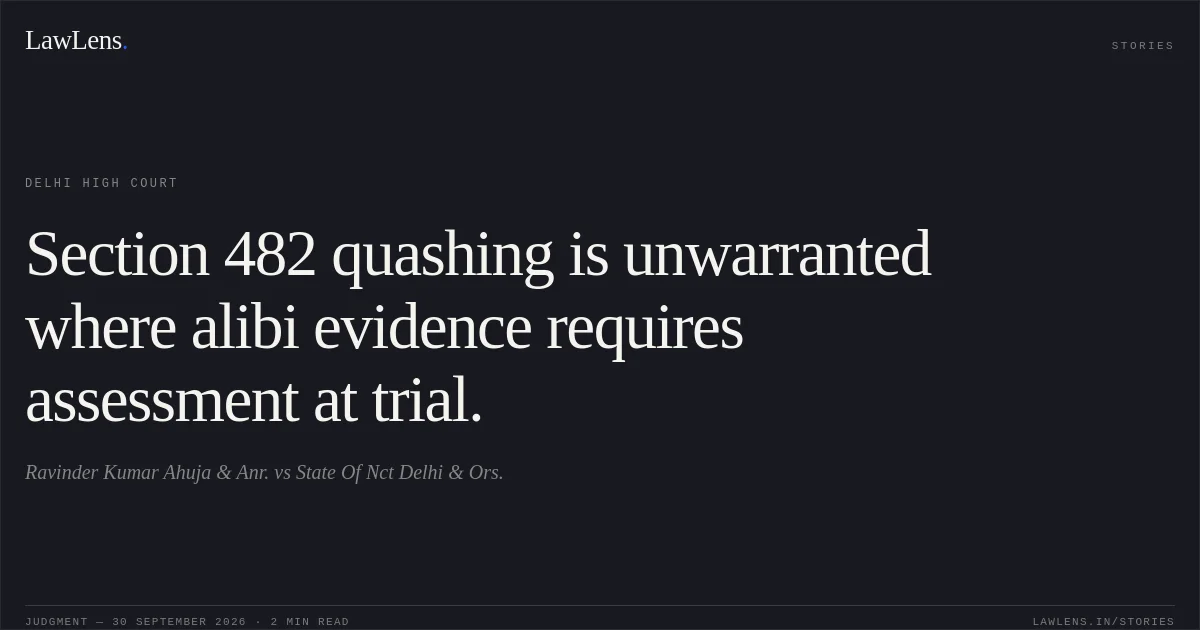
The petitioners sought quashing under Section 482 CrPC of an FIR alleging sexual offences at a farmhouse where the prosecutrix worked as a security guard.
Source reference: para. 1–10After investigation, they were charge-sheeted under Sections 376D, 354, 328 and 34 IPC.
Source reference: para. 1–10They relied principally on call-detail records (CDRs), an entry/exit register, the prosecutrix’s duty roster, medical records and alleged property disputes to contend that the allegations were impossible or fabricated.
Source reference: para. 1–10The State opposed quashing, arguing that assessing those materials would require a factual inquiry.
Source reference: para. 11–17Issues
Whether the petitioners’ CDRs, entry/exit register and related records constituted sterling and unimpeachable material that completely displaced the prosecution case and justified quashing under Section 482 CrPC.
Source reference: para. 19, 24Whether the other circumstances relied upon by the petitioners—including delay, lack of corroboration, medical material and the alleged property dispute—could be conclusively assessed at the quashing stage.
Source reference: para. 32–39Law Applied
Section 482 CrPC empowers the High Court to prevent abuse of process, but ordinarily does not permit a mini-trial, appreciation of evidence or assessment of the prosecution case against a probable defence (Priyanka Jaiswal v. State of Jharkhand, Muskan v. Ishaan Khan (Sataniya) and Ryan Sequeira v. State of NCT of Delhi).
Source reference: para. 20–21, 30–31, 40An exception applies where defence material is of sterling and unimpeachable quality and completely demolishes the prosecution case; ordinary pleas of alibi generally require proof at trial (Rahul v. State of Uttar Pradesh, applying Prashant Bharti v. State (NCT of Delhi)).
Source reference: para. 22–23, 40The controlling inquiry was therefore whether the petitioners’ material conclusively established that the alleged offences could not have occurred, rather than merely furnishing a substantial defence.
Source reference: para. 19, 41Reasoning
The Court held that the records did not establish complete impossibility.
Source reference: para. 25–26Petitioner No. 1’s own entry/exit record placed him at the farmhouse on 25 September 2022, when the prosecutrix was on day duty, while the unspecified date of the alleged incident prevented the Court from treating the records as disproving every possible overlap.
Source reference: para. 25–26As to Petitioner No. 2, the CDR showed his visit on 7 September and no corresponding location for the prosecutrix’s phone, but accepting this as conclusive would require treating both the register and handset-location data as definitive proof of physical presence or absence.
Source reference: para. 27–29The remaining matters—including non-corroboration, delay, the prosecutrix’s continued employment, refusal of an internal examination, medical evidence, and the alleged property motive—also required evidentiary assessment or explanation at trial.
Source reference: para. 32–39The Court therefore found that deciding the petitioners’ case would entail impermissible appreciation of evidence.
Source reference: para. 41Holding
The Court dismissed the petition and declined to quash FIR No. 712/2022 or the proceedings against the petitioners.
It left their defences open for consideration by the Trial Court, clarified that its observations were not findings on the merits, and directed that the Trial Court decide the matter independently.
Source reference: para. 42–45Acts & Sections Cited
7 provisions across 2 statutes referred to in this judgment. Each provision opens on LawLens.
Code of Criminal Procedure, 19733
Indian Penal Code, 18604
Original Court PDF
Ravinder Kumar Ahuja & Anr.vsState Of Nct Delhi & Ors.
Click to open original judgment
Original judgment, available to read, download and summarize on LawLens.in