Facts
The petitioners, landlords of premises at 309, Bipin Behari Ganguly Street, challenged proceedings arising from a complaint that they had padlocked a toilet previously used by the opposite party no. 2 and other members of a Council occupying a room in the premises
Source reference: para. 2–4, 15–16The landlords had initiated ejectment proceedings against the occupants, and contended that the criminal complaint was retaliatory and that the charge sheet had been submitted mechanically
Source reference: para. 7–11After investigation, a charge sheet was filed under Sections 290/114 of the Indian Penal Code and Section 3(za)(A) of the Scheduled Castes and the Scheduled Tribes (Prevention of Atrocities) Act, 1989; the Special Judge took cognizance
Source reference: para. 5–6The petitioners sought to quash the proceedings under Section 482 Cr.P.C.
Source reference: para. 1Issues
1. Whether the material in the case diary and charge sheet disclosed a prima facie case against the petitioners warranting continuation of the criminal proceedings
Source reference: para. 14–16, 192. Whether the High Court should exercise its inherent jurisdiction under Section 482 Cr.P.C. to quash the proceedings as allegedly false, retaliatory, and an abuse of process
Source reference: para. 1, 10–11, 17–19Law Applied
Section 482 Cr.P.C. preserves the High Court’s inherent power to prevent abuse of process and secure the ends of justice, but that power must be exercised sparingly and with circumspection.
Source reference: no citationRelying on Neeharika Infrastructure Pvt. Ltd. (as cited in the judgment), the Court stated that criminal proceedings should not ordinarily be scuttled at the initial stage and that, when considering a quashing request, the Court should not assess the reliability or genuineness of the allegations or conduct a mini-trial.
Source reference: para. 18–19The proceedings under challenge arose under Section 3(za)(A) of the SC/ST (Prevention of Atrocities) Act, 1989 and Sections 290/114 IPC.
Source reference: para. 1, 5Reasoning
The case diary included witness statements, including that of the premises’ caretaker, indicating that the complainant and other Council members had previously been permitted to use the toilet and that a padlock was later put on it, preventing their access.
Source reference: para. 14–16The Court considered this material sufficient to disclose a prima facie case.
Source reference: para. 14–16The pending ejectment dispute and the petitioners’ claim that the complaint was retaliatory did not justify weighing the truth of the allegations at the quashing stage; their genuineness was for determination at trial.
Source reference: para. 16–19Holding
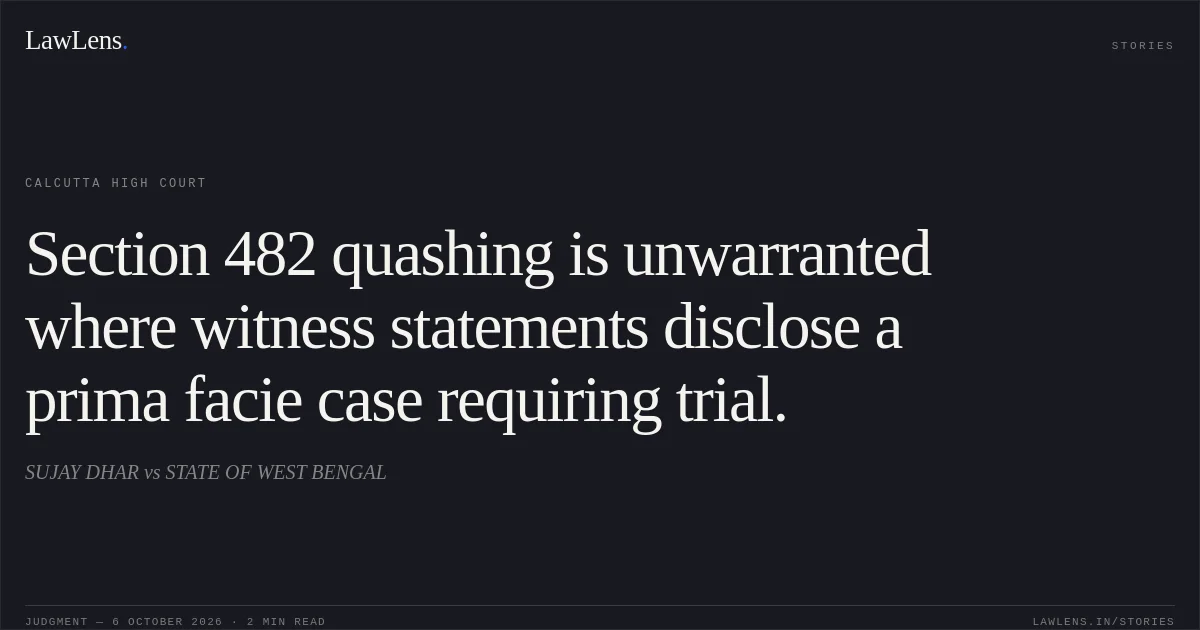
The Court held that a prima facie case was disclosed and that the petitioners had not established grounds for quashing under Section 482 Cr.P.C.
The revision was dismissed, the interim order was vacated, and the trial court was directed to proceed expeditiously and conclude the trial in accordance with law, uninfluenced by the High Court’s observations.
Source reference: para. 19–24Acts & Sections Cited
6 provisions across 4 statutes referred to in this judgment. Each provision opens on LawLens.
Code of Criminal Procedure, 19732
Scheduled Castes and the Scheduled Tribes (Prevention of Atrocities) Act, 19891
Indian Penal Code, 18602
West Bengal Premises Tenancy Act, 19971
Original Court PDF
SUJAY DHARvsSTATE OF WEST BENGAL
Click to open original judgment
Original judgment, available to read, download and summarize on LawLens.in