Facts
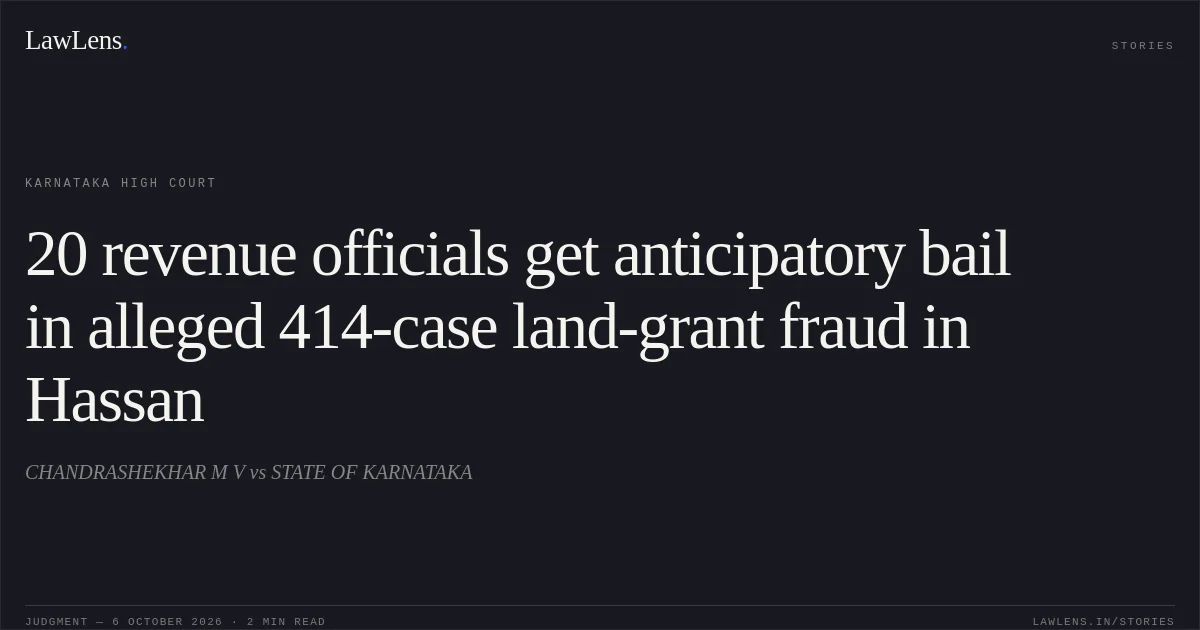
The petitioners sought anticipatory bail in Crime No. 157/2019, registered against unknown persons on a complaint alleging fraudulent grants of land reserved for persons displaced by the Hemavathi River Project.
Source reference: p. 11; para. 5The first information stated that 414 cases of allegedly fraudulent grants to undeserving persons, involving revenue officials and other persons, had been traced for the period 1 January 2015 to 30 November 2018.
Source reference: p. 11; para. 5The alleged offences were under Sections 465, 468 and 420 of the IPC, Section 192(a)(1)–(3) of the Karnataka Land Revenue Act, 1964, and Section 4(1)–(3) of the Karnataka Land Grabbing Prohibition Act, 2007.
Source reference: pp. 9–10; para. 1After the Sessions Court rejected their anticipatory-bail application, the petitioners approached the High Court, undertaking to cooperate with the investigation.
Source reference: pp. 10–11; paras. 3, 6They relied on a recent order granting anticipatory bail to similarly situated accused persons; the State did not dispute that submission.
Source reference: p. 11; para. 4Issues
1. Whether the petitioners were entitled to anticipatory bail in Crime No. 157/2019, having regard to the order granting bail to similarly situated accused persons and their undertaking to cooperate with the investigation.
Source reference: pp. 11–12; paras. 4–72. Whether anticipatory bail should be made subject to conditions requiring the petitioners to appear before the Investigating Officer, cooperate with the investigation, and attend court.
Source reference: pp. 12–14; paras. 6–7Law Applied
The petition was considered under Section 482 of the Bharatiya Nagarik Suraksha Sanhita, 2023, which provides for anticipatory bail.
Source reference: p. 10; para. 1The alleged offences arose under Sections 465, 468 and 420 of the Indian Penal Code, 1860, Section 192(a)(1)–(3) of the Karnataka Land Revenue Act, 1964, and Section 4(1)–(3) of the Karnataka Land Grabbing Prohibition Act, 2007.
Source reference: pp. 9–10; para. 1The Court applied the reasoning in its order dated 28 September 2026 in the listed connected criminal petitions, which had considered the allegations, bail granted to similarly placed accused, the petitioners’ cooperation undertaking and the maximum punishment of seven years.
Source reference: pp. 11–12; paras. 4–6Reasoning
The Court found that its reasoning in the earlier order granting anticipatory bail to similarly situated accused applied equally to these petitioners.
Source reference: pp. 11–12; para. 6The petitioners had undertaken to cooperate with the police, and the maximum punishment for the alleged offences was seven years.
Source reference: p. 12; para. 5The Court therefore granted anticipatory bail, subject to conditions intended to secure the petitioners’ availability and cooperation during the investigation and trial.
Source reference: pp. 12–14; paras. 6–7Holding
The High Court allowed the petition and directed that, in the event of their arrest in Crime No. 157/2019, the petitioners be released on bail.
Each petitioner must appear before the Investigating Officer within 15 days of receiving the order and execute a personal bond of ₹1,00,000 with two sureties for the like amount; they must regularly attend the Trial Court unless exempted, cooperate with the investigation, appear when called, refrain from tampering with prosecution witnesses, and not commit similar offences in future.
Source reference: pp. 13–14; order clauses (a)–(d)Acts & Sections Cited
5 provisions across 3 statutes referred to in this judgment. Each provision opens on LawLens.
Code of Criminal Procedure, 19731
Bharatiya Nagarik Suraksha Sanhita, 20231
Indian Penal Code, 18603
Original Court PDF
CHANDRASHEKHAR M VvsSTATE OF KARNATAKA
Click to open original judgment
Original judgment, available to read, download and summarize on LawLens.in