01Facts
The first revision petitioner (accused No. 1) is the husband of the de facto complainant (PW-1, Kalpana). Accused Nos. 2 and 3 are his in-laws.
The charge-sheet alleges an offence under s. 498-A IPC read with s. 34 IPC.
¶ 3The complainant alleges that at the 2000 marriage her parents gave 40 grams of gold and ₹50,000 as dowry.
¶ 3 · ¶ 8The judgment elsewhere records 50 grams of gold and ₹50,000.
¶ 17The complainant alleges that accused No. 1 married a second wife (PW-2) in 2002, that the accused later demanded money from her parental home, and that they subjected her to physical and mental cruelty.
¶ 3 · ¶ 17In cross-examination, PW-1 admitted that after about two years of marriage, from 2002 onward, she and accused No. 1 were not on speaking terms and resided separately.
¶ 9 · ¶ 20PW-2 stated that the marriage took place in 2002 and that the accused left the house after the complainant's family brought police.
¶ 27PW-2 did not fully support the prosecution and was declared hostile; she spoke of cruelty only as heard from neighbours.
¶ 34PW-3 and PW-4 (PW-1's parents) gave hearsay evidence of dowry demands, with PW-4 placing the incident in the fifth year of marriage, around 2005.
¶ 28 · ¶ 35The first information was lodged in 2014.
¶ 26 · ¶ 28The trial court (CC No. 4482/2014, judgment dated 06.09.2022) convicted accused Nos. 1–3 under s. 498-A r/w s. 34 IPC and sentenced them to two years' simple imprisonment and a fine of ₹10,000.
¶ 5The Principal District and Sessions Judge, Hassan, dismissed the appeal (Crl.A. No. 175/2022, judgment dated 05.02.2026).
¶ 6The petitioners then filed this revision petition.
pp. 2–302Issues
i.1. Whether the trial court and the appellate court wrongly appreciated the ingredients of s. 498-A IPC and failed to consider the bar of limitation, such that their concurrent judgments are perverse, vexatious, capricious, or grossly erroneous.
¶ 1103Law Applied
The settled limits of revisional jurisdiction, as stated in Kuntegowda v. Thurubaiah (2026 SCC OnLine SC 1485): the High Court interferes only where the lower court's finding is perverse, grossly erroneous, glaringly unreasonable, or wholly untenable in law; rests on immaterial or no material; or ignores relevant material or exercises discretion arbitrarily or capriciously.
¶ 13–14S. 468(2)(c) CrPC, which bars cognizance of an offence punishable with imprisonment of more than one year but not exceeding three years after three years from the offence.
¶ 24–25S. 498-A IPC, which penalises a husband or relative who subjects a woman to "cruelty", defined as (a) wilful conduct likely to drive the woman to suicide or cause grave injury or danger to life, limb or health (mental or physical), or (b) harassment to coerce her or her relatives to meet an unlawful demand for property or valuable security.
¶ 32–33Provisions in the judgment · 6 · Linked ones open on LawLens
Code of Criminal Procedure, 1973 Section 397Section 401Section 468
Bharatiya Nagarik Suraksha Sanhita, 2023 Section 438Section 442
Indian Penal Code, 1860 Section 34
04Reasoning
The first information was an omnibus allegation that did not specify when, where, how, or what dowry was demanded, or from whom.
¶ 19 · ¶ 31PW-1's admission that she had lived separately from accused Nos. 1–3 since 2002 undermined any claim of later demand or cruelty by them, and no specific allegation against accused Nos. 2 and 3 was made.
¶ 20–21PW-3's evidence likewise showed no transaction between the parties after separation.
¶ 22The Court read the evidence of PW-3 and PW-4 as placing any demand around 2002–2005.
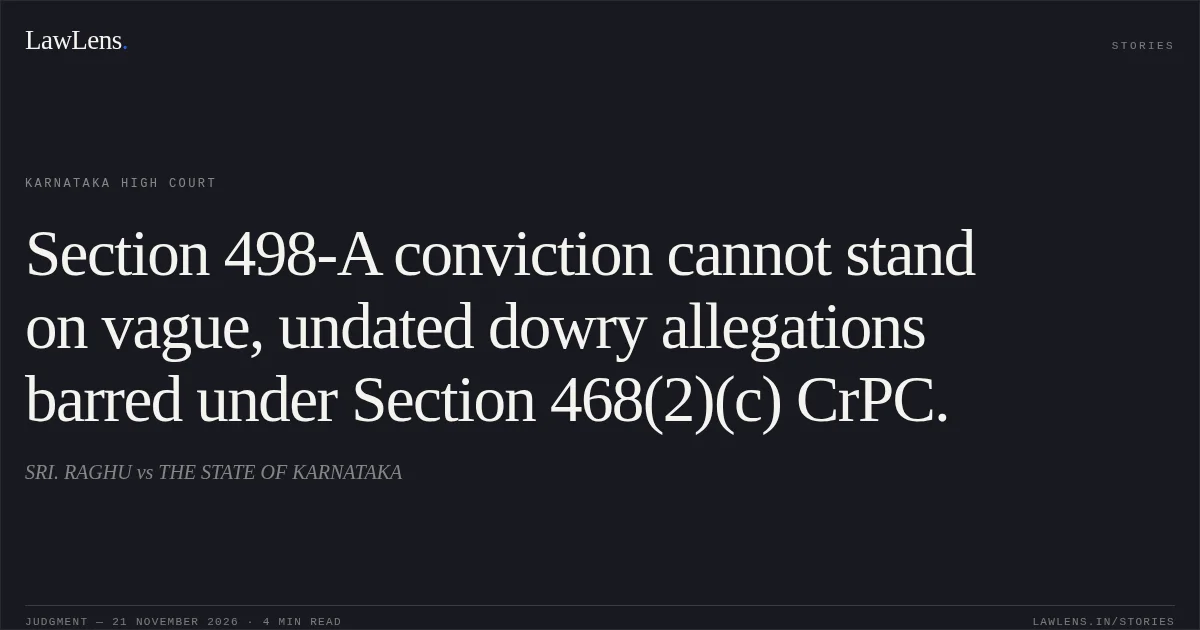
¶ 28Since s. 498-A carries a maximum of three years, the complaint lodged in 2014 fell outside the s. 468(2)(c) period, and the alleged demand could not have occurred within three years of the complaint.
¶ 23 · ¶ 26 · ¶ 36–37There was no direct evidence of wilful cruelty of the kind described in the Explanation to s. 498-A: PW-2 was hostile, PW-3 and PW-4 had only heard of cruelty from their daughter, and the police witnesses gave formal evidence only.
¶ 30 · ¶ 34–35The twelve-year delay was treated as a further ground for doubt.
¶ 36The judgment does not expressly address the HCGP's contention that s. 498-A is a continuing offence and that s. 468 therefore does not apply; the limitation finding rests instead on the absence of cruelty or demand within three years of the complaint.
¶ 10 · ¶ 37The trial and appellate courts did not examine limitation or the ingredients of s. 498-A, relied on immaterial evidence, and ignored relevant material, so their concurrent findings were perverse.
¶ 3805Holding
The concurrent judgments of the trial and appellate courts were perverse, grossly erroneous, and vexatious, and warranted interference under revisional jurisdiction.
¶ 12 · ¶ 38The revision petition is allowed. Accused Nos. 1–3 are acquitted of the offence under s. 498-A IPC, set at liberty, and their bail bonds are cancelled.
¶ 39(i)–(iv)Original Court PDF
SRI. RAGHUvsTHE STATE OF KARNATAKA
Click to open original judgment
Original judgment, available to read, download and summarize on LawLens.in



