Facts
The marriage between petitioner no. 1, Md. Tanweer, and opposite party no. 2, Tarannum Perween, took place in 2020.
Source reference: para. 3The FIR alleged that petitioner no. 1 sought money from his wife for restarting or establishing a business during the financial hardship caused by the COVID-19 lockdown, and that he and his three brothers—petitioners nos. 2 to 4—subjected her to dowry-related cruelty.
Source reference: para. 3–4; pp. 2–3The allegations against the brothers were general, omnibus and sweeping, without specific acts attributed to them.
Source reference: para. 3–4; pp. 2–3During investigation in a subsequent case lodged by the wife under Section 498A IPC, no charge-sheet was filed against petitioners nos. 2 to 4, and cognizance was taken only against petitioner no. 1.
Source reference: para. 5; pp. 3–4The parties were admittedly residing together at Mumbai, although the wife alleged that she was not being treated with due dignity and honour.
Source reference: para. 5–6; pp. 3–4The petitioners challenged the order dated 8 January 2024 by which the learned S.D.J.M., Patna City, took cognizance in Sultanganj P.S. Case No. 95 of 2022.
Source reference: para. 13–14; pp. 7–8Issues
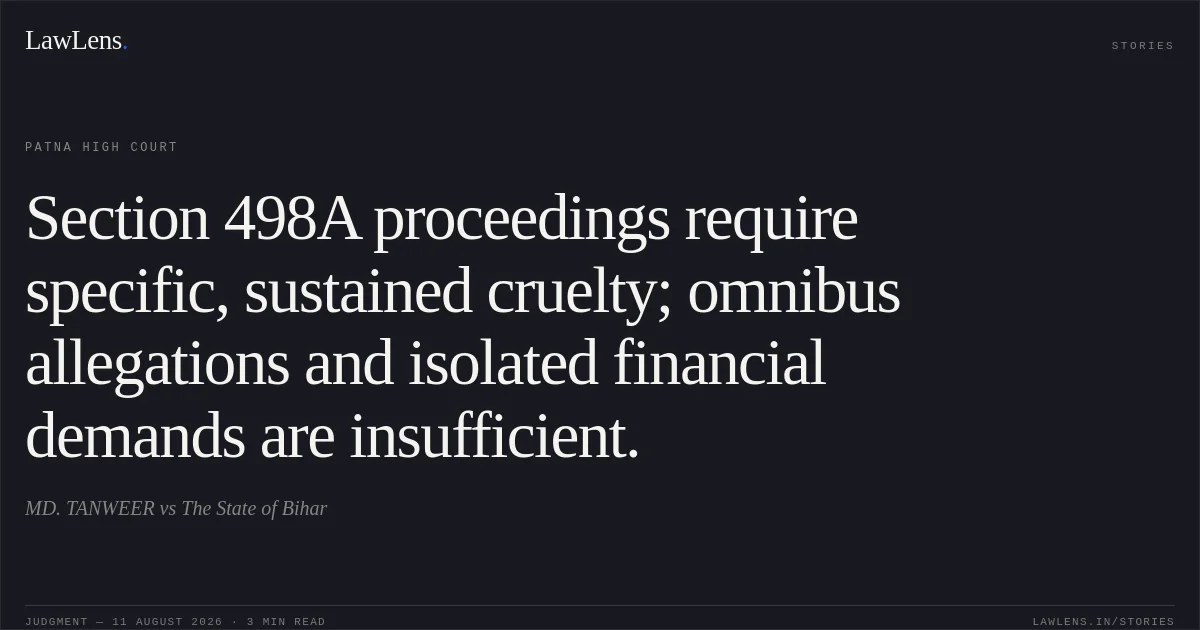
Whether the allegations against petitioners nos. 2 to 4, being general and omnibus in nature and unsupported by specific acts, justified continuation of criminal proceedings under Section 498A IPC.
Source reference: para. 4, 7–8; pp. 2–5Whether the allegations against petitioner no. 1 concerning a demand for money to re-establish his business constituted “cruelty” within the meaning of Section 498A IPC.
Source reference: para. 9–10; pp. 5–6Whether, in light of the parties residing together and the absence of allegations disclosing the statutory ingredients of Section 498A IPC, the entire criminal proceeding and cognizance order ought to be quashed.
Source reference: para. 11–14; pp. 6–8Law Applied
The Court applied Section 498A IPC, under which cruelty comprises either wilful conduct likely to drive the woman to suicide or cause grave injury or danger to her life, limb or health, or harassment intended to coerce her or her relatives to meet an unlawful demand for property or valuable security.
Source reference: para. 9; p. 5Relying on Kahkashan Kausar v. State of Bihar, (2022) 6 SCC 599, the Court held that relatives should not be subjected to criminal prosecution on the basis of vague, general or omnibus allegations.
Source reference: para. 4; pp. 2–3It further relied on Geddam Jhansi v. State of Telangana, 2025 SCC OnLine SC 263, for the principle that criminal process involving family relationships must be invoked cautiously and only where specific allegations, supported by material, disclose a criminal offence.
Source reference: para. 8; p. 5The Court also referred to Achin Gupta v. State of Haryana, (2025) 3 SCC 756, for the proposition that trivial matrimonial irritations, quarrels and ordinary marital discord do not, by themselves, constitute cruelty.
Source reference: para. 12; pp. 6–7Reasoning
The Court found that the allegations against petitioners nos. 2 to 4 were wholly general and sweeping, and that the subsequent case filed by the informant did not result in a charge-sheet or cognizance against them, indicating an attempt to implicate the husband’s relatives to exert pressure on the family.
Source reference: para. 7; p. 4Applying the statutory ingredients of Section 498A IPC, the Court held that the FIR did not disclose any wilful conduct by the petitioners likely to cause grave injury or danger to the wife’s life, limb or health.
Source reference: para. 10; p. 6It further held that the allegation against petitioner no. 1—that he sought financial assistance to restart his business during economic hardship—did not, on the facts alleged, amount to an unlawful dowry demand or a sustained course of harassment.
Source reference: para. 3, 10; pp. 2, 6A stray demand for money, without a series of acts establishing cruelty, was insufficient.
Source reference: para. 3, 10; pp. 2, 6The parties’ admitted cohabitation at Mumbai and the possibility that they were not leading a peaceful conjugal life did not, without more, establish an offence under Section 498A IPC.
Source reference: para. 6, 11; pp. 4, 6Holding
The Court answered the issues in favour of the petitioners.
It held that the FIR did not disclose the necessary ingredients of Section 498A IPC against either the relatives or the husband.
Source reference: para. 13–14; pp. 7–8Accordingly, the order dated 8 January 2024 taking cognizance in Sultanganj P.S. Case No. 95 of 2022 was quashed as against all four petitioners, and the entire criminal proceeding arising from that case was quashed.
Source reference: para. 13–14; pp. 7–8The application was consequently allowed.
Source reference: para. 13–14; pp. 7–8Acts & Sections Cited
2 provisions across 1 statute referred to in this judgment. Linked provisions open on LawLens.
Indian Penal Code, 18602
Original Court PDF
MD. TANWEERvsThe State of Bihar
Click to open original judgment
Original judgment, available to read, download and summarize on LawLens.in