Facts
The complainant, Respondent No. 2, married Petitioner No. 1 in 2010.
Source reference: p. 2, para. 3She alleged that, after approximately three peaceful years, the petitioners demanded a motorcycle and gold chain as dowry, assaulted her, denied her food and clothing, and ultimately ousted her from the matrimonial home.
Source reference: p. 2, para. 3The complaint was filed on 10 November 2014 and was subsequently referred to the police under Section 156(3) of the Code of Criminal Procedure.
Source reference: p. 2, para. 2; p. 3, para. 4The Sub-Divisional Judicial Magistrate, Saran at Chapra, took cognizance against the petitioners under Section 498A of the Indian Penal Code by order dated 3 December 2016.
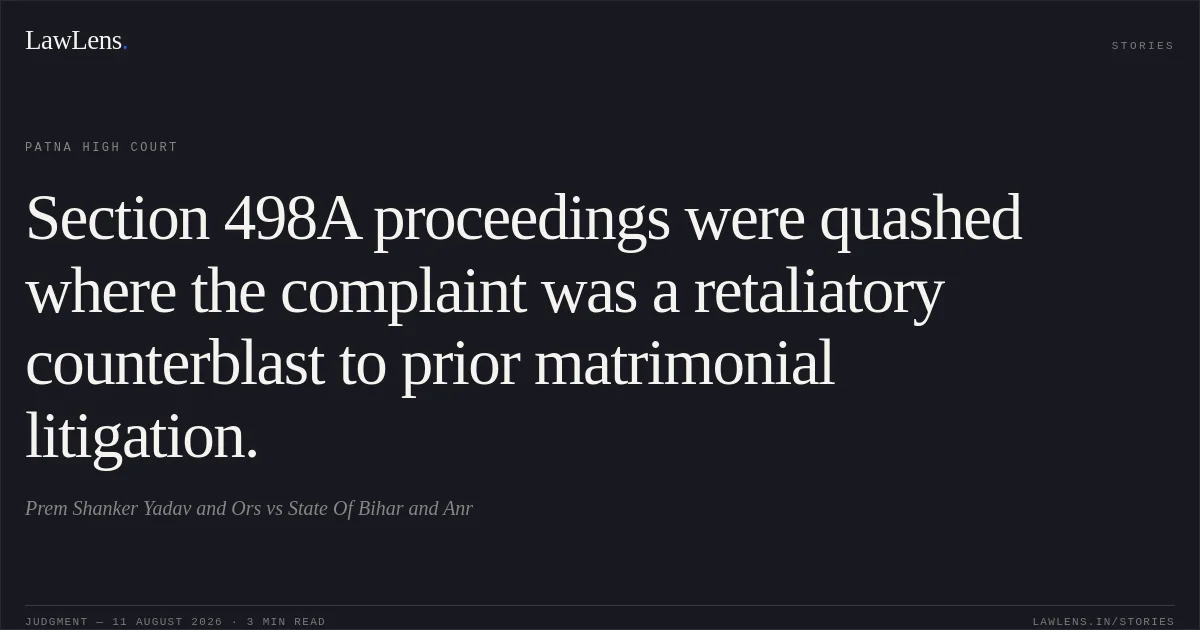
Source reference: p. 3, para. 4The petitioners contended that the complaint was a retaliatory proceeding filed after Petitioner No. 1 instituted a divorce case under Section 13 of the Hindu Marriage Act, 1955, and after earlier criminal litigation concerning the complainant had arisen.
Source reference: pp. 3–4, para. 4Issues
Whether the order dated 3 December 2016 taking cognizance under Section 498A IPC against the petitioners should be quashed where the complaint allegedly contained general and omnibus allegations and was filed as a retaliatory counterblast to previous matrimonial and criminal proceedings
Source reference: p. 2, para. 2; pp. 3–4, para. 4Whether continuation of the criminal prosecution against the petitioners, including the husband’s relatives against whom no specific overt act was attributed, amounted to an abuse of the process of the court
Source reference: pp. 4–5, para. 4; p. 5, para. 7Law Applied
The court considered Section 498A IPC, which criminalises cruelty by the husband or his relatives towards a married woman, and the principles governing quashing of criminal proceedings where the allegations are frivolous, vexatious, malicious, or constitute an abuse of process.
Source reference: p. 4, para. 4It relied on State of Haryana v. Bhajan Lal, 1992 Supp (1) SCC 335, particularly Category 7, under which proceedings may be quashed where they are manifestly attended with mala fide or instituted maliciously for an ulterior motive.
Source reference: p. 4, para. 4The court also considered Nitin Ahluwalia v. State of Punjab, 2025 SCC OnLine SC 2013, concerning retaliatory criminal proceedings arising amidst matrimonial litigation, and Preeti Gupta v. State of Jharkhand, (2010) 7 SCC 667, and K. Subba Rao v. State of Telangana, (2018) 14 SCC 452, on the tendency to implicate the husband’s relatives in Section 498A proceedings through general allegations without specific attribution of acts.
Source reference: pp. 4–5, para. 4Section 156(3) CrPC and Section 13 of the Hindu Marriage Act were also referred to in the procedural and factual background.
Source reference: p. 3, para. 4Reasoning
The court found that the complaint was lodged against the backdrop of prior litigation between the parties, including the husband’s divorce proceeding and earlier criminal proceedings involving the complainant.
Source reference: pp. 3–4, para. 4It accepted the petitioners’ contention that the Section 498A case was a retaliatory counterblast intended to exert pressure and harass them.
Source reference: pp. 3–4, para. 4The allegations against the petitioners were also general and omnibus, particularly in relation to the husband’s relatives, without specific acts or individual roles being attributed to them.
Source reference: p. 2, para. 3; pp. 4–5, para. 4Applying the principles in Bhajan Lal and the cited Supreme Court authorities, the court concluded that continuation of the prosecution would amount to an abuse of the process of the court.
Source reference: p. 5, para. 7Holding
The court answered the issues in favour of the petitioners.
It held that the criminal complaint and the cognizance order were retaliatory in nature and that continuation of the proceedings under Section 498A IPC would constitute an abuse of process.
Source reference: p. 5, para. 7Accordingly, the order dated 3 December 2016 passed by the Sub-Divisional Judicial Magistrate, Saran at Chapra, in Complaint Case No. 3280 of 2014 was quashed, and the criminal miscellaneous application was allowed.
Source reference: p. 5, paras. 7–8Acts & Sections Cited
5 provisions across 3 statutes referred to in this judgment. Each provision opens on LawLens.
Indian Penal Code, 18603
Hindu Marriage Act, 19551
Code of Criminal Procedure, 19731
Original Court PDF
Prem Shanker Yadav and OrsvsState Of Bihar and Anr
Click to open original judgment
Original judgment, available to read, download and summarize on LawLens.in