Facts
The petitioners, decree-holders in Regular Darkhast No. 10 of 2013, challenged the dismissal of the execution proceedings for default on 27 May 2024.
Source reference: no citationInstead of filing an application for restoration within the prescribed thirty-day period, they filed Special Civil Application No. 17586 of 2025 before the High Court on 04 December 2025.
Source reference: no citationThat petition was withdrawn on 15 January 2026 with liberty to approach the Executing Court, and the period spent before the High Court was directed to be excluded while computing limitation.
Source reference: para. 8, para. 14The petitioners thereafter filed a restoration/review application on 23 January 2026 under Order XXI Rule 106 read with Order IX Rule 4 and Section 151 of the Code of Civil Procedure, along with an application under Section 5 of the Limitation Act, 1963.
Source reference: para. 8–9The Additional Senior Civil Judge, Rajula, rejected the delay application on 20 February 2026, relying on Paschim Gujarat Vij Company Ltd. v. Rajesh Steel Industries.
Source reference: para. 9The petitioners challenged that order under Article 227 of the Constitution.
Source reference: no citationIssues
Whether an application under Section 5 of the Limitation Act, 1963 is maintainable for condoning delay in filing an application for restoration under Order XXI Rule 106 of the CPC
Source reference: para. 10–12Whether an application for restoration of an execution proceeding dismissed for default can be filed beyond thirty days prescribed under Order XXI Rule 106(3) of the CPC
Source reference: para. 10, para. 13Whether the period spent prosecuting the earlier writ petition could revive or extend the limitation period, when the restoration application was filed after expiry of the initial thirty-day period
Source reference: para. 14Whether the Executing Court committed any jurisdictional or legal error warranting interference under Article 227 of the Constitution
Source reference: para. 14.2–15Law Applied
The Court applied Order XXI Rule 105(2) and Rule 106(3) of the CPC, under which an execution proceeding dismissed for default may be restored only through an application filed within thirty days from the date of the dismissal order.
Source reference: no citationSection 5 of the Limitation Act, 1963 expressly excludes applications made under any provision of Order XXI of the CPC; consequently, delay in filing an Order XXI Rule 106 restoration application cannot be condoned under Section 5.
Source reference: para. 11–12Relying on Damodaran Pillai v. South Indian Bank Ltd., 2005 AIR SC 3460, the Court held that the civil court cannot condone such delay by invoking inherent powers under Section 151 CPC when Section 5 is expressly excluded, and that the limitation period begins from the date of the dismissal order, not from the date of knowledge.
Source reference: para. 13The Court also followed Paschim Gujarat Vij Company Ltd. v. Rajesh Steel Industries, (2014) 3 GLR 2454, which affirmed the non-maintainability of a delayed restoration application under Order XXI Rule 106.
Source reference: para. 9, para. 12Reasoning
The execution proceeding was dismissed on 27 May 2024, but the restoration application was filed only on 23 January 2026, well beyond the thirty-day period under Order XXI Rule 106(3).
Source reference: para. 14Since Section 5 of the Limitation Act does not apply to applications under Order XXI, the petitioners could not obtain condonation of delay either under Section 5 or through the court’s inherent powers under Section 151 CPC.
Source reference: para. 12–13Although the High Court had excluded the period from 04 December 2025 to 15 January 2026 while permitting withdrawal of the earlier writ petition, that direction could not assist the petitioners because the writ petition itself had been filed long after the original thirty-day limitation period had expired.
Source reference: para. 14The restoration application and the accompanying delay application were therefore legally non-maintainable, and the Executing Court committed no error in rejecting them.
Source reference: para. 14.1–14.2Holding
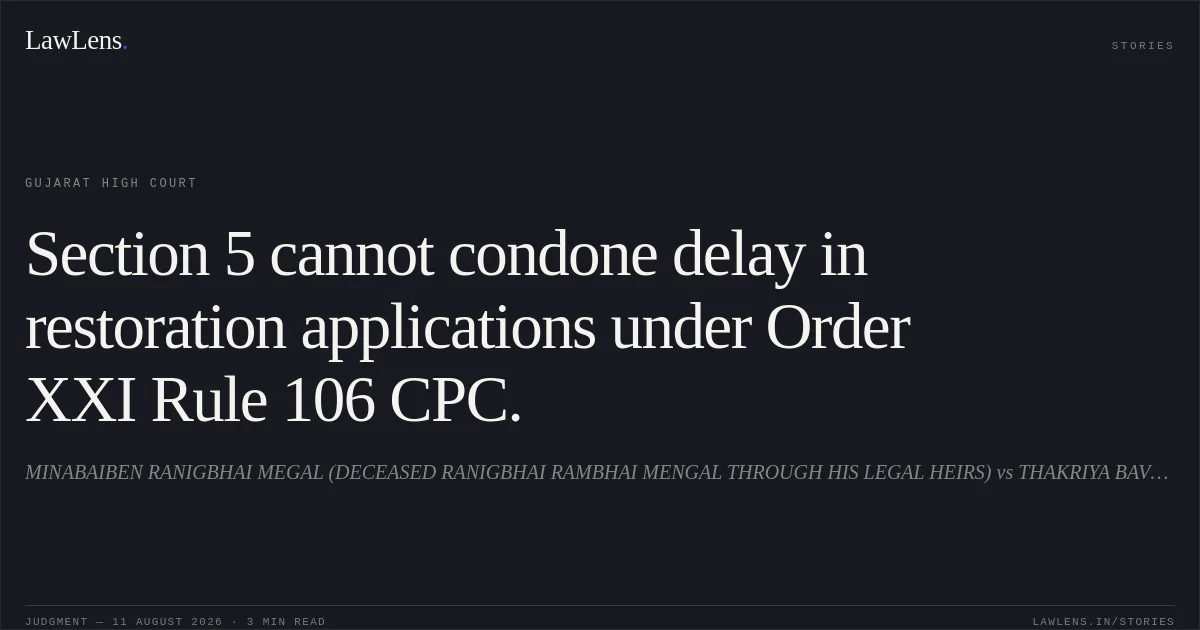
The High Court held that a delayed application for restoration under Order XXI Rule 106 CPC is not maintainable, as Section 5 of the Limitation Act is expressly excluded and the thirty-day period cannot be extended through inherent powers.
The earlier writ proceedings did not revive the already-expired limitation period.
Source reference: no citationFinding no jurisdictional or legal error in the order dated 20 February 2026, the Court dismissed the petition in limine, made no order as to costs, and vacated any interim relief.
Source reference: para. 14.1–15Acts & Sections Cited
2 provisions across 2 statutes referred to in this judgment. Each provision opens on LawLens.
Limitation Act, 19631
Code of Civil Procedure, 19081
Original Court PDF
MINABAIBEN RANIGBHAI MEGAL (DECEASED RANIGBHAI RAMBHAI MENGAL THROUGH HIS LEGAL HEIRS)vsTHAKRIYA BAVBHAI LAKHAMANBHAI
Click to open original judgment
Original judgment, available to read, download and summarize on LawLens.in